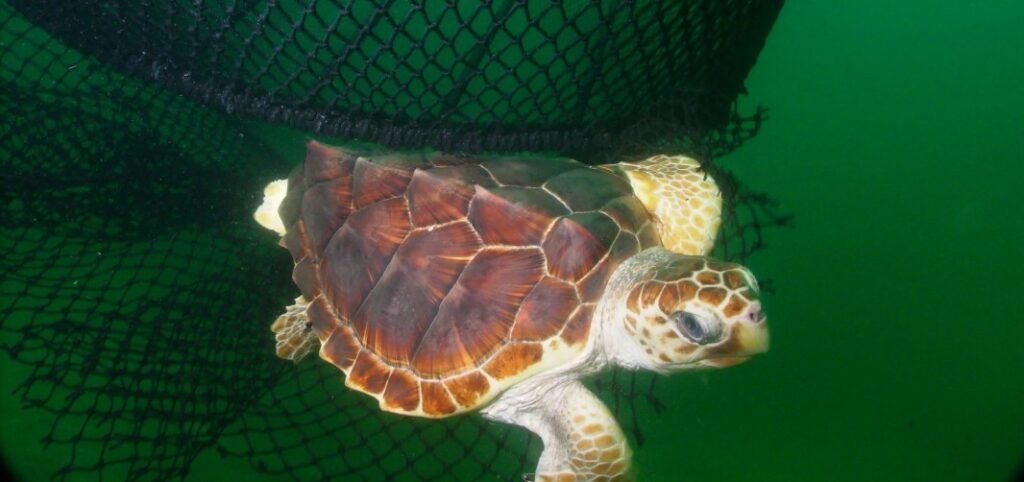
Bycatch is the unintentional capture of non-target marine species during commercial or recreational fishing operations aimed at a different species. It includes fish that are the wrong size or species, as well as sea turtles, marine mammals, seabirds, and sharks caught incidentally in gear set for another target.
Why Bycatch Happens
Most fishing gear cannot distinguish perfectly between target and non-target species, since nets, longlines, and trawls simply capture whatever enters their range within a given area and depth. Bycatch rates vary enormously by gear type, with some methods like longlining and bottom trawling historically producing far higher incidental catch than more selective techniques such as pole-and-line fishing.
Species Commonly Affected
Sea turtles are frequently caught in shrimp trawls and longlines, while small whales, dolphins, and seals can become entangled in gillnets and lose the ability to surface for air. Seabirds, particularly albatrosses, are drawn to baited longline hooks and drown after becoming hooked, and juvenile fish of commercially valuable species are often discarded dead after being caught undersized.
Mitigation Technologies
Turtle excluder devices fitted to shrimp trawls allow turtles to escape through a trap door while retaining shrimp, and circle hooks reduce turtle and seabird injuries compared with traditional J-hooks on longlines. Acoustic deterrent devices, known as pingers, can reduce dolphin and porpoise entanglement in gillnets, while modified net designs and streamer lines help seabirds avoid baited hooks.
Regulatory Responses
Many countries require bycatch reduction devices by law in specific fisheries, and some impose total allowable bycatch limits that can close a fishery early if exceeded. Observer programs, in which trained personnel or electronic monitoring systems record what is actually caught, give regulators independent data on bycatch rates that self-reported logbooks often understate.
Measuring Progress
Scientists track bycatch trends through observer coverage, discard surveys, and gear trials comparing standard and modified equipment, allowing fisheries to demonstrate measurable reductions over time. Despite considerable progress in some fleets, bycatch remains one of the leading threats to several endangered marine species worldwide.
Discards and Dead Bycatch
Not all bycatch is kept. Fish and other organisms caught unintentionally are sometimes discarded at sea, either because regulations prohibit landing them or because they have no commercial value, and a significant share of discarded animals die from the stress and injury of capture even when released promptly. Some fisheries now require that certain bycatch be landed and counted against quotas rather than discarded, partly to create a stronger incentive for fishers to avoid catching it in the first place.
Economic Dimensions
Reducing bycatch can carry real costs for fishers, including gear modification expenses, reduced target catch efficiency, and additional time spent complying with monitoring requirements, which has sometimes slowed voluntary adoption of mitigation technology. Subsidy programs and market incentives, such as price premiums for bycatch-reduced or certified seafood, have helped offset these costs in some fisheries and encouraged broader adoption of effective gear modifications.
International Coordination
Because many fishing fleets operate across national boundaries or on the high seas, bycatch mitigation increasingly depends on international agreements and regional fisheries bodies that set common standards for gear and reporting across member countries. Without this coordination, vessels could simply relocate to waters with weaker bycatch rules, undermining the environmental benefit of stricter regulations adopted elsewhere.
Citizen Science and Reporting
In some fisheries, recreational anglers and small-scale commercial fishers now use smartphone apps to voluntarily report bycatch encounters, supplementing formal observer programs with a much larger volume of field observations than professional monitoring alone could achieve. While self-reported data require careful validation, these citizen science programs have helped identify bycatch hotspots and seasonal patterns that informed subsequent targeted regulatory responses in several regions.
Looking Ahead
Artificial intelligence-assisted camera systems are beginning to supplement or replace human observers on some vessels, automatically identifying and counting bycatch species in real time at a fraction of the cost of placing trained personnel aboard every boat. As these systems mature and gain regulatory acceptance, they are expected to dramatically expand bycatch monitoring coverage in fleets that have historically had little or no independent oversight of what they actually catch.
Species-Specific Protections
Some bycatch mitigation efforts focus intensively on single, highly vulnerable species, such as particular sea turtle populations or small cetaceans with very limited remaining numbers, applying the most stringent available gear requirements specifically within their known range rather than uniformly across an entire fishery. These targeted approaches can achieve substantial protection for a critically endangered population without imposing the same restrictions on fishing grounds where that species rarely occurs.
Data Gaps in Small Fleets
Bycatch monitoring remains far weaker in small-scale and artisanal fleets than in large industrial operations, partly because placing observers or cameras aboard thousands of small individual boats is logistically and financially difficult. Closing this data gap is increasingly recognized as essential for getting an accurate global picture of bycatch impacts on vulnerable species.
As gear technology, monitoring, and international cooperation continue to improve, the overall trajectory for bycatch reduction has been encouraging in many well-studied fleets, even though substantial work remains in less monitored fisheries worldwide.
Ultimately, reducing bycatch to the lowest practical level remains an achievable goal wherever adequate monitoring, proven gear technology, and genuine regulatory will come together in a single fishery.
Readers interested in how a specific fishery performs on bycatch can typically consult observer program reports and certification assessments published by the relevant national fisheries agency or independent certifying body.
Collectively, these efforts illustrate that bycatch is a solvable problem in most fisheries, given the right combination of gear, monitoring, and consistent enforcement over time.
Key facts
- Includes untargeted fish, turtles, marine mammals, and seabirds.|Rates vary widely by gear type and fishing method.|Turtle excluder devices and circle hooks reduce it.|Remains a leading threat to several endangered species.
Quick checkWhat is bycatch in fishing?Show answer
Bycatch is any marine animal caught unintentionally while fishing for a different target species, including turtles, seabirds, and marine mammals.
Sources
- NOAA Fisheries; World Wildlife Fund
Editorially reviewed by Specialty Digest Editorial TeamLast reviewed November 3, 2026Researched and drafted with AI assistanceReport an issue