Extinction is the complete disappearance of a species, meaning no living members of it remain anywhere on Earth. It is, in one sense, as old as life itself: species have been going extinct and new ones arising for as long as evolution has operated, and extinction is generally considered a normal, ongoing part of that process rather than only a sign of catastrophe.
Background extinction versus mass extinction
Biologists distinguish between the background extinction rate, the slow, steady pace at which species disappear through ordinary evolutionary turnover, and mass extinction, a much faster, more severe event. Based on the fossil record, scientists estimate the background rate loses roughly 10 percent of species every million years, about 30 percent every 10 million years, and about 65 percent every 100 million years, figures drawn from the long sweep of Earth’s evolutionary history rather than any single catastrophic event. A mass extinction is generally defined by both its severity and its speed: a loss of at least 75 percent of species within a period that is short by geological standards, typically under about two million years, is enough to qualify.
The Big Five mass extinctions
Paleontologists have identified five mass extinction events in the fossil record severe enough to be grouped together as the Big Five. The End Ordovician extinction struck roughly 444 million years ago, the Late Devonian extinction around 360 million years ago, and the End Permian extinction, the most severe of the five, around 250 million years ago. The End Triassic extinction followed around 200 million years ago, and the End Cretaceous extinction, roughly 65 million years ago, ended the age of the non-avian dinosaurs and is the event most people picture when they hear the term. Each event had a different proposed combination of causes, among them massive volcanic activity, sea-level and climate shifts, and, in the case of the End Cretaceous event specifically, a large asteroid impact, so the Big Five are not evidence of one single recurring mechanism.
Local, global, and functional extinction
Not every disappearance is total. A species can go extinct in one region while surviving elsewhere, a pattern called local extinction or extirpation, as happened when wolves were eliminated from most of the continental United States while the species persisted in Canada and parts of the northern Rockies. A species can also become functionally extinct, meaning its population has fallen so low that it no longer plays a meaningful ecological role even though a few individuals technically remain, or it can be classified extinct in the wild while surviving only in zoos, captive-breeding programs, or populations deliberately established outside its historical range. Global extinction, the loss of every last individual anywhere, is the irreversible endpoint all of these other categories can lead toward.
Is a sixth mass extinction underway?
Many conservation scientists argue that current, human-driven extinction rates are far above the natural background rate, raising the question of whether a sixth mass extinction is already underway. The evidence and the framing remain genuinely debated among researchers: some conclude current losses already meet mass-extinction criteria when projected forward, while other assessments are more cautious, noting that confirmed modern extinctions remain far short of the 75 percent threshold that has historically defined the Big Five, and that future rates depend heavily on choices societies make in the coming decades rather than being locked in already. Both sides agree current extinction rates are elevated well above background levels, driven mainly by habitat loss, overexploitation, invasive species, and climate change; they differ chiefly on how to characterize the trajectory and how much weight to put on worst-case projections.
Human-caused extinctions
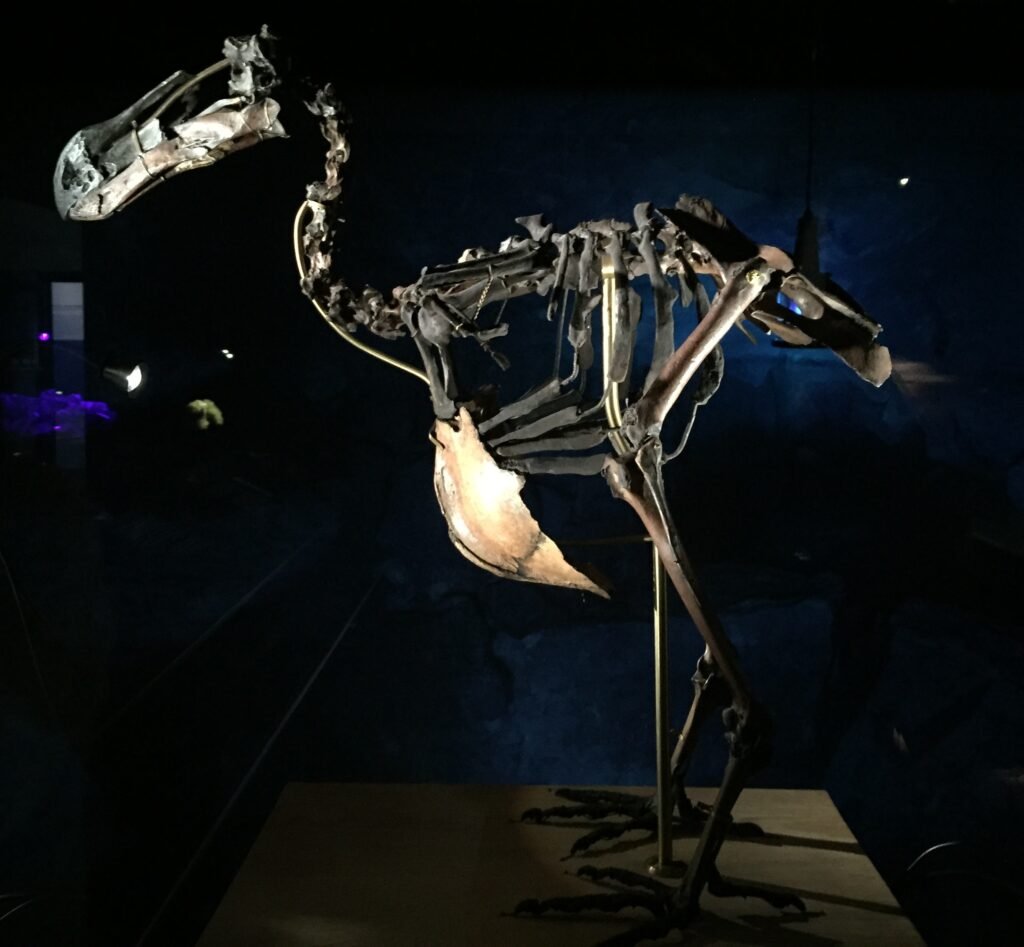
Well-documented historical cases illustrate how quickly human activity can drive a species to extinction compared with the pace of background extinction. The dodo, a flightless bird found only on the island of Mauritius, went extinct within roughly a century of European sailors arriving in the late sixteenth century, driven by a combination of hunting, introduced animals such as pigs and rats that ate its eggs, and the loss of its island habitat; because no complete specimen survived, much of what is known about its appearance comes from reconstructed skeletons and a handful of contemporary illustrations. The passenger pigeon offers an even starker case: a species once so numerous in North America that migrating flocks were described as darkening the sky for hours, it was hunted commercially on an industrial scale through the nineteenth century and went extinct within a few decades, with the last known individual dying in captivity in 1914. Both cases became touchstones in the history of conservation precisely because they showed that abundance alone offers no protection against sufficiently intense, sustained human pressure.
Why extinction is treated as irreversible
Once the last individual of a species dies, its specific genetic lineage and the particular combination of traits it carried cannot be recovered, which is why conservation policy generally treats extinction as a uniquely irreversible outcome compared to population decline, which can at least in principle be reversed given enough time and intervention. This is also why measures such as captive breeding, seed banks, and protected habitat are often framed as buying time rather than guaranteeing a species’ survival: they can prevent extinction but cannot undo it once it has actually occurred.
FAQs
What is the difference between local extinction and global extinction? Local extinction, or extirpation, means a species disappears from a particular region while surviving elsewhere; global extinction means every individual of the species anywhere on Earth has died, with no possibility of natural recovery.
Are scientists certain Earth is in a sixth mass extinction right now? No. There is broad agreement that current human-driven extinction rates are well above natural background levels, but researchers are genuinely divided on whether today’s confirmed losses already meet the stricter, historically defined threshold for a mass extinction event or whether that point still lies ahead depending on future choices.
Key facts
- The background extinction rate loses roughly 10 percent of species every million years, based on the fossil record.
- A mass extinction is generally defined as losing at least 75 percent of species within a geologically short period, typically under about two million years.
- The Big Five mass extinctions ran from the End Ordovician (about 444 million years ago) to the End Cretaceous (about 65 million years ago), each with a different proposed combination of causes.
- Local extinction (extirpation) means a species disappears from one region while surviving elsewhere; global extinction means it disappears everywhere.
- Researchers are genuinely divided on whether a human-driven sixth mass extinction is already underway or still lies ahead.
Related concepts
In the news
Quick checkWhy do scientists treat extinction as different in kind from ordinary population decline?Show answer
Population decline can in principle be reversed given enough time and intervention, but once the last individual of a species dies, its specific genetic lineage is gone permanently, which is why extinction is treated as a uniquely irreversible outcome rather than just a severe case of decline.
Sources
- Our World in Data. Mass extinctions. 2024 (accessed 2026-11-01)
Editorially reviewed by Specialty Digest Editorial TeamLast reviewed November 1, 2026Researched and drafted with AI assistanceReport an issue