Overview
The Great Awakening refers to a series of intense Protestant religious revivals that swept through the American colonies and parts of Britain beginning in the 1730s, dramatically reshaping religious life and emphasizing personal, emotionally engaged conversion experience over inherited or merely formal religious affiliation.
Key Figures
Itinerant preachers such as George Whitefield traveled extensively, drawing enormous crowds with emotionally powerful open-air sermons, while theologians including Jonathan Edwards combined rigorous intellectual argument with vivid, often dramatic depictions of sin and salvation that profoundly moved listeners across social classes and denominational lines.
Religious and Social Impact
The revival movement cut across existing denominational boundaries, creating new networks of evangelical cooperation while also provoking considerable controversy and division within established churches uncomfortable with the emotional intensity and sometimes unconventional preaching methods associated with revivalist meetings.
Later Awakenings
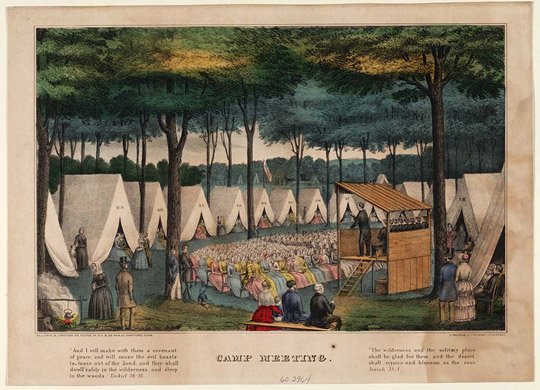
A Second Great Awakening followed in the early nineteenth century, marked by large outdoor camp meetings, particularly on the American frontier, and contributing to the growth of new denominations alongside renewed energy within existing ones. Further waves of revival continued intermittently throughout the nineteenth century in various regions.
Social and Political Consequences
These revival movements left lasting marks well beyond religious practice, contributing to increased lay religious authority relative to formally trained clergy, energizing reform movements including abolitionism and temperance, and shaping distinctively American patterns of religious pluralism and competition among denominations.
Role Today
The Great Awakening legacy continues to shape American evangelical Christianity, which still emphasizes personal conversion experience as central to authentic faith, a direct inheritance from the revivalist theology first popularized during these eighteenth and nineteenth century awakenings.
Theological Content
Revival preaching typically combined vivid depictions of human sinfulness and divine judgment with the promise of accessible, transformative salvation available to any sincere convert, a combination that proved powerfully persuasive to many listeners regardless of their prior religious background or formal theological training.
Jonathan Edwards own sermons, while often remembered chiefly for their dramatic imagery, also reflected careful theological argument grounded in Reformed Protestant tradition, illustrating how revivalist preaching could combine rigorous doctrine with emotionally powerful delivery rather than treating the two as mutually exclusive approaches to religious persuasion.
Institutional Consequences
The revivals contributed to the founding of several American colleges, including institutions intended to train a new generation of evangelically minded ministers, reflecting how revival energy translated into lasting educational and institutional infrastructure well beyond the immediate emotional experience of individual conversion events.
Opposition and Controversy
Not all contemporary religious leaders welcomed the revivals, with some established clergy, sometimes called Old Lights in contrast to revival-supporting New Lights, criticizing what they viewed as excessive emotionalism, theological carelessness, and disruptive challenges to established congregational authority and order.
This division between supporters and critics of revivalist methods produced lasting splits within several denominations, illustrating how the awakenings, while unifying many believers across prior boundaries, simultaneously generated new lines of internal religious controversy and institutional separation.
Comparative International Context
Similar revival phenomena occurred in Britain around the same period, associated particularly with early Methodist leaders including John Wesley, whose parallel emphasis on personal conversion and active lay religious participation reflected a broader transatlantic evangelical movement rather than a purely American phenomenon confined to the colonies alone.
Role in Shaping National Identity
Historians studying the American Revolution have noted connections between revivalist emphasis on individual conscience and authority independent of established hierarchy, and later revolutionary political rhetoric, suggesting the awakenings may have indirectly contributed to a broader culture receptive to challenging inherited institutional authority in colonial society.
This connection remains debated among historians, who caution against overstating direct causal links between religious revival and political revolution, while still acknowledging that the cultural shifts accompanying the awakenings likely interacted in complex ways with the broader currents of change reshaping colonial American society during this period.
Closing Note
The Great Awakening legacy extends well beyond its immediate historical moment, continuing to shape the distinctive emphasis on personal conversion experience that remains central to evangelical Christian identity across the United States and increasingly around the world today.
Historians continue to study its complex legacy, weighing genuine spiritual transformation against its more contested social and political ripple effects.
Final Thought
Few religious movements have left as deep a mark on American religious culture as the Great Awakening, whose emphasis on personal conversion experience continues to echo through evangelical Christianity nearly three centuries later.
Its revivalist spirit still animates religious life across much of the country today.
Each new wave of revival draws, consciously or not, on patterns first established during these early awakenings.
Few periods capture the raw emotional power of religious transformation quite as vividly as this one still does.
Its echo persists across many congregations even now.
Historians, pastors, and sociologists alike continue to study its patterns closely.
That scrutiny shows no sign of ending soon.
New studies of its sermons and letters keep appearing regularly, deepening the historical record considerably.
Interest shows no sign of fading anytime soon among historians of American religion.
It remains a cornerstone topic for historians of American religious life.
It endures as a defining chapter of American religious history.
It will likely remain so for a long time yet to come.
Historians continue to debate how much of the Great Awakening reflected genuine spontaneous religious feeling among ordinary colonists and how much reflected the organizing skill of itinerant preachers who moved from town to town building anticipation before they arrived. Both forces likely worked together. The printed sermon and the newspaper advertisement were new tools in the 1740s, and preachers such as Whitefield used them as effectively as any revivalist movement before them. Letters and diaries from the period describe congregations weeping, fainting, and crying out during sermons, reactions that alarmed established clergy who worried that emotion was displacing sound doctrine. The controversy split many New England congregations into rival factions that argued over whether the revivals were a genuine work of God or a dangerous enthusiasm that threatened social order. Those arguments fed directly into later debates about religious liberty, since colonies had to decide whether to tolerate preachers who challenged settled parish boundaries and licensed ministries.
Key facts
- Array
Quick checkWhat distinguished the Great Awakening from earlier, more formal religious practice?Show answer
It emphasized intense personal conversion experience and emotional engagement with faith, contrasting with the more formal, inherited religious practice common in established congregations beforehand.
Sources
- Array
Editorially reviewed by Specialty Digest Editorial TeamLast reviewed November 4, 2026Researched and drafted with AI assistanceReport an issue