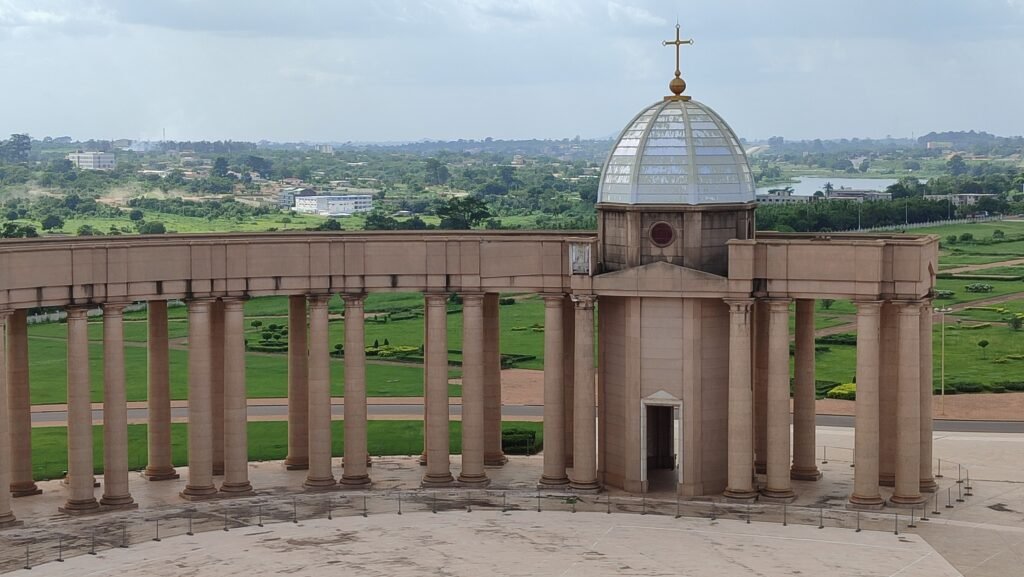
Ivory Coast, officially Cote d’Ivoire, is a country in West Africa and the world’s largest producer of cocoa, whose economy has expanded rapidly over the past decade and a half. Its administrative capital, Yamoussoukro, is home to the Basilica of Our Lady of Peace, one of the largest churches on Earth.
Where Is Ivory Coast Located?
Ivory Coast lies on the Gulf of Guinea in West Africa, bordered by Liberia and Guinea to the west, Mali and Burkina Faso to the north, and Ghana to the east, with a coastline along the Atlantic Ocean to the south. Its landscape ranges from coastal lagoons and dense tropical rainforest in the south to savanna in the north. Yamoussoukro is the country’s official political capital, while Abidjan, the former capital, remains the largest city and the main economic and administrative center.
A Brief History
The territory became a French colony in the late nineteenth century and part of French West Africa, gaining independence in 1960 under its first president, Felix Houphouet-Boigny, who led the country for more than three decades and pursued close economic ties with France. Ivory Coast experienced strong growth for its first two decades of independence, often called the “Ivorian miracle,” but political instability followed his death in 1993, culminating in a civil war beginning in 2002 and a further post-election conflict in 2010 and 2011. Since then, the country has pursued reconstruction and sustained economic growth.
Government and Economy Today
Ivory Coast is a presidential republic. According to the World Bank, the country has sustained one of the fastest growth rates in Sub-Saharan Africa for more than a decade, with real GDP growth averaging 6.5 percent from 2021 to 2023 and continuing at a similar pace in 2024 and 2025, supported by strong private demand and low inflation. The World Bank classifies Ivory Coast as a lower-middle-income economy, and the country has launched a program to diversify beyond raw commodity exports, including expanding its processing of cashews, of which it is also a leading global producer.
Culture and People
Ivory Coast is home to more than 60 ethnic groups and a population of roughly 32.7 million people in 2025, according to the World Bank. French is the official language, reflecting the colonial period, alongside numerous indigenous languages. Cocoa and cashew farming remain central to rural livelihoods, and Abidjan’s skyline and cultural scene have made it one of West Africa’s major cities.
What Is Ivory Coast Known For?
Ivory Coast is best known internationally as the world’s leading producer of cocoa, the raw material for chocolate, and increasingly as a major processor and exporter of cashews. Its most recognizable landmark is the Basilica of Our Lady of Peace in Yamoussoukro, completed in 1989 and among the largest churches in the world by area, modeled on St. Peter’s Basilica in Rome.
Key Takeaways
- Ivory Coast sits on West Africa’s Gulf of Guinea coast, bordered by Liberia, Guinea, Mali, Burkina Faso and Ghana.
- It gained independence from France in 1960 and experienced a civil war in the 2000s before a sustained economic recovery.
- The World Bank classifies it as a lower-middle-income economy with one of Sub-Saharan Africa’s fastest growth rates over the past decade.
- It is the world’s largest cocoa producer and a major cashew producer and processor.
- The Basilica of Our Lady of Peace in Yamoussoukro, completed in 1989, is among the largest churches in the world.
Key facts
Quick checkWhat is Ivory Coast the world's leading producer of?Show answer
Ivory Coast is the world's largest producer of cocoa, the raw material used to make chocolate, and is also a major producer and processor of cashews.
Sources
- World Bank. Cote d'Ivoire Overview. Accessed 2026 (accessed 2026)
- World Bank. Cote d'Ivoire, Population total. 2025 (accessed Accessed 2026)
Editorially reviewed by Specialty Digest Editorial TeamLast reviewed September 27, 2026Researched and drafted with AI assistanceReport an issue