Jamaica is an island country in the Caribbean Sea, widely known as the birthplace of reggae music and for producing some of the world’s fastest sprinters. Beneath that global cultural profile is a small, highly tourism-dependent economy that remains especially exposed to hurricanes.
Where Is Jamaica Located?
Jamaica lies in the Caribbean Sea, about 145 kilometers south of Cuba and roughly 190 kilometers west of Haiti. The island is mountainous at its center, rising to the Blue Mountains in the east, which are famous for coffee cultivation, and ringed by coastal plains and beaches, particularly along the northern coast around Montego Bay and Ocho Rios. Kingston, on the southeastern coast, is the capital and largest city.
A Brief History
Jamaica was inhabited by the indigenous Taino people before Christopher Columbus’s arrival in 1494. Spain colonized the island in the early sixteenth century, and England seized it in 1655, developing a plantation economy built on enslaved African labor that made Jamaica one of the world’s leading sugar producers for two centuries. Jamaica gained independence from the United Kingdom in 1962. Reggae music, along with related genres such as ska and dancehall, emerged from Kingston in the 1960s and 1970s and became one of Jamaica’s most influential cultural exports, closely associated with the musician Bob Marley.
Government and Economy Today
Jamaica is a parliamentary democracy and a Commonwealth realm. According to the World Bank, the country has made significant progress reducing public debt, from around 140 percent of GDP in 2012 to roughly 65 percent in 2024, through disciplined fiscal policy. The economy remains heavily dependent on tourism and agriculture, which together account for over a third of jobs, and is highly vulnerable to extreme weather: Hurricane Melissa struck in October 2025 as the strongest storm in the island’s recorded history, a year after Hurricane Beryl, disrupting economic activity despite strong pre-crisis financial planning.
Culture and People
Jamaica’s population was approximately 2.8 million in 2025, according to the World Bank. English is the official language, alongside Jamaican Patois, an English-based creole widely spoken in daily life. The island’s culture has an outsized global reach relative to its size, through reggae music, Rastafari religious and cultural movements that originated on the island, and a track and field program that has produced numerous Olympic sprint champions.
What Is Jamaica Known For?
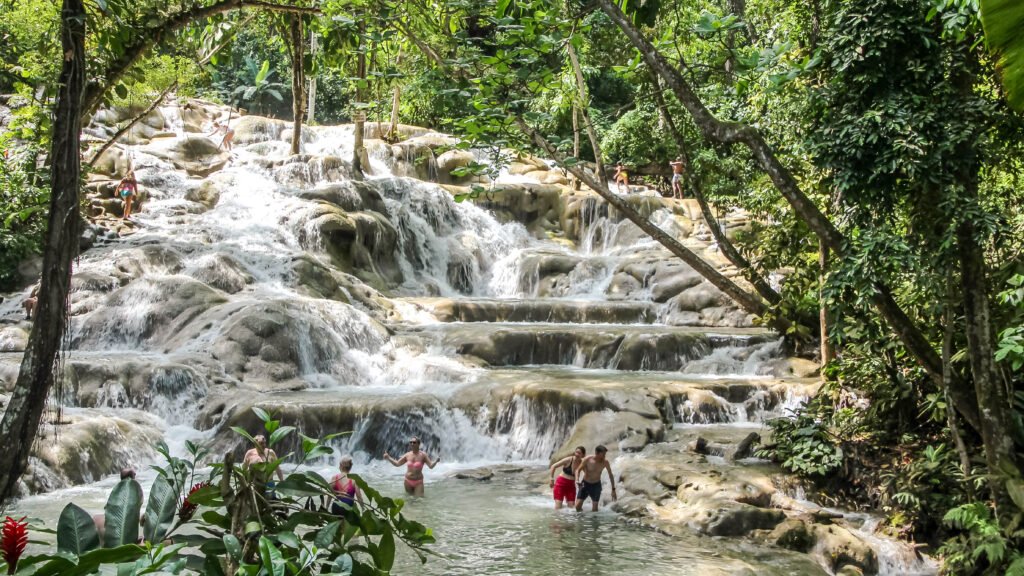
Jamaica is best known internationally for reggae music and Bob Marley, for elite sprinters including Usain Bolt, and for Caribbean beach tourism. Its most iconic natural landmark is Dunn’s River Falls near Ocho Rios, a terraced waterfall cascading directly onto the beach where it meets the sea, and one of the island’s most visited natural sites.
Key Takeaways
- Jamaica is a mountainous Caribbean island south of Cuba, with Kingston as its capital.
- Colonized by Spain and then England, it built a plantation economy on enslaved labor before gaining independence in 1962.
- Its economy depends heavily on tourism and agriculture and is highly exposed to hurricanes, including the record-strength Hurricane Melissa in 2025.
- Jamaica is the birthplace of reggae music and has produced numerous world-record sprinters.
- Dunn’s River Falls, a terraced waterfall meeting the sea near Ocho Rios, is the island’s most iconic natural landmark.
Key facts
Quick checkWhat is Jamaica's most iconic natural landmark?Show answer
Dunn's River Falls, a terraced waterfall near Ocho Rios that cascades directly onto the beach where it meets the sea.
Sources
- World Bank. Jamaica, Population total. 2025 (accessed Accessed 2026)
- World Bank. Jamaica Overview. Accessed 2026 (accessed 2026)
Editorially reviewed by Specialty Digest Editorial TeamLast reviewed September 27, 2026Researched and drafted with AI assistanceReport an issue