Photography is the process and art of capturing a permanent image using light, originally through a light-sensitive chemical surface and today increasingly through digital sensors, a technology whose basic chemical and optical principles were worked out independently by several inventors in the early nineteenth century.
Early invention
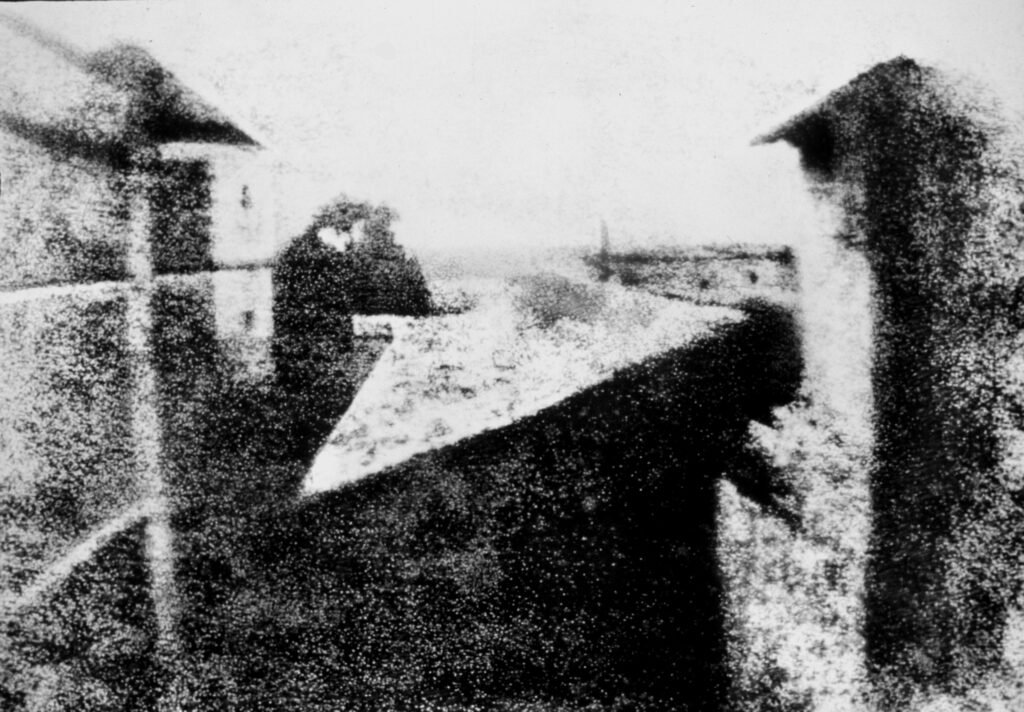
French inventor Joseph Nicephore Niepce produced the earliest known fixed, permanent photographic image in 1822, though that specific image was later destroyed, while his landscape view made around 1826 or 1827, requiring an exposure of more than eight hours, survives today as the oldest known surviving photograph taken directly from nature. Louis Daguerre publicly introduced the daguerreotype process in 1839, producing a detailed, permanent positive image on a silver-plated copper sheet, with exposure times that were gradually shortened from several minutes down to mere seconds as the process improved.
The negative and the modern process
English inventor William Henry Fox Talbot patented the calotype process in 1841, a paper-based negative method that, unlike the daguerreotype’s one-of-a-kind positive plate, allowed a single negative to be used for printing multiple positive copies, establishing the negative-based lineage that photography would follow for the next century and a half. Later nineteenth-century advances, including the wet-plate collodion process introduced in 1851 and gelatin dry-plate emulsions introduced in 1871, steadily made photography faster, cheaper, and more practical outside a specialized studio.
Mass photography and the 35mm era
Kodak’s first Brownie camera, introduced in 1900, brought inexpensive, simple, reloadable photography to ordinary consumers for the first time, turning photography from a specialized professional or hobbyist pursuit into a routine part of everyday family life. The German company Leica introduced the 35mm format to still photography in 1925, offering a smaller, more portable camera that proved especially influential among photojournalists and street photographers working quickly in changing conditions.
The digital transition
Kodak engineers built the first megapixel digital image sensor in 1986, a key early step toward digital photography, and Adobe released the first version of its Photoshop image-editing software in 1990, giving photographers and designers powerful new digital tools for altering images after capture. Kodak’s DC40 and Apple’s QuickTake 100, both released in 1995, were among the first digital cameras marketed directly to ordinary consumers, and the shift away from film accelerated sharply over the following decade, culminating symbolically in 2008 when Polaroid discontinued instant film entirely, explicitly citing the rise of digital imaging.
Photography as art and documentation
Photography has always occupied a dual role, serving simultaneously as a documentary tool for recording real events and places and as a fine-art medium in its own right, a tension that has shaped debates over photography’s status as art since its earliest decades and continues to influence how photographs are exhibited, collected, and critically evaluated today.
Color photography
Color photography developed more gradually than black-and-white processes, with the Autochrome plate, introduced commercially in 1907 by the Lumiere brothers in France, representing an early practical color process, while Kodak’s introduction of Kodachrome color film in 1935 brought significantly improved color photography to a wider base of amateur and professional photographers.
Photojournalism
Photography transformed journalism by letting publications show readers direct visual evidence of distant events rather than relying solely on written description or illustration, with war photography in particular, from the American Civil War through the twentieth century’s major conflicts, playing an especially influential role in shaping public understanding of distant events.
Photography and museums
Major museums gradually began collecting and exhibiting photography as fine art over the course of the twentieth century, a shift that helped settle longstanding debates over whether a mechanically produced image could carry the same artistic status traditionally reserved for painting and sculpture.
Smartphone photography
The widespread adoption of smartphones equipped with increasingly capable cameras in the 2000s and 2010s dramatically expanded who takes and shares photographs, making photography a routine daily activity for billions of people rather than a specialized pursuit requiring dedicated equipment.
Photographic genres
Photography encompasses a wide range of distinct genres, including portraiture, landscape, documentary, fashion, and scientific or technical photography, each developing its own conventions, equipment preferences, and professional practices suited to its particular subject matter and purpose.
Copyright and photography
Photography raises distinct copyright questions, since a photographer’s creative choices in composition, lighting, and timing are generally recognized as sufficient original expression to earn copyright protection, even though the resulting image is produced mechanically rather than built up stroke by stroke as in painting or drawing.
Stereophotography and early novelties
Beyond standard single-image photography, nineteenth-century audiences also enjoyed stereophotography, which used two slightly offset images viewed through a special device to create an illusion of three-dimensional depth, an early popular novelty that anticipated much later interest in three-dimensional and virtual imaging.
Instant photography
Polaroid’s instant film, introduced commercially in 1948, let photographers see a finished print within minutes of taking a picture, long before digital cameras offered anything comparable, and instant photography retained a devoted following among artists and hobbyists even decades after more convenient alternatives became available.
Photography education
Formal photography education expanded considerably over the twentieth century, with dedicated degree programs, workshops, and online courses now teaching both the technical fundamentals of exposure and composition and the broader history and critical theory surrounding the medium.
FAQs
What was the first permanent photograph? French inventor Joseph Nicephore Niepce produced the earliest known fixed, permanent photographic image in 1822, though his later landscape view from around 1826 or 1827 is the oldest surviving photograph taken directly from nature.
Why was the calotype process important? Unlike the daguerreotype’s one-of-a-kind positive image, William Henry Fox Talbot’s 1841 calotype process used a paper negative that could be reprinted multiple times, establishing the negative-based approach photography followed for generations afterward.
Key facts
- Niepce produced the earliest surviving photograph around 1826-27
- Daguerre's 1839 daguerreotype produced a detailed permanent positive image
- Talbot's 1841 calotype introduced the reprintable negative process
- Kodak's 1900 Brownie brought photography to mass consumers; digital cameras emerged in the 1990s
Related concepts
Quick checkWhat made the calotype process different from the daguerreotype?Show answer
The calotype used a paper negative that could be reprinted multiple times, while the daguerreotype produced only a single, one-of-a-kind positive image.
Sources
- Wikipedia, Timeline of photography technology
Editorially reviewed by Specialty Digest Editorial TeamLast reviewed November 1, 2026Researched and drafted with AI assistanceReport an issue