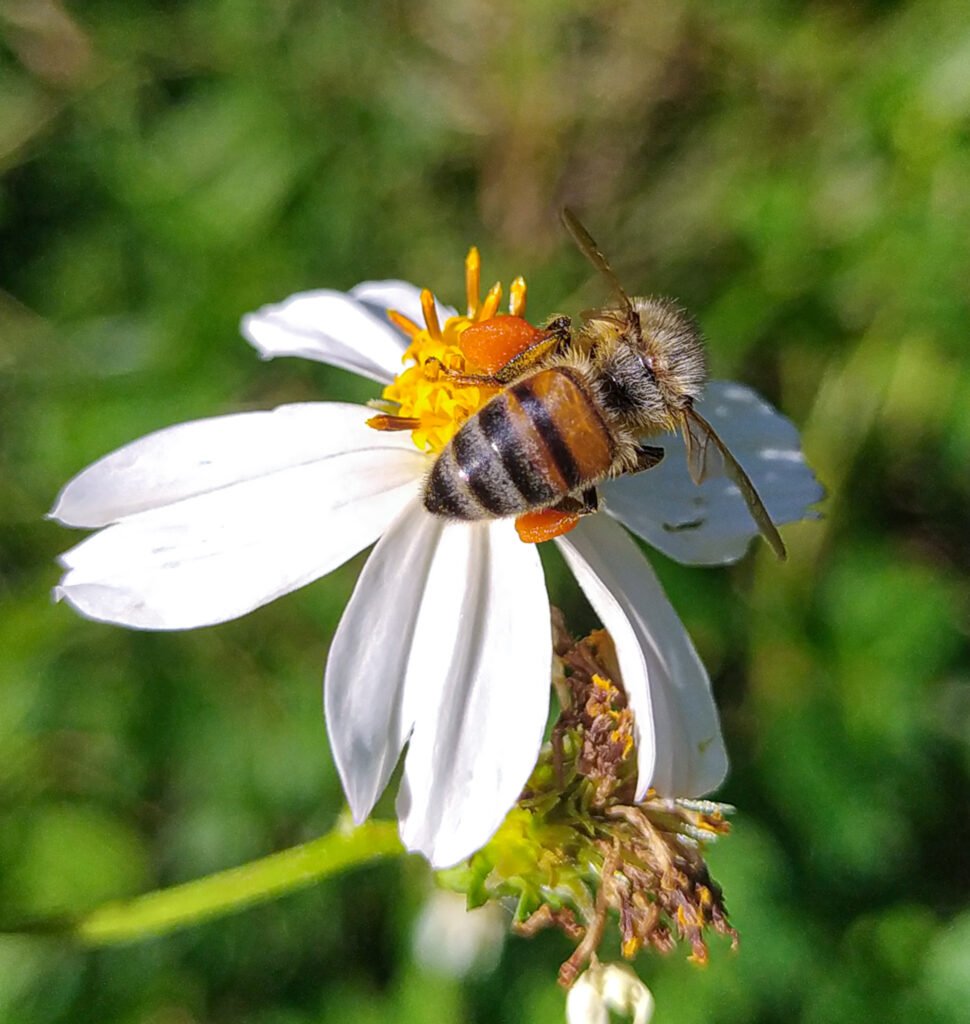
Pollination is the transfer of pollen from a flower’s male structures to its female structures, enabling fertilization and the production of seeds and fruit. Some plants self-pollinate or rely on wind to carry pollen, but a large share of the world’s flowering plants, including many of the crops people eat, depend instead on animals, chiefly insects, to carry pollen from flower to flower as they forage for nectar or pollen itself.
How animal pollination works
As a bee, butterfly, moth, bird, bat, or other pollinator visits a flower to feed, pollen grains stick to its body and are carried, often unintentionally, to the next flower it visits, where some of that pollen brushes off onto the receptive female structures, enabling fertilization. Many flowering plants have evolved specific traits, such as particular colors, scents, shapes, or flowering times, that attract the specific pollinators they rely on most, a close evolutionary relationship that means the loss of a key pollinator species can directly threaten the plants adapted to depend on it. Honey bees receive the most public attention because they are easy to manage commercially and visit an enormous range of crop species, but wild bees, many of which are solitary rather than social, along with butterflies, moths, hoverflies, and in some regions birds and bats, together account for a substantial share of real-world crop pollination.
How much of the food supply depends on pollinators
According to assessments compiled by the Intergovernmental Science-Policy Platform on Biodiversity and Ecosystem Services, roughly 75 percent of the world’s food crop types benefit at least partly from animal pollination, and nearly 90 percent of wild flowering plant species depend to some degree on animal pollinators, underscoring that pollination’s importance extends well beyond agriculture into the health of natural ecosystems generally. The crops that depend most heavily on animal pollination tend to be fruits, vegetables, nuts, and certain oil and stimulant crops such as coffee and cacao, while several of the world’s staple calorie crops, including wheat, rice, and corn, are wind-pollinated or self-pollinating and do not depend on animal pollinators in the same direct way, a distinction that matters for understanding pollinator decline’s impact: the crops most at risk are generally not the ones supplying most of humanity’s calories, but they are disproportionately the ones supplying dietary variety, micronutrients, and farm income.
The economic value of pollination
IPBES has estimated that global crop production directly dependent on animal pollination is worth somewhere between 235 billion and 577 billion dollars per year, a wide range that reflects the difficulty of isolating pollination’s specific economic contribution from other farming inputs, but one that consistently places pollination among the most economically significant ecosystem services nature provides to agriculture. Production of pollinator-dependent crops has grown by roughly 300 percent over the past 50 years, a trend driven both by rising demand for fruits, vegetables, and specialty crops and by the expansion of cultivated land devoted to them, which has in turn increased agriculture’s overall reliance on reliable, abundant pollinator populations.
Pollinator decline and its drivers
Regional and national assessments reviewed by IPBES found that more than 40 percent of invertebrate pollinator species, particularly bees and butterflies, are threatened with local extinction in the areas studied, while about 16 percent of vertebrate pollinators, such as pollinating bats and birds, face global extinction risk, rising to roughly 30 percent for pollinators found only on islands. Confirmed declines are strongest in North Western Europe and North America, where long-term monitoring data exist; data are too sparse across much of the rest of the world to draw firm global conclusions, even though many scientists suspect similar pressures are at work elsewhere. The drivers most frequently cited include habitat loss and fragmentation that removes the wildflowers and nesting sites many wild pollinators need, pesticide exposure, the spread of pathogens and parasites, including some inadvertently spread by managed honey bee colonies, and climate change shifting the timing of flowering relative to pollinator activity.
A case study: California almonds
California’s almond orchards illustrate just how dependent some crops have become on managed pollination at an industrial scale. Almonds bloom for only a few weeks each February, and because almond trees cannot pollinate themselves, growers rely almost entirely on honey bees trucked in from across the United States, with beekeepers transporting the large majority of the country’s commercially managed honey bee colonies to California specifically for almond bloom season before dispersing them again for other crops later in the year. This concentrated, continent-spanning pollination effort has made almond growers and commercial beekeeping economically interdependent, but it has also drawn scrutiny, since crowding so many colonies from so many different regions into one area for a few weeks can accelerate the spread of pests and diseases between colonies, a tradeoff that illustrates the broader tension between meeting large-scale crop pollination demand and protecting pollinator health.
Protecting pollinators
Conservation responses include planting wildflower strips and hedgerows along farm field margins to provide forage and nesting habitat, reducing or better timing pesticide applications to limit exposure during pollinator activity, diversifying crop rotations to extend flowering periods throughout the season, and maintaining semi-natural habitat patches within otherwise intensively farmed landscapes. Some of these measures, such as hedgerow planting, overlap directly with practices already used in agroforestry and organic farming, reflecting a broader recognition that pollinator-friendly farming and other sustainable agricultural practices often reinforce one another rather than competing for the same land.
FAQs
Would losing pollinators cause mass starvation? Not directly, since the staple crops that supply most of the world’s calories, including wheat, rice, and corn, do not depend on animal pollination, but a severe pollinator decline would still sharply reduce the variety, availability, and affordability of fruits, vegetables, nuts, and other nutrient-dense foods that do depend on it.
Are honey bees the most important pollinators? Not necessarily. Honey bees are the most visible and commercially managed pollinator and visit an unusually wide range of crops, but wild bees and other wild pollinators collectively provide a very large share of real-world crop pollination, and some crops are pollinated more effectively by specific wild species than by honey bees at all.
Key facts
- ~75% of food crop types benefit at least partly from animal pollination (IPBES)
- ~90% of wild flowering plants depend on animal pollinators
- Global value of pollinator-dependent crops: USD 235-577 billion/year
- >40% of invertebrate pollinators (bees, butterflies) regionally threatened
Related concepts
Quick checkWould losing pollinators cause mass starvation?Show answer
Not directly, since staple calorie crops like wheat, rice and corn are not animal-pollinated, but dietary variety and nutrition would suffer sharply.
Sources
- IPBES. Pollinators, Pollination and Food Production (Summary for Policymakers). 2016 (accessed 2026-11-01)
Editorially reviewed by Specialty Digest Editorial TeamLast reviewed November 1, 2026Researched and drafted with AI assistanceReport an issue