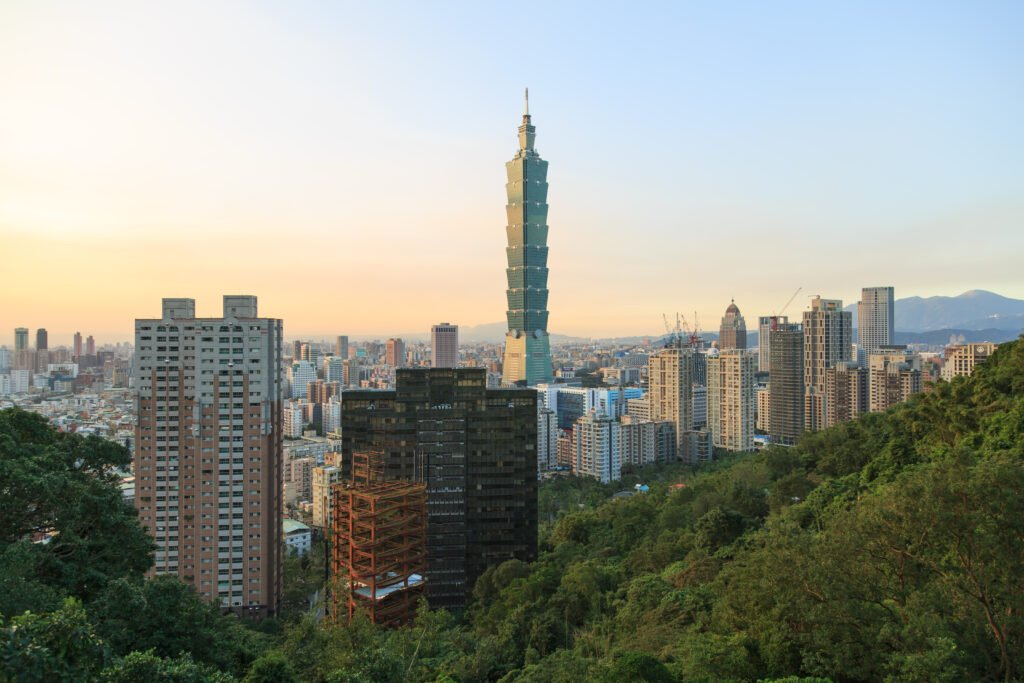
Taiwan is an island in East Asia, separated from mainland China by the Taiwan Strait, and is governed as the Republic of China (ROC). It is a densely populated, highly developed democracy known for its advanced electronics and semiconductor industry, its mountainous interior, and a political status that remains one of the most closely watched disputes in international affairs.
Where Is Taiwan Located?
Taiwan lies in the western Pacific Ocean, across the Taiwan Strait from mainland China, with Japan‘s Ryukyu Islands to the northeast and the Philippines to the south. The territory governed by the Republic of China includes the main island of Taiwan along with smaller island groups such as Penghu, Kinmen, and Matsu, the latter two lying close to the Chinese mainland. Taipei, in the north of the main island, is the capital and largest metropolitan area.
Geography
The main island is dominated by a mountainous spine running north to south, home to more than 200 peaks above 3,000 meters, including Yushan (Jade Mountain), East Asia’s highest peak outside the Himalayas at 3,952 meters. The densely populated western coastal plain contrasts with a rugged, sparsely populated eastern coast where mountains often meet the Pacific directly. Taiwan sits on the Pacific Ring of Fire, making earthquakes frequent, and its subtropical to tropical climate brings a wet season and periodic typhoons.
A Brief History of Taiwan
Early Settlement and Colonial Rule
Taiwan’s Indigenous Austronesian peoples have inhabited the island for thousands of years. Dutch and Spanish trading outposts were established in the early seventeenth century, and from 1624 the Dutch East India Company controlled much of the island’s southwest until it was expelled in 1662 by Ming loyalist forces under Zheng Cheng-gong, known as Koxinga. Qing dynasty China took control of Taiwan’s western and northern coastal areas by 1683, and in 1895, following the Treaty of Shimonoseki, the Qing ceded Taiwan to Japan, which ruled the island as a colony until 1945.
Republic of China Government and Democratization
After Japan’s surrender at the end of World War II, administration of Taiwan passed to the Republic of China. In 1949, as the Chinese Communist Party won the Chinese Civil War on the mainland, the ROC government relocated to Taiwan, which it has governed since. The ROC constitution, promulgated in 1947, did not underpin genuine democratic governance until after martial law was lifted in 1987; a series of constitutional amendments between 1991 and 2005 established direct presidential elections and reformed the legislature, and today the president, vice president, and legislature are chosen in regular direct elections.
Government, Status, and Economy
Taiwan’s government describes itself as the Republic of China and, since constitutional amendments in 1991, has exercised jurisdiction only over Taiwan and its outlying islands rather than mainland China. The People’s Republic of China (PRC), based in Beijing, claims Taiwan as part of its territory and has not renounced the use of force to bring it under its control; Taiwan’s government rejects this claim and maintains that the PRC has never governed the island. Most countries maintain only unofficial relations with Taiwan while holding formal diplomatic ties with the PRC under some form of a One China policy, and Taiwan has not held a seat at the United Nations since 1971, when the UN General Assembly recognized the PRC as the representative of China. A small number of countries maintain formal diplomatic relations with Taipei. Economically, Taiwan is a highly developed, export-oriented economy built on electronics and semiconductor manufacturing; it is home to the Taiwan Semiconductor Manufacturing Company (TSMC), the world’s largest contract chipmaker, whose products underpin much of the global electronics and artificial intelligence hardware supply chain.
Culture and People
Taiwan’s population is predominantly Han Chinese, descended largely from waves of migration from mainland China’s Fujian and Guangdong provinces beginning in the seventeenth century, alongside a smaller number of mainlanders who arrived after 1949. Sixteen officially recognized Indigenous Austronesian tribes make up just over 2.6 percent of the population, and the island is home to more than 600,000 immigrants, mostly from China and Southeast Asia. Mandarin Chinese is the primary official language, though Hokkien (Taiwanese), Hakka, and Indigenous languages are widely spoken and increasingly supported through public broadcasting and education policy. Taiwan’s religious life blends Buddhism, Taoism, and folk traditions, and its cities are known for night markets, temple festivals, and a thriving contemporary arts scene.
What Is Taiwan Known For?
Taiwan is globally recognized for Taipei 101, a 508-meter skyscraper that was the world’s tallest building from 2004 to 2010 and remains the island’s most identifiable landmark, its distinctive tiered form engineered to withstand both earthquakes and typhoon winds. The country is equally well known for its role at the center of the global semiconductor industry, its national parks and mountain scenery, including Taroko Gorge’s marble canyons, and its status as one of Asia’s most vibrant democracies with strong protections for press freedom and civil liberties.
Why Taiwan Matters
Taiwan’s combination of advanced technology manufacturing and an unresolved political status gives it outsized significance relative to its size. Its semiconductor industry supplies chips essential to consumer electronics, automobiles, and artificial intelligence systems worldwide, making its economic stability a matter of global concern. Its history as a layered society of Indigenous peoples, successive waves of Chinese settlers, Dutch and Japanese colonial administration, and postwar democratization offers a distinct case study in how a small island has repeatedly absorbed outside rule while building its own political identity.
Key Takeaways
- Taiwan is governed as the Republic of China from its capital, Taipei, administering the main island along with Penghu, Kinmen, and Matsu.
- The ROC government relocated to Taiwan in 1949 after the Chinese Communist Party won the Chinese Civil War on the mainland.
- Martial law was lifted in 1987, and constitutional amendments between 1991 and 2005 established Taiwan’s current direct elections for president and legislature.
- The People’s Republic of China claims Taiwan as its territory; Taiwan’s government rejects this claim, and the island has not held a UN seat since 1971.
- Taiwan hosts TSMC, the world’s largest contract semiconductor manufacturer, making it central to the global electronics and AI hardware supply chain.
- Taipei 101 was the world’s tallest building from 2004 to 2010 and remains Taiwan’s most recognizable landmark.
Sources
- Taiwan.gov.tw, Government Portal of the Republic of China (Taiwan), “History” [1]: taiwan.gov.tw
- Taiwan.gov.tw, “People” [2]: taiwan.gov.tw
- Taiwan.gov.tw, “Political System” [3]: taiwan.gov.tw
Key facts
- Martial law was lifted in 1987, opening the way to direct presidential and legislative elections3
- 16 officially recognized Indigenous Austronesian tribes make up about 2.6% of the population2
- Home to TSMC, the world's largest contract semiconductor manufacturer
- Taipei 101 was the world's tallest building from 2004 to 2010
- Not a UN member state since 1971, when the General Assembly recognized the People's Republic of China
Quick checkWhat is the name of the world's largest contract semiconductor manufacturer, headquartered in Taiwan?Show answer
Taiwan Semiconductor Manufacturing Company (TSMC).
Sources
- Taiwan.gov.tw (Ministry of Foreign Affairs, ROC). History. Undated (accessed Date accessed: 2026-10-04)
- Taiwan.gov.tw (Ministry of Foreign Affairs, ROC). People. Undated (accessed Date accessed: 2026-10-04)
- Taiwan.gov.tw (Ministry of Foreign Affairs, ROC). Political System. Undated (accessed Date accessed: 2026-10-04)
Editorially reviewed by Specialty Digest Editorial TeamLast reviewed October 4, 2026Researched and drafted with AI assistanceReport an issue