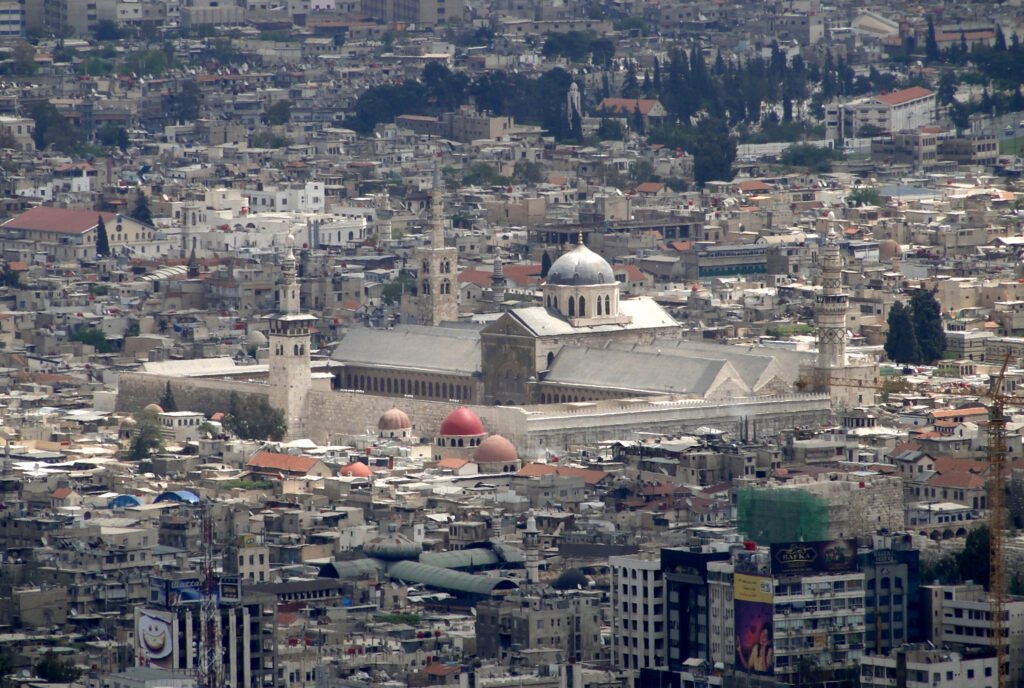
Syria is a country in the Levant region of the eastern Mediterranean, bordered by Turkey to the north, Iraq to the east, Jordan to the south, and Israel and Lebanon to the southwest and west. Its capital, Damascus, is among the longest continuously inhabited cities in the world, and the country sits at a crossroads of trade routes and civilizations that has shaped the wider Middle East for more than four thousand years.
Where Is Syria Located?
Syria occupies the eastern shore of the Mediterranean Sea, part of the historical region known as the Levant or the Fertile Crescent. Its neighbors are Turkey to the north, Iraq to the east and southeast, Jordan to the south, and Israel and Lebanon along its southwestern border. The Golan Heights, a plateau in the southwest, has been occupied by Israel since the 1967 Arab-Israeli war and annexed by Israel in 1981 in a move not recognized by the United Nations; Syria continues to regard the territory as its own. The country’s geography ranges from a narrow, fertile Mediterranean coastal strip to the arid Syrian Desert that covers much of the south and east, with the Euphrates River crossing the country from northwest to southeast and supporting much of its agriculture.
Geography and Climate
Syria’s landscape divides into four broad zones: the coastal plain along the Mediterranean, a double mountain range (the An-Nusayriyah Mountains near the coast and the Anti-Lebanon range bordering Lebanon), a central plateau of steppe and farmland, and the Syrian Desert in the south and east, which merges into the deserts of Jordan and Iraq. The Euphrates, Syria’s longest river, enters from Turkey and flows southeast toward Iraq, and its valley has supported continuous agricultural settlement since antiquity. The climate is Mediterranean along the coast, with hot, dry summers and mild, wet winters, shifting to a semi-arid and desert climate further inland.
A Brief History of Syria
Ancient and Classical Periods
Syria’s territory has been continuously settled since at least the third millennium BCE, serving as a corridor between Mesopotamia, Anatolia, Egypt, and the Mediterranean world. The region came under Akkadian, Assyrian, Babylonian, and Persian rule before Alexander the Great’s conquests brought Greek influence in the fourth century BCE. Under Rome and later the Byzantine Empire, cities such as Damascus, Aleppo, and Palmyra flourished as centers of trade and learning; Palmyra in particular grew into a wealthy caravan city that briefly broke away from Rome under Queen Zenobia in the third century CE.
Islamic Caliphates and Ottoman Rule
Following the Muslim conquests of the seventh century, Damascus became the capital of the Umayyad Caliphate from 661 to 750 CE, the first great dynastic Islamic empire, which stretched from Spain to Central Asia. Later dynasties, including the Abbasids, Seljuks, and Mamluks, governed the region before the Ottoman Empire absorbed it in 1516, ruling for four centuries until the end of World War I.
French Mandate, Independence, and Ba’ath Rule
After the Ottoman collapse, the League of Nations placed Syria under French administration as a mandate territory. Syria gained full independence in 1946. Decades of political instability followed, including a series of military coups, until the Ba’ath Party seized power in 1963. Hafez al-Assad, an air force commander, took control in 1970 and ruled until his death in 2000, when his son Bashar al-Assad succeeded him.
Civil War and Political Transition
Protests that began in 2011 as part of the wider Arab Spring escalated into a multi-sided civil war involving the government, numerous opposition and rebel factions, Kurdish-led forces, and, between 2014 and 2019, the self-proclaimed Islamic State, which seized and later lost large areas of eastern Syria. The conflict drew in regional and international powers and produced one of the largest displacement crises in the modern era. In early December 2024, a rapid offensive by opposition forces led to the fall of the Assad government after nearly fourteen years of war, and a transitional administration took power in Damascus. The World Bank estimates that the conflict damaged close to one-third of Syria’s pre-war capital stock, with direct physical damage to infrastructure and buildings of about $108 billion, and has put total reconstruction costs at approximately $216 billion based on an assessment covering 2011 to 2024.
Government and Economy
Syria is currently governed by a transitional administration that took power after the fall of the Assad government in December 2024, following more than five decades of rule by the Assad family and the Ba’ath Party. The country’s political institutions, including a new constitutional framework, remain in a period of formation. Economically, Syria is classified by the World Bank among lower-income economies still recovering from the conflict. According to the World Bank, the economy is showing signs of recovery as sanctions relief, national reconciliation efforts, and reconstruction activity take hold, though the scale of rebuilding required, estimated at nearly ten times Syria’s 2024 gross domestic product, remains an immense challenge. International support has included a World Bank grant of $100 million approved in 2026 to help modernize Syria’s financial sector and a further $225 million in financing to help restore water and health services damaged during the war.
Culture and People
Syria’s population, estimated by the World Bank at approximately 25.6 million in 2025, is predominantly Arab and Arabic-speaking, with significant Kurdish, Armenian, Assyrian, and Turkmen minorities. Aramaic, the language once spoken across the ancient Near East, survives today in a few villages, most notably Maaloula, north of Damascus. Religiously, Syria is diverse: a Sunni Muslim majority lives alongside significant communities of Alawites, Christians of several denominations, Druze, and Ismailis, a pluralism that has long shaped the country’s social fabric even through periods of conflict. Syrian cuisine, music, and craftsmanship, including Damascene textiles and metalwork, reflect centuries of exchange along the trade routes that once crossed the region.
What Is Syria Known For?
Syria is home to six UNESCO World Heritage Sites, all currently listed as World Heritage in Danger because of the conflict: the ancient cities of Damascus, Aleppo, and Bosra; the Crusader-era castle of Krak des Chevaliers; the so-called Dead Cities of northern Syria; and the desert oasis city of Palmyra. Damascus’s Umayyad Mosque, completed in 715 CE on a site that has hosted an Aramean temple, a Roman temple to Jupiter, and a Byzantine church in succession, remains one of the oldest and most architecturally significant mosques in the world and is regarded as the city’s defining monument. Palmyra, once a wealthy caravan city linking Rome with Persia and the Silk Road, suffered severe damage to monuments including the Temple of Bel during its occupation by the Islamic State between 2015 and 2017. In the twenty-first century, Syria has also become known internationally for the scale of the humanitarian and displacement crisis caused by its civil war, and more recently for the political transition following the end of Assad-family rule.
Why Syria Matters
Few places illustrate the long arc of Middle Eastern history as clearly as Syria, where Bronze Age trade cities, the capital of an early Islamic empire, and Ottoman and French colonial administration have each left a lasting imprint. Its ancient cities, especially Damascus and Aleppo, were centers of religion, scholarship, and commerce that helped shape civilizations across the Mediterranean and the Islamic world. Today, Syria’s path through reconstruction after one of the twenty-first century’s most destructive conflicts, and the political transition that followed the fall of the Assad government, makes it a closely watched test of how a country rebuilds its institutions, economy, and social fabric after prolonged war.
Key Takeaways
- Syria lies in the Levant on the eastern Mediterranean, bordered by Turkey, Iraq, Jordan, Lebanon, and Israel, with the Golan Heights occupied by Israel since 1967.
- Damascus served as the capital of the Umayyad Caliphate from 661 to 750 CE and is among the longest continuously inhabited cities in the world.
- Syria holds six UNESCO World Heritage Sites, including Damascus, Aleppo, and Palmyra, all currently listed as in danger due to the civil war.
- Nearly fourteen years of civil war, beginning in 2011, ended with the fall of the Assad government in December 2024 and the start of a political transition.
- The World Bank estimates Syria’s reconstruction costs at approximately $216 billion, around ten times its 2024 GDP.
- The population, estimated at 25.6 million in 2025, is predominantly Arab and Arabic-speaking with significant Kurdish, Christian, Alawite, Druze, and other minority communities.
Sources
- World Bank, “Syria Overview” (2026) [1]: worldbank.org/en/country/syria/overview
- World Bank, “Syria’s Post-Conflict Reconstruction Costs Estimated at $216 Billion” (October 2025) [2]: worldbank.org
- World Bank, “Syria: World Bank Approves US$100 Million Grant for Financial Sector Modernization” (August 2026) [3]: worldbank.org
- World Bank, “Syria: World Bank Approves US$225 Million Financing to Restore Water and Health Services” (April 2026) [4]: worldbank.org
- UNESCO World Heritage Centre, Syrian Arab Republic [5]: whc.unesco.org
Key facts
- Population: approximately 25.6 million (2025)1
- Capital: Damascus, one of the longest continuously inhabited cities in the world5
- Six UNESCO World Heritage Sites, all listed as in danger5
- Civil war (2011-2024) ended with the fall of the Assad government in December 20241
- Estimated reconstruction costs: approximately $216 billion2
Quick checkWhich ancient caliphate ruled from Damascus between 661 and 750 CE?Show answer
The Umayyad Caliphate, the first major dynastic Islamic empire.
Sources
- World Bank. Syria Overview. 2026 (accessed Date accessed: 2026-10-04)
- World Bank. Syria Post-Conflict Reconstruction Costs Estimated at $216 Billion. 2025-10-21 (accessed Date accessed: 2026-10-04)
- World Bank. Syria Approves US$100 Million Grant for Financial Sector Modernization. 2026-08-07 (accessed Date accessed: 2026-10-04)
- World Bank. Syria Approves US$225 Million Financing to Restore Water and Health Services. 2026-04-23 (accessed Date accessed: 2026-10-04)
- UNESCO World Heritage Centre. Syrian Arab Republic. Undated (accessed Date accessed: 2026-10-04)
Editorially reviewed by Specialty Digest Editorial TeamLast reviewed October 4, 2026Researched and drafted with AI assistanceReport an issue