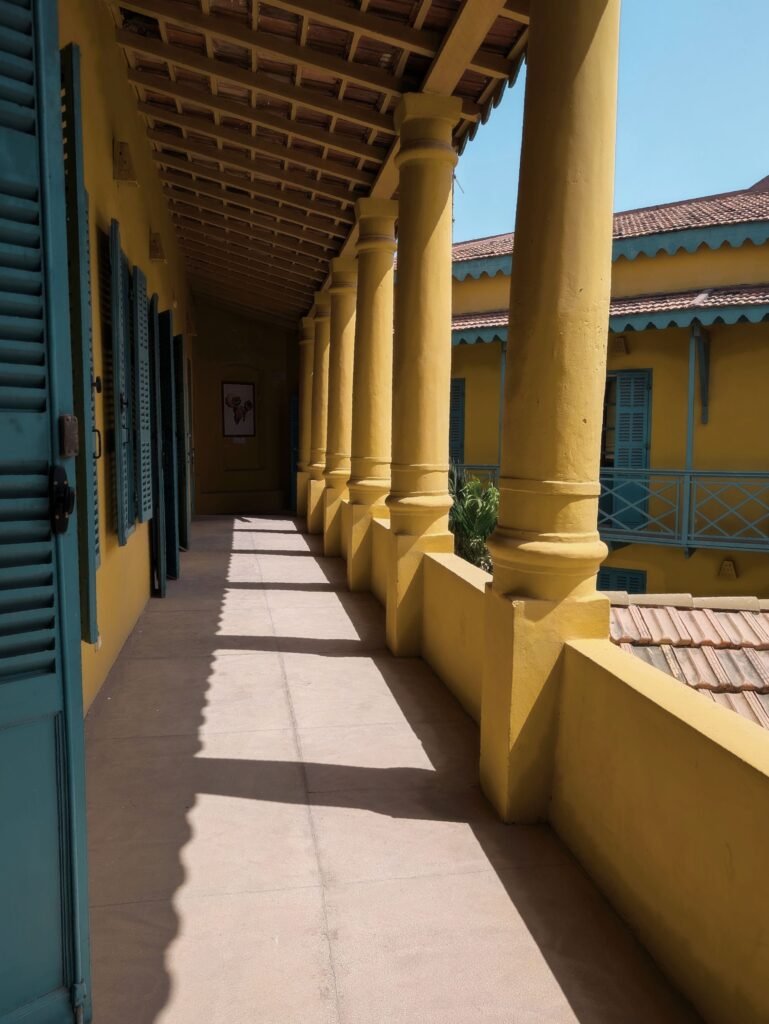
Senegal is a country on the westernmost point of mainland Africa, known for the city of Dakar, a long history as one of the continent’s more stable democracies, and Goree Island, one of the Atlantic slave trade’s most somber historical sites.
Where Is Senegal Located?
Senegal sits at the western tip of West Africa on the Atlantic coast, bordered by Mauritania to the north, Mali to the east, and Guinea and Guinea-Bissau to the south. The Gambia forms a narrow enclave almost entirely surrounded by Senegalese territory along the Gambia River. The capital, Dakar, occupies the Cap-Vert peninsula, the westernmost point of the African mainland.
Geography and Climate
Senegal is mostly low-lying savanna, with a tropical climate split between a dry season and a short rainy season. The Senegal River forms much of the northern border with Mauritania, while the Gambia and Casamance rivers cross the south of the country. According to the World Bank, Senegal has a population of roughly 18 million people, with nearly a quarter concentrated in the Dakar region, which itself covers only about 0.3% of the country’s total territory.[1]
A Brief History
Senegal was home to early West African states and later part of larger regional empires before France established trading posts along the coast from the seventeenth century onward. Goree Island, just off Dakar, became one of the Atlantic coast’s major points of departure for enslaved Africans shipped to the Americas, and its House of Slaves is preserved today as a UNESCO World Heritage site and memorial. Senegal became a French colony and later part of French West Africa before gaining independence in 1960.
Government and Economy Today
Senegal is widely regarded as one of the most politically stable countries in Africa, having undergone three peaceful transitions of power since independence. On March 24, 2024, opposition candidate Bassirou Diomaye Diakhar Faye won the presidency outright in the first round of voting.[1] The economy grew an estimated 6.1% in 2024, driven largely by new offshore oil and gas production, while growth outside the hydrocarbon sector slowed to 3.5% amid election-related disruption and flood damage to agriculture.[1] Inflation fell sharply, from 5.9% in 2023 to 0.8% in 2024, helped by lower food and fuel prices.[1]
Culture and People
French is the official language, but Wolof is the most widely spoken language in daily life, alongside Pulaar, Serer, and other national languages. Senegal is predominantly Muslim, with influential Sufi brotherhoods playing a major role in religious and social life, while a small Christian minority is concentrated partly in the south. Dakar has long been a center of West African music and the arts, having produced internationally known musicians such as Youssou N’Dour, and the Senegalese tradition of teranga, or hospitality, is widely cited as central to national identity.
What Is Senegal Known For?
Internationally, Senegal is best known for Goree Island, whose House of Slaves and so-called Door of No Return have made it one of the most visited historical memorials in West Africa and a frequent stop for official state visits addressing the legacy of the slave trade. Senegal is also known for its relative political stability, its mbalax and West African music scene, and as the first mainland sub-Saharan African country Europeans encountered when sailing south along the Atlantic coast.
Why Senegal Matters
Senegal’s record of peaceful democratic transitions sets it apart in a region that has seen frequent coups and contested elections in recent years, making it a frequent reference point for discussions of democratic resilience in West Africa. Goree Island also gives Senegal an outsized role in how the history and memory of the transatlantic slave trade are preserved and taught worldwide.
Key Takeaways
- Senegal occupies the westernmost point of mainland Africa and surrounds The Gambia almost entirely.
- Goree Island, with its House of Slaves, is a UNESCO World Heritage site tied to the Atlantic slave trade.
- Independent from France since 1960, Senegal has had three peaceful transfers of power, most recently in March 2024.
- The economy grew 6.1% in 2024, boosted by new offshore oil and gas production.
- Wolof is the most widely spoken language, though French remains the official language.
Sources
Key facts
- Population is about 18 million, nearly a quarter living in the Dakar region1
- Independent from France since 1960, with three peaceful transfers of power
- Bassirou Diomaye Diakhar Faye won the presidency in the first round on March 24, 20241
- Economy grew 6.1% in 2024, driven by new oil and gas production1
Quick checkWhat UNESCO World Heritage site near Dakar is tied to the Atlantic slave trade?Show answer
Goree Island, home to the House of Slaves and its Door of No Return.
Sources
- World Bank. Senegal Overview. Undated, continuously updated (accessed 2026-10-04)
Editorially reviewed by Specialty Digest Editorial TeamLast reviewed October 4, 2026Researched and drafted with AI assistanceReport an issue