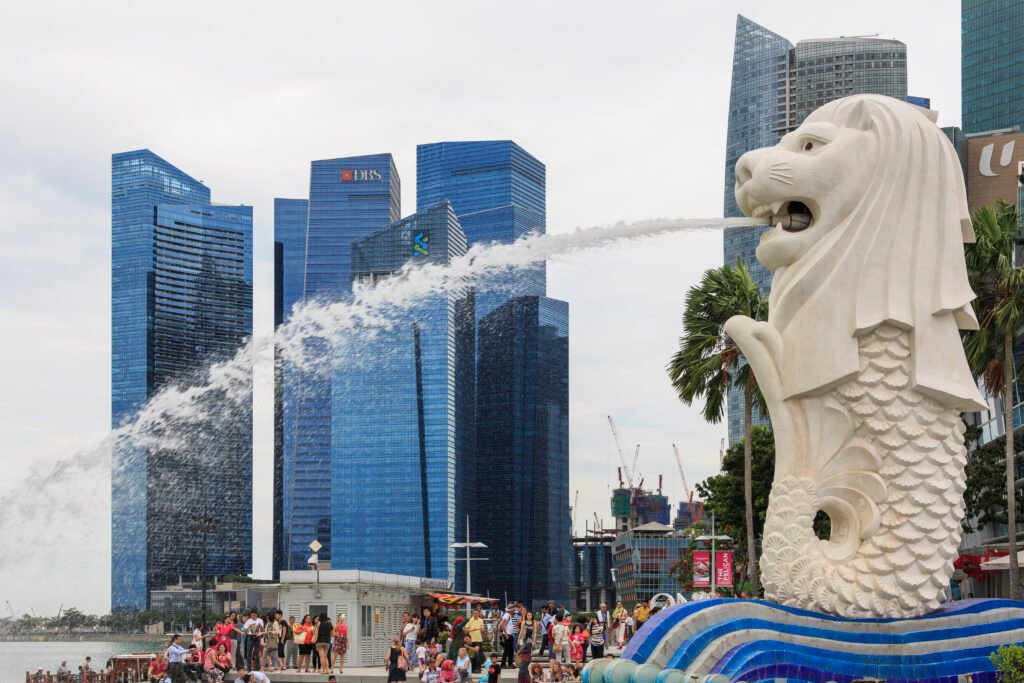
Singapore is a city-state on an island at the southern tip of the Malay Peninsula, famous for the half-lion, half-fish Merlion statue and for turning itself from one of the poorest places in Asia into one of the wealthiest in a single generation.
Where Is Singapore Located?
Singapore sits at the southern tip of the Malay Peninsula in Southeast Asia, separated from Malaysia by the narrow Johor Strait and from Indonesia by the Singapore Strait to the south. The main island, along with several dozen smaller islets, makes up the entire territory of the country, which also serves as its own capital, with no separate capital city.
Geography and Land Reclamation
Singapore is a low-lying island with limited natural land area, and it has expanded its footprint substantially through land reclamation since independence, adding land along its southern and eastern coasts for ports, airports, and the reservoirs it uses to manage its water supply. According to the World Bank, the country had a population of about 6.11 million as of June 2025, packed into one of the most densely built urban environments in the world.[1]
A Brief History
Singapore was a small trading settlement before the British East India Company established a trading post there in 1819, after which it grew into one of the British Empire’s most important Asian ports. It became self-governing in 1959, briefly joined the Federation of Malaysia in 1963, and separated to become fully independent in 1965 under founding Prime Minister Lee Kuan Yew.
Government and Economy Today
Singapore is a parliamentary republic that the World Bank describes as having been one of the poorest countries in the world sixty years ago, before transforming into a high-income nation known for a business-friendly regulatory environment that ranks among the most competitive anywhere.[1] It is the world’s busiest transshipment hub, handling more than 30 million twenty-foot equivalent container units a year, and a major gateway between Asian and Western markets.[1] The government invests heavily in workforce training through SkillsFuture, a national upskilling program launched in 2015, and the World Bank notes that each Singaporean receives roughly $300,000 in government subsidies over a lifetime for education and continued professional development.[1]
Culture and People
Singapore recognizes four official languages, English, Mandarin Chinese, Malay, and Tamil, reflecting a population built largely from Chinese, Malay, and Indian communities that settled around the port over the nineteenth and twentieth centuries. That mix is visible in neighborhoods such as Chinatown, Little India, and Kampong Glam, and in a food culture, centered on hawker centers, that UNESCO has recognized for its role in Singaporean community life.
What Is Singapore Known For?
Singapore is best known internationally for the Merlion, a statue with the head of a lion and the body of a fish standing at Marina Bay, which has served as the country’s unofficial mascot and most recognizable image since it was installed in 1972. The country is equally well known for its port, its strict laws and clean streets, and for the speed of its development from colonial trading post to global financial center.
Why Singapore Matters
As one of the few countries to move from low income to high income within a single lifetime, Singapore is frequently studied as a model of state-led economic development, and its position astride the Strait of Malacca gives it outsized influence over one of the busiest shipping corridors on Earth. Its education and workforce policies, including SkillsFuture, are also widely referenced by other governments designing their own retraining programs.
Key Takeaways
- Singapore is a city-state island at the tip of the Malay Peninsula, between Malaysia and Indonesia.
- It became fully independent in 1965 after briefly joining the Federation of Malaysia.
- The Merlion statue at Marina Bay, installed in 1972, is the country’s most recognizable symbol.
- Singapore is the world’s busiest transshipment hub, handling over 30 million container units a year.
- Population was about 6.11 million as of June 2025, in one of the world’s most densely built environments.
Sources
Key facts
Quick checkWhat statue is Singapore's most recognizable landmark?Show answer
The Merlion, a lion-headed, fish-bodied statue at Marina Bay, installed in 1972.
Sources
- World Bank. Singapore Overview. Undated, continuously updated (accessed 2026-10-04)
Editorially reviewed by Specialty Digest Editorial TeamLast reviewed October 4, 2026Researched and drafted with AI assistanceReport an issue