Indonesia is a Southeast Asian country made up of more than 17,000 islands, stretching along the equator between the Indian and Pacific Oceans. It is the world’s largest archipelagic state, the fourth most populous country, and, according to the World Bank, Southeast Asia’s largest economy. Its capital is Jakarta, on the island of Java, though the government has begun moving some functions to a new planned capital, Nusantara, in East Kalimantan on Borneo.
Geography: A Nation Built on Thousands of Islands
Indonesia sits on the Pacific “Ring of Fire,” a zone of intense volcanic and seismic activity that runs around the rim of the Pacific Ocean. The country has more active volcanoes than almost any other nation, and earthquakes and occasional tsunamis are a regular feature of life for many coastal communities. The five largest islands are Sumatra, Java, Borneo (shared with Malaysia and Brunei), Sulawesi, and the Indonesian portion of New Guinea, known as Papua.
The archipelago straddles what biologists call the Wallace Line, an invisible boundary named for the naturalist Alfred Russel Wallace that separates distinct plant and animal communities of Asian and Australian origin. West of the line, wildlife resembles that of mainland Asia. East of it, species such as marsupials and cockatoos point toward Australia and the Pacific. This position gives Indonesia one of the highest levels of biodiversity of any country on Earth, including species found nowhere else, such as the Komodo dragon and the orangutan.
A Brief History of Indonesia
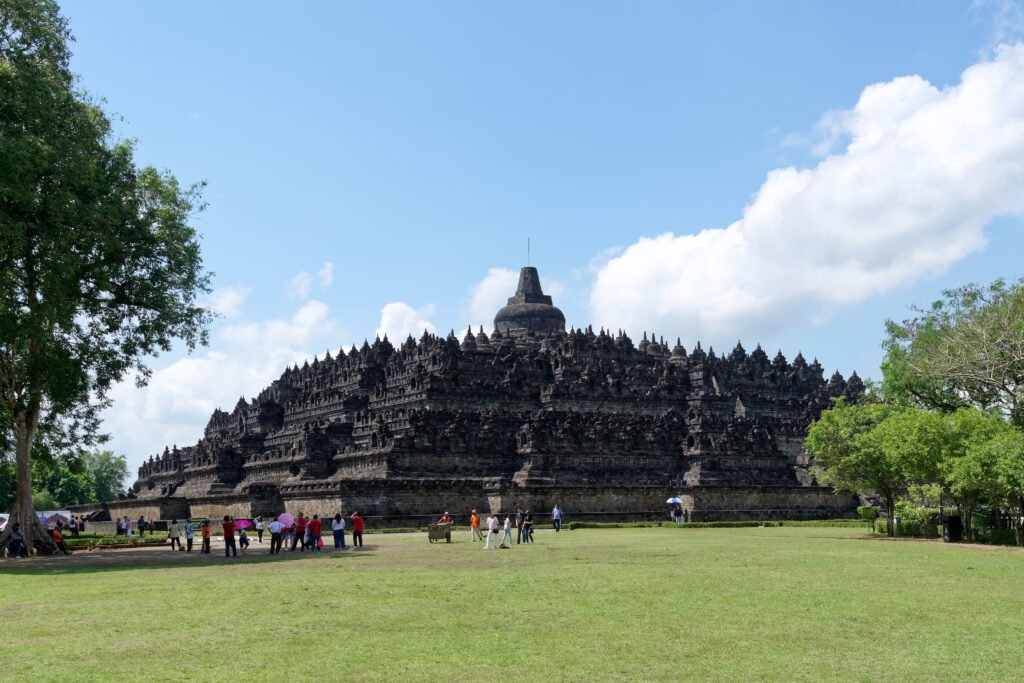
Java and Sumatra were home to powerful early kingdoms, including the Hindu-Buddhist Srivijaya and Majapahit empires, which for centuries controlled trade routes linking India, China, and the wider archipelago. Borobudur, the enormous Buddhist temple complex in Central Java, dates from the 8th and 9th centuries and stands as physical evidence of that era’s religious and artistic sophistication. Islam arrived gradually through trade from roughly the 13th century onward and became the dominant religion across most of the islands, while Hindu tradition persisted most visibly on Bali.
European traders reached the archipelago in the early 1500s, and the Dutch East India Company established control over parts of it during the 17th century. Dutch colonial rule, later administered directly by the Netherlands, lasted in various forms for roughly three centuries. Japan occupied Indonesia during the Second World War, and independence leaders Sukarno and Mohammad Hatta proclaimed the Republic of Indonesia on August 17, 1945. The Netherlands formally recognized independence in 1949 after years of armed and diplomatic struggle.
Sukarno led the country as its first president until 1967, when General Suharto took power amid a violent political crisis. Suharto then ruled for three decades under a system historians generally describe as authoritarian, until mass protests forced his resignation in 1998. Since then, Indonesia has held regular multiparty elections and is often described by outside observers as the world’s third largest democracy by population.
Indonesia’s modern borders have not gone unchallenged. Papua, the western half of the island of New Guinea, was incorporated into Indonesia in 1969 following a UN-supervised process that Papuan advocacy groups and some historians have long criticized as coercive, and a low-level separatist movement and Indonesian security presence have continued there for decades, with human rights organizations documenting abuses attributed to multiple sides. East Timor, a former Portuguese colony occupied by Indonesia in 1975, voted for independence in a 1999 UN-organized referendum after a period of violence documented by international investigators, and became the sovereign nation of Timor-Leste in 2002. These episodes remain contested, and Indonesian officials, independence advocates, and outside researchers describe them differently.
Government and Economy
Indonesia is a unitary presidential republic. Voters elect a president directly to a five-year term, and an elected legislature, working alongside regional governments across the archipelago’s more than 30 provinces, makes national law. The country’s founding ideology, Pancasila, sets out five principles, including belief in God, national unity, and social justice, and is invoked across Indonesian political life.
The World Bank describes Indonesia as Southeast Asia’s largest economy, with a gross domestic product of roughly 1.45 trillion US dollars in 2025 and a labor force of about 143 million people. Agriculture, manufacturing, and services all contribute substantially, and the country is a major global exporter of coal, palm oil, and nickel, the last of which has become increasingly important as global demand for electric vehicle batteries grows. Indonesia cut its poverty rate by more than half between 1999 and 2019, though informal, lower-productivity work still employs a large share of the labor force, particularly in agriculture. The government has set a long-term goal of reaching high-income status by 2045, the centennial of independence.
Culture and People
More than 300 distinct ethnic groups live within Indonesia’s borders, the largest being the Javanese, followed by Sundanese, Batak, Madurese, and many others, each with its own language and customs. Indonesian, a standardized form of Malay adopted as the national language at independence, functions as a unifying common language alongside hundreds of local and regional languages still spoken day to day. Indonesia has the world’s largest Muslim population, and Islam shapes daily and public life across most of the archipelago, while Bali remains predominantly Hindu and pockets of Christian, Buddhist, and traditional belief persist elsewhere, particularly in eastern Indonesia.
Indonesian culture is expressed through forms recognized well beyond its borders: the shadow puppet theater known as wayang kulit, gamelan orchestral music built from tuned metal percussion, batik textile dyeing, and Balinese dance and temple ceremony. UNESCO recognizes several of these traditions on its lists of intangible cultural heritage.
What Indonesia Is Best Known For
Internationally, Indonesia is probably best known for Bali’s beaches and temples, for its volcanoes and rainforests, and for Borobudur, the world’s largest Buddhist temple. UNESCO inscribed Borobudur as a World Heritage Site in 1991 and describes it as an 8th and 9th century monument built in three tiers: a pyramidal base of terraces, a middle section of circular platforms, and a summit crowned by a monumental stupa, surrounded by 72 smaller openwork stupas each holding a statue of the Buddha. Komodo National Park, home to the Komodo dragon, the world’s largest living lizard species, is another globally recognized natural landmark and is also a UNESCO World Heritage Site.
Why Indonesia Matters
Indonesia’s size alone gives it outsized importance. It is a member of the G20, a founding member of the Association of Southeast Asian Nations, and, as the world’s fourth most populous country and largest Muslim-majority nation, a significant voice in global discussions of trade, climate policy, and religious moderation. Its rainforests and peatlands hold some of the world’s largest tropical carbon reserves, which makes Indonesian land use policy directly relevant to global climate goals, and its position along major shipping lanes between the Indian and Pacific Oceans gives it strategic weight in regional trade and security. How Indonesia manages its transition toward high-income status over the next two decades is likely to affect economic and environmental outcomes well beyond Southeast Asia.
Key Takeaways
- Indonesia is the world’s largest archipelago, spanning more than 17,000 islands between the Indian and Pacific Oceans.
- With roughly 285.7 million people as of 2025 (World Bank), it is the fourth most populous country and the largest Muslim-majority nation.
- Borobudur, an 8th and 9th century Buddhist temple complex in Central Java, is Indonesia’s most iconic landmark and a UNESCO World Heritage Site.
- Indonesia became independent from the Netherlands in 1945 and has been a multiparty democracy since 1998, after three decades of Suharto’s authoritarian rule.
- It is Southeast Asia’s largest economy, with a GDP of about 1.45 trillion US dollars in 2025, built on agriculture, manufacturing, services, and exports such as palm oil, coal, and nickel.
- The country sits on the Pacific Ring of Fire and straddles the Wallace Line, giving it exceptional volcanic activity and biodiversity.
- Indonesia’s territorial history includes contested episodes, notably in Papua and the former territory of East Timor, that different parties describe differently.
Sources
- World Bank, “Indonesia Overview,” worldbank.org/en/country/indonesia/overview
- World Bank Open Data, population and GDP indicators for Indonesia (SP.POP.TOTL, NY.GDP.MKTP.CD), api.worldbank.org
- UNESCO World Heritage Centre, “Borobudur Temple Compounds,” whc.unesco.org/en/list/592/
Key facts
- Official name: Republic of Indonesia
- Capital: Jakarta (a new planned capital, Nusantara, is under construction in East Kalimantan)
- Population: approximately 285.7 million (2025, World Bank)
- Land: an archipelago of more than 17,000 islands in Southeast Asia
- Government: unitary presidential republic
- Official language: Indonesian (Bahasa Indonesia)
- Currency: Indonesian rupiah
- GDP: approximately 1.45 trillion US dollars (2025, World Bank); Southeast Asia's largest economy
- Religion: Muslim-majority; home to the world's largest Muslim population
- Independence: proclaimed August 17, 1945, from the Netherlands
Quick checkWhat is Indonesia best known for globally?Show answer
Indonesia is best known internationally for Borobudur, the world's largest Buddhist temple, along with Bali's beaches and temples, its volcanic landscape, and Komodo National Park, home to the Komodo dragon.
Sources
- World Bank, "Indonesia Overview," https://www.worldbank.org/en/country/indonesia/overview
- World Bank Open Data, Population and GDP indicators for Indonesia, https://api.worldbank.org/v2/country/IDN/indicator/
- UNESCO World Heritage Centre, "Borobudur Temple Compounds," https://whc.unesco.org/en/list/592/
Editorially reviewed by Specialty Digest Editorial TeamLast reviewed September 27, 2026Researched and drafted with AI assistanceReport an issue