Tonga is an archipelago kingdom in the South Pacific made up of more than 170 islands, roughly three dozen of them inhabited. It is the last remaining monarchy among the Pacific Island nations and the only one in the region never formally colonized by a Western power.
Where Is Tonga Located?
Tonga lies in the South Pacific Ocean, east of Fiji and south of Samoa, within the Polynesian triangle. Its roughly 170 islands are grouped into three main clusters running north to south: Tongatapu in the south, home to the capital Nuku’alofa and most of the population; Ha’apai in the center; and Vava’u in the north.
Geography
Tonga’s islands are a mix of low coral limestone formations, particularly in the Ha’apai and Tongatapu groups, and higher volcanic islands further north and west. The kingdom sits along the Tonga Trench, one of the deepest parts of the world’s oceans, and lies on the Pacific Ring of Fire, making it prone to volcanic activity and earthquakes. In January 2022, the underwater Hunga Tonga-Hunga Ha’apai volcano erupted in one of the most powerful volcanic explosions recorded in the modern era, generating a tsunami that caused significant damage across several islands and a shockwave detected by instruments around the world.
A Brief History of Tonga
The Tu’i Tonga Empire
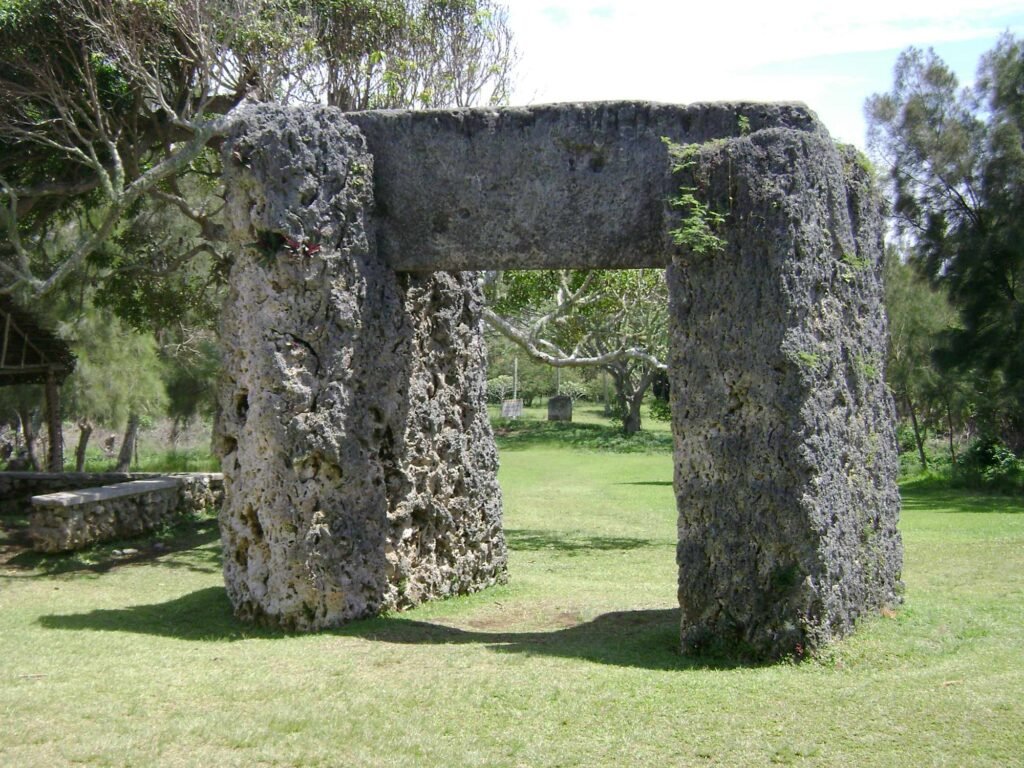
Tonga’s political history stretches back more than a thousand years to the Tu’i Tonga dynasty, founded around the tenth century CE, which developed into one of the most influential maritime polities in the Pacific, with authority and tribute links extending to parts of Fiji, Samoa, and Niue at its height. The Ha’amonga ‘a Maui, a massive coral limestone trilithon on Tongatapu believed to have been built in the thirteenth century under a Tu’i Tonga king, survives today as one of the most significant structures from this era, thought to have served a ceremonial or calendrical purpose.
Unification and the Modern Kingdom
In the nineteenth century, the chief Taufa’ahau unified Tonga’s rival chiefdoms and, after converting to Christianity, was crowned King George Tupou I in 1845, founding the dynasty that still reigns. Tonga adopted its first constitution in 1875. From 1900, Tonga entered a treaty of friendship with Britain under which Britain controlled its foreign affairs while the Tongan monarchy retained internal self-government, an arrangement that meant Tonga was never formally colonized or annexed. Tonga became fully independent within the Commonwealth in 1970.
Government and Economy
Tonga is a constitutional monarchy, the only one remaining among the Pacific Island states, under the dynasty founded by King George Tupou I. A series of democratic reforms since 2010 expanded the role of popularly elected representatives in the Legislative Assembly, moving the kingdom toward a more representative form of government while preserving the monarchy’s constitutional role. Tonga’s economy is small and relies heavily on agriculture, including squash exports, fishing, tourism, and substantial remittances sent home by Tongans living abroad, particularly in New Zealand, Australia, and the United States. As a Pacific Island state, Tonga works closely with the World Bank and other development partners on infrastructure, climate resilience, and disaster recovery programs following events such as the 2022 volcanic eruption and tsunami.
Culture and People
Tongans are Polynesian, and Tongan, closely related to other Polynesian languages such as Samoan and Hawaiian, is spoken alongside English. Christianity, introduced by missionaries in the nineteenth century, is central to Tongan life, and Sunday is observed as a day of rest enshrined in the constitution, with most commercial activity pausing. Traditional social structure, including respect for chiefly rank and the practice of exchanging fine woven mats and tapa cloth at major life events, remains an important part of Tongan identity alongside a large and influential diaspora community overseas.
What Is Tonga Known For?
Tonga’s best-known ancient landmark is the Ha’amonga ‘a Maui, a trilithon of massive coral limestone slabs on Tongatapu, often described as the Stonehenge of the Pacific, which remains the most significant surviving monument from the era of the Tu’i Tonga empire. The kingdom is also known for being the last Polynesian monarchy, for its humpback whale migration season, when whales travel to Tongan waters to breed and calve, and, more recently, for the 2022 Hunga Tonga-Hunga Ha’apai eruption, one of the largest volcanic events recorded in modern history.
Why Tonga Matters
Tonga’s unbroken monarchy and its status as the only Pacific Island nation never formally colonized give it a distinct place in the history of Pacific decolonization, most of which followed formal periods of Western colonial rule. The legacy of the Tu’i Tonga empire, including monuments such as the Ha’amonga ‘a Maui, documents one of the most far-reaching political systems to have developed in Pacific history before European contact. More recently, the scale of the 2022 volcanic eruption has made Tonga a focal point for international research into the atmospheric and climatic effects of large volcanic events.
Key Takeaways
- Tonga comprises more than 170 islands grouped into the Tongatapu, Ha’apai, and Vava’u island groups in the South Pacific.
- The Tu’i Tonga dynasty, founded around the tenth century CE, built one of the Pacific’s most influential precolonial maritime polities.
- Tonga was never formally colonized; it entered a protective treaty with Britain in 1900 and became fully independent in 1970.
- It is the only remaining monarchy among the Pacific Island nations, under the dynasty founded by King George Tupou I in 1845.
- The Ha’amonga ‘a Maui trilithon on Tongatapu, built around the thirteenth century, is Tonga’s most significant ancient monument.
- The January 2022 Hunga Tonga-Hunga Ha’apai eruption was one of the most powerful volcanic events recorded in the modern era.
Sources
- World Bank, Pacific Island Countries regional overview (2026) [1]: worldbank.org/en/region/eap/pacific-islands
- World Bank Open Data, Tonga population indicator (SP.POP.TOTL) [2]: data.worldbank.org
Key facts
- Population: approximately 104,000 (2025)2
- More than 170 islands grouped into Tongatapu, Ha'apai, and Vava'u
- Never formally colonized; entered a protective treaty with Britain in 1900, fully independent since 1970
- The only remaining Pacific Island monarchy, founded by King George Tupou I in 1845
- Site of the January 2022 Hunga Tonga-Hunga Ha'apai eruption, among the most powerful volcanic events of modern times
Quick checkWhat distinguishes Tonga from every other Pacific Island nation in terms of its colonial history and government?Show answer
It was never formally colonized and remains the only monarchy among the Pacific Island states.
Sources
- World Bank. Pacific Island Countries. 2026 (accessed Date accessed: 2026-10-04)
- World Bank Open Data. Tonga population, total. 2025 (accessed Date accessed: 2026-10-04)
Editorially reviewed by Specialty Digest Editorial TeamLast reviewed October 4, 2026Researched and drafted with AI assistanceReport an issue