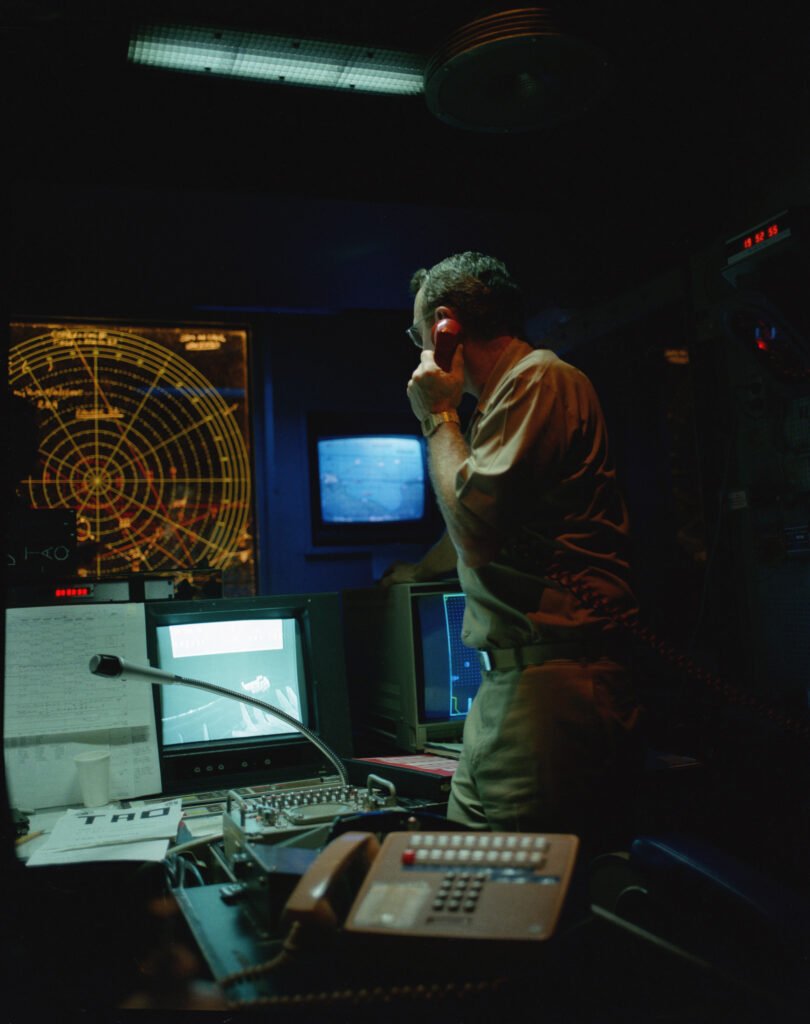
Overview
Command and control describes both the authority a military commander holds over assigned forces and the practical systems, procedures, and personnel used to exercise that authority. It covers how orders are issued, how information flows up and down a chain of command, and how decisions are made under the pressure and uncertainty of military operations.
Core elements
Effective command and control depends on a clear chain of command, reliable communications, and timely intelligence. Commanders must be able to receive accurate information about the situation, decide on a course of action, and transmit orders to subordinate units quickly enough that those orders remain relevant by the time they are executed.
Technology and systems
Modern command and control increasingly depends on sophisticated communications and information technology, including secure radio networks, satellite links, and computerized decision support systems. These systems are often grouped under extended labels such as C4ISR, reflecting the integration of command, control, communications, computers, intelligence, surveillance, and reconnaissance into a single operational concept.
Vulnerabilities and disruption
Because effective command and control is so central to military effectiveness, disrupting an adversarys ability to command and coordinate forces is a recurring objective in warfare. This can involve jamming communications, striking headquarters, or using cyber operations to degrade information systems, all aimed at creating confusion and slowing the pace at which an opposing force can respond to changing circumstances.
Centralized and decentralized approaches
Military organizations differ in how much authority they push down to lower levels of command. Centralized command and control concentrates decision making authority at higher headquarters, which can improve coordination across a large force but risks slowing decisions when communication with front line units is delayed or disrupted. Decentralized approaches, sometimes described through the German term Auftragstaktik or mission command, grant subordinate commanders greater latitude to make decisions based on their understanding of the commanders overall intent, trading some central coordination for speed and adaptability.
Information and decision cycles
Analysts often describe effective command and control through decision cycle models, such as the observe, orient, decide, act framework, which emphasizes that a force capable of moving through this cycle faster than its opponent can seize and maintain the initiative. Delays at any stage of this cycle, whether from poor sensors, slow analysis, or indecisive leadership, can allow a less capable but faster moving opponent to gain an advantage.
Vulnerability to disruption
Because modern command and control relies heavily on electronic communications and computer networks, it has become a prime target for electronic warfare and cyber operations. Jamming radio frequencies, spoofing satellite navigation signals, or infiltrating military computer networks can degrade a forces ability to coordinate even when its personnel and equipment remain largely intact, making the protection of command and control systems a growing priority in modern military planning.
Joint and coalition command
Command and control becomes considerably more complex when multiple military branches or multiple national militaries must operate together under a single overall structure. Joint commands, which integrate land, air, sea, and sometimes space and cyber forces under unified leadership, and coalition commands, which bring together forces from multiple allied nations, each require carefully negotiated command arrangements to clarify who has authority over which forces and how disputes between commanders from different services or nations will be resolved.
Historical evolution
Command and control arrangements have evolved considerably with changes in communication technology, from reliance on messengers and visual signals in earlier eras of warfare to todays near instantaneous digital communication across global distances. Each major advance in communication technology has reshaped how much authority can realistically be centralized at higher headquarters versus how much must be delegated to commanders closer to the actual fighting.
Redundancy and resilience
Given the vulnerability of command and control systems to disruption, militaries increasingly build deliberate redundancy into their communications architecture, maintaining multiple independent channels, including satellite, radio, and even older analog backup systems, so that the loss of any single communication method does not completely sever a commanders ability to direct forces during a crisis.
Human factors
Despite heavy investment in technology, command and control ultimately depends on human judgment under conditions of stress, fatigue, and incomplete information. Military training places significant emphasis on decision making under pressure, since even the most sophisticated communications and sensor systems cannot substitute for a commanders ability to interpret ambiguous information correctly and make timely decisions when the full picture of a rapidly evolving situation is never completely available.
Continuing evolution
As artificial intelligence and automated decision support tools become more capable, military organizations are beginning to explore how much of the command and control process can be assisted or even partially automated, while still preserving meaningful human judgment and accountability over decisions involving the use of lethal force.
Training for degraded conditions
Recognizing that communications may be disrupted during actual combat, many militaries specifically train commanders and units to continue operating effectively even when normal command and control links are degraded or entirely severed, emphasizing commanders intent and pre established contingency plans so that subordinate units can continue to act purposefully without constant direction from higher headquarters.
Closing note
These basic requirements for timely, accurate information and clear lines of authority are expected to persist even as the technology supporting them continues to change.
Commanders at every level continue to be evaluated heavily on their ability to manage this flow of information effectively under pressure.
It remains one of the most heavily studied and continuously refined aspects of modern military organization.
Its basic logic has outlasted many generations of communications technology.
Key facts
- Array
Quick checkWhat does the abbreviation C2 refer to in military contexts?Show answer
C2 stands for command and control, referring to the authority a commander exercises over forces and the systems and procedures used to direct and coordinate military operations.
Sources
- Array
Editorially reviewed by Specialty Digest Editorial TeamLast reviewed November 4, 2026Researched and drafted with AI assistanceReport an issue