Iraq is a country in the Middle East, positioned where the Tigris and Euphrates rivers run down toward the Persian Gulf. It borders Turkey to the north, Iran to the east, Kuwait and Saudi Arabia to the south, and Jordan and Syria to the west, with a short coastline on the Persian Gulf in the southeast. Its capital, Baghdad, sits on the Tigris near the country’s center. Iraq occupies most of the historic region known as Mesopotamia, the land between the two rivers where some of the world’s earliest cities, writing systems, and law codes developed. Today it is a federal parliamentary republic with a population of roughly 47 million people (2025, World Bank).
Key Takeaways
- Iraq lies between the Tigris and Euphrates rivers in the historic region of Mesopotamia, often described as the cradle of civilization.
- Its population is about 47 million (2025, World Bank), with Arabic and Kurdish as official languages.
- Oil dominates the economy: it accounted for an estimated 53 percent of real GDP and 91 percent of merchandise exports in 2025 (World Bank).
- Iraq holds six UNESCO World Heritage Sites, including Babylon, Hatra, and the Ashur archaeological site.
- Modern Iraq’s history spans Ottoman and British rule, the 1958 revolution, the Saddam Hussein era, the 2003 US-led invasion, and the later conflict with ISIS.
- Iraq is a federal parliamentary republic, and the Kurdistan Region in the north holds significant constitutional autonomy.
Where Is Iraq? Geography and Natural Features
Iraq covers about 438,300 square kilometers (169,200 square miles), roughly the size of California, though with only about 58 kilometers of coastline on the Persian Gulf near the port city of Basra. The country’s defining feature is the pair of rivers that give Mesopotamia its name: the Tigris and Euphrates rise in the mountains of Turkey and flow southeast across Iraq, eventually joining near Basra to form the Shatt al-Arab before reaching the Gulf. Between them lies a broad alluvial plain that has supported irrigated agriculture for thousands of years.
Iraq’s terrain changes considerably from north to south. The northeast, home to the Kurdistan Region, rises into foothills and mountains along the border with Turkey and Iran. Western and southern Iraq are largely desert, part of the wider Syrian and Arabian desert belt. In the far south, the Tigris and Euphrates feed the Mesopotamian Marshes, a rare wetland ecosystem in an otherwise arid country and part of a UNESCO World Heritage Site recognized for both its biodiversity and archaeological significance. Summers are long, hot, and dry across most of the country, winters are comparatively mild, and water flow from the two rivers, both of which cross neighboring countries upstream, remains a central concern for Iraqi agriculture.
A Brief History of Iraq
Ancient Mesopotamia: A Cradle of Civilization
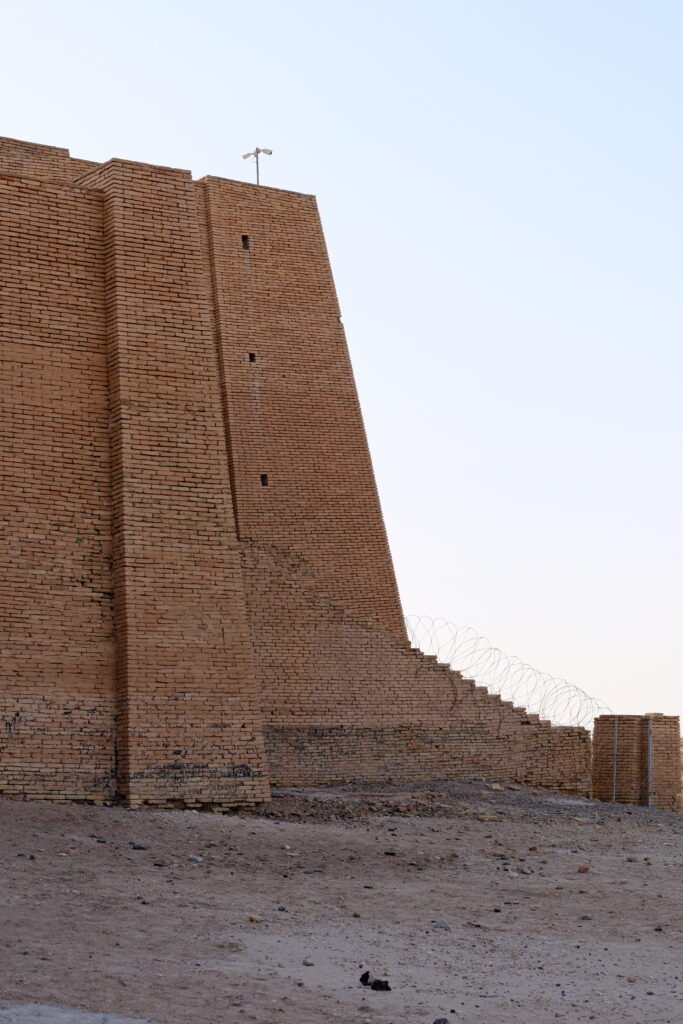
The land that is now Iraq was home to some of the earliest complex societies in human history. Sumerian city-states such as Ur and Uruk, in the south of the country, developed cuneiform writing, codified law, and organized urban life beginning in the fourth millennium BCE. The Great Ziggurat of Ur, a massive stepped temple platform built around 2100 BCE under King Ur-Nammu, still stands near Nasiriyah and remains one of the best-preserved monuments of this era. Later Mesopotamian powers, including the Akkadian Empire, Babylon under rulers such as Hammurabi and Nebuchadnezzar II, and the Assyrian Empire centered at Nineveh and Nimrud, extended this civilization’s reach across the wider region for roughly three thousand years.
Islamic Empires and Ottoman Rule
Following the Arab Muslim conquests of the seventh century, Baghdad was founded in 762 CE and became the capital of the Abbasid Caliphate, growing into one of the largest and most scholarly cities in the medieval world. For a period in the ninth century, the caliphate’s capital shifted to Samarra, where the Great Mosque of Samarra and its distinctive spiral Malwiya Minaret were completed around 852 CE. The Mongol sack of Baghdad in 1258 ended Abbasid rule, and the region later passed through several dynasties before becoming a set of provinces within the Ottoman Empire from the sixteenth century until the First World War.
The Modern Iraqi State
After the Ottoman collapse, Britain administered Iraq under a League of Nations mandate, and the Kingdom of Iraq gained formal independence in 1932. A 1958 coup ended the monarchy and established a republic, and the Ba’ath Party took power a decade later, with Saddam Hussein becoming president in 1979. His government fought a prolonged war with Iran from 1980 to 1988, then invaded and briefly annexed Kuwait in 1990, prompting the 1991 Gulf War and more than a decade of United Nations sanctions. In 2003, a United States-led coalition invaded Iraq and removed Saddam Hussein’s government, a decision whose legality and justification remain disputed among governments, legal scholars, and historians. The years that followed brought a prolonged insurgency and sectarian conflict, and in 2014 the group known as ISIS seized large areas of northern and western Iraq, including the city of Mosul. An Iraqi-led campaign, backed by an international coalition, regained this territory by 2017. Since then, Iraq has continued to operate as a federal state in which the Kurdistan Region, in the north, exercises substantial autonomy; a 2017 Kurdish independence referendum was not recognized internationally, and the question of the region’s future status remains a live and unresolved issue in Iraqi politics.
Government and Economy
Iraq is a federal parliamentary republic under a constitution adopted in 2005. A directly elected Council of Representatives forms the legislature, a prime minister leads the government as head of the executive, and a president serves as head of state in a largely ceremonial capacity. The Kurdistan Region maintains its own regional government and security forces within this federal structure, a degree of autonomy unique among Iraq’s provinces.
The economy is heavily dependent on oil, which the World Bank estimates accounted for about 53 percent of real GDP, 88 percent of government revenue, and 91 percent of merchandise exports in 2025, leaving Iraq’s public finances highly sensitive to swings in global oil prices and production levels. The World Bank classifies Iraq as upper-middle-income, with a GDP of roughly 254 billion US dollars in 2025. Youth unemployment is a persistent challenge: Iraqis aged 15 to 29 make up nearly 29 percent of the population, and the World Bank reports overall unemployment near 13.5 percent alongside a labor force participation rate of only about 38 percent, reflecting a private sector that has struggled to absorb new workers and a strong preference for public-sector jobs. Since 2004, the World Bank has supported Iraqi efforts to rebuild infrastructure, restore basic services, and strengthen public institutions, though the country also faces real exposure to water scarcity and other climate-related risks.
Culture and People of Iraq
Iraq’s population, estimated at about 47 million in 2025, is predominantly Arab, with a Kurdish minority generally estimated at 15 to 20 percent, concentrated mainly in the north. Smaller communities include Turkmen and Assyrians. Arabic and Kurdish are both official languages. Islam is the majority religion, encompassing both Shia and Sunni communities, and Iraq has long been home to historic Christian and Yazidi populations, though both have shrunk substantially due to displacement and violence in recent decades, including the 2014 killing, enslavement, and forced displacement of Yazidis by ISIS, which the United Nations and multiple governments have characterized as genocide.
Culturally, Iraq’s Abbasid-era capital left a lasting imprint on Arabic and Islamic scholarship, poetry, and storytelling, including the tales collected in One Thousand and One Nights, many of which are set in Baghdad’s court. Traditional Iraqi maqam, a highly structured form of vocal and instrumental music, remains an important part of the country’s artistic heritage, alongside a long-standing tradition of poetry that continues to hold a prominent place in Iraqi public life.
What Is Iraq Best Known For?
Globally, Iraq is best known first for its ancient past: it is the heartland of Mesopotamia, where writing, codified law, and some of the earliest cities on record took shape, and where sites like Babylon, Ur, and Nineveh are still studied in classrooms worldwide. It is also widely known, especially to more recent generations, for the modern conflicts centered on the country: the Iran-Iraq War, the 1991 Gulf War, the 2003 invasion and its aftermath, and the rise and eventual territorial defeat of ISIS. Both identities, ancient and contemporary, shape how Iraq tends to be perceived internationally.
Why Iraq Matters
Iraq’s significance rests on more than history alone. As a major oil producer and OPEC member, its production decisions and political stability directly affect global energy markets. Its location at the junction of the Arab world, Iran, and Turkey gives it an outsized role in regional security and diplomacy, and the unresolved status of Kurdish autonomy within a federal Iraqi state continues to be watched closely by neighboring governments. At the same time, Iraq’s dense concentration of archaeological heritage, from the ziggurats of Sumer to the mosques of the Abbasid caliphate, makes it a focal point for studying how urban civilization, writing, and law first developed, a legacy that still informs fields from archaeology to legal history well beyond the country’s borders.
Sources
- World Bank, “Iraq Overview,” worldbank.org/en/country/iraq/overview (accessed 2026)
- World Bank Open Data, population and GDP indicators for Iraq, api.worldbank.org (accessed 2026)
- UNESCO World Heritage Centre, “Iraq,” whc.unesco.org/en/statesparties/iq (accessed 2026)
Key facts
- Capital: Baghdad
- Population: about 47 million (2025, World Bank)
- Official languages: Arabic, Kurdish
- Government: Federal parliamentary republic
- Area: about 438,300 sq km (169,200 sq mi)
- GDP: about 254 billion US dollars (2025, World Bank)
- UNESCO World Heritage Sites: 6 (Hatra, Ashur, Samarra Archaeological City, Erbil Citadel, Ahwar of Southern Iraq, Babylon)
Quick checkWhat historic region, known as the cradle of civilization, makes up most of modern Iraq?Show answer
Mesopotamia, the land between the Tigris and Euphrates rivers, where the Sumerians, Akkadians, Babylonians, and Assyrians built some of the world's earliest cities and legal codes.
Sources
- World Bank, "Iraq Overview," worldbank.org/en/country/iraq/overview
- World Bank Open Data, population and GDP indicators for Iraq (api.worldbank.org)
- UNESCO World Heritage Centre, "Iraq," whc.unesco.org/en/statesparties/iq
Editorially reviewed by Specialty Digest Editorial TeamLast reviewed September 27, 2026Researched and drafted with AI assistanceReport an issue