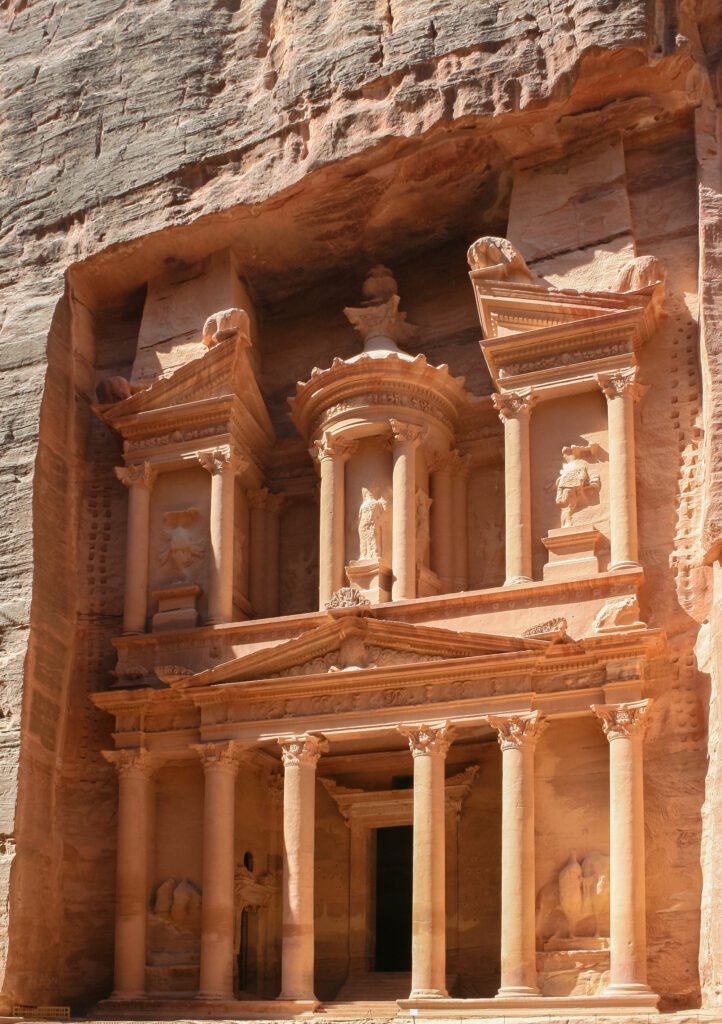
Jordan is a country in the Middle East best known for Petra, the ancient city carved into rose-colored sandstone cliffs, and for its role as one of the region’s most stable states despite scarce water, few natural resources and a large refugee population.
Where Is Jordan Located?
Jordan lies in Western Asia, bordered by Syria to the north, Iraq to the northeast, Saudi Arabia to the east and south, and Israel and the West Bank to the west, with a short coastline on the Red Sea at the Gulf of Aqaba. Much of the country is arid or semi-arid desert, including the eastern badia region, while the Jordan Rift Valley along its western border contains the Jordan River and the Dead Sea. Amman, in the northwest, is the capital and largest city.
A Brief History
The area has been continuously inhabited for thousands of years and was home to the Nabataeans, an Arab trading people who carved the city of Petra into the surrounding sandstone as their capital beginning around the fourth century BCE, using it as a hub on incense and spice trade routes before it declined under Roman and later rule and was largely forgotten outside the region until the nineteenth century. The modern state emerged from the British Mandate for Transjordan after the First World War and became the independent Kingdom of Jordan in 1946, ruled by the Hashemite dynasty, which traces its lineage to the Prophet Muhammad, since its founding.
Government and Economy Today
Jordan is a constitutional monarchy with an elected parliament. According to the World Bank, Jordan hosts an estimated 475,000 registered refugees, equivalent to roughly four percent of its population, reflecting decades of displacement from conflicts in neighboring countries, alongside rapid population growth that has placed pressure on jobs, housing and public services. The World Bank classifies Jordan as an upper-middle-income economy; growth was estimated at 2.8 percent in 2025, supported by agriculture, manufacturing and services, while unemployment remained elevated at 21.4 percent in the third quarter of 2025. The country ranks among the most water-scarce in the world.
Culture and People
Jordan’s population was approximately 11.5 million in 2025, according to the World Bank. Arabic is the official language, and the population is predominantly Muslim with a Christian minority. Jordanian culture reflects Bedouin and broader Arab traditions alongside a long history as a crossroads of trade and, more recently, a base for archaeological research into the ancient civilizations of the region.
What Is Jordan Known For?
Jordan is best known internationally for Petra, the Nabataean city whose facades, including the elaborately carved Treasury, are cut directly into sandstone cliffs; the site was named a UNESCO World Heritage Site in 1985. Jordan is also known for Wadi Rum’s desert landscape and for its role as a relatively stable, moderate state in a volatile region.
Key Takeaways
- Jordan lies in Western Asia between Syria, Iraq, Saudi Arabia, Israel and the West Bank, with Amman as its capital.
- It became the independent Kingdom of Jordan in 1946 under the Hashemite dynasty after the British Mandate period.
- Jordan is a constitutional monarchy and an upper-middle-income economy that hosts a very large refugee population relative to its size.
- The country is among the most water-scarce in the world.
- Petra, the Nabataean city carved into sandstone and a UNESCO World Heritage Site since 1985, is Jordan’s most iconic landmark.
Key facts
Quick checkWhat is Jordan's most famous archaeological site?Show answer
Petra, an ancient Nabataean city carved into sandstone cliffs beginning around the fourth century BCE, designated a UNESCO World Heritage Site in 1985.
Sources
- World Bank. Jordan, Population total. 2025 (accessed Accessed 2026)
- World Bank. Jordan Overview. Accessed 2026 (accessed 2026)
Editorially reviewed by Specialty Digest Editorial TeamLast reviewed September 27, 2026Researched and drafted with AI assistanceReport an issue