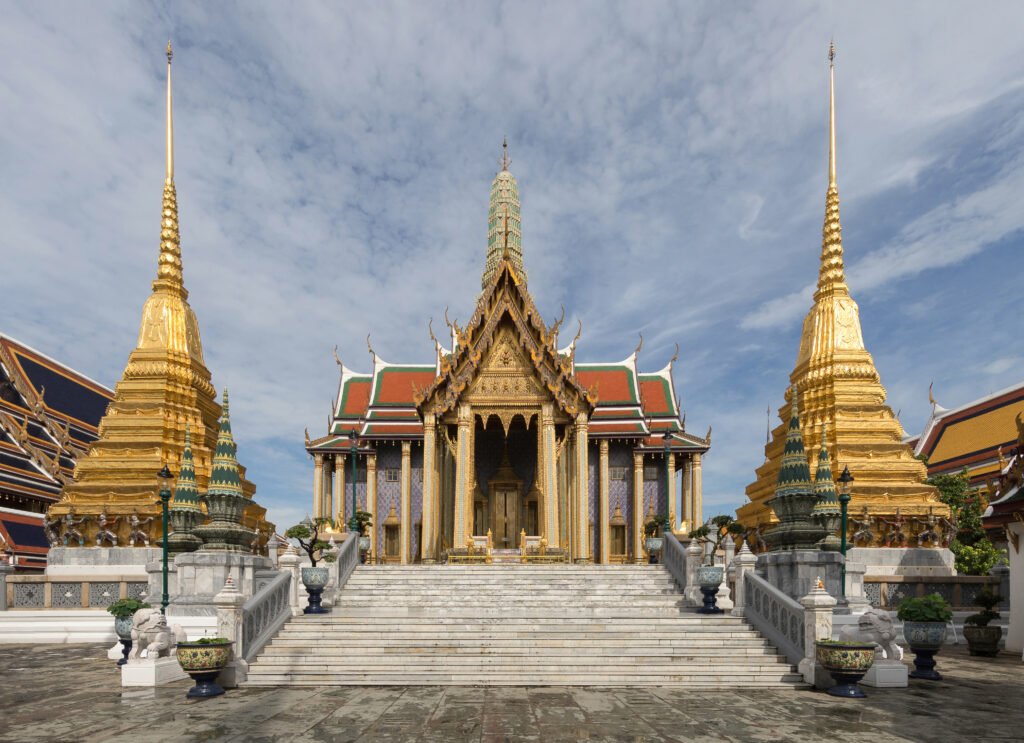
Thailand is a Southeast Asian kingdom on the Indochinese and Malay peninsulas, the only country in the region never colonized by a European power. Over the past three decades it has transformed from an agriculture-based economy into a diversified upper-middle-income economy integrated into global supply chains.
Where Is Thailand Located?
Thailand sits at the center of mainland Southeast Asia, bordered by Myanmar to the west and northwest, Laos to the north and northeast, Cambodia to the east, and Malaysia to the south, with coastlines on the Gulf of Thailand and the Andaman Sea. Bangkok, the capital, lies near the mouth of the Chao Phraya River in the country’s central plain and has grown from a city of about 5 million people in 1991 to a megacity of nearly 18 million today.
Geography
Thailand’s landscape includes the fertile central plain drained by the Chao Phraya River, a historic rice-growing heartland; the Khorat Plateau in the northeast, bordering the Mekong River and Laos; mountainous terrain in the north near the borders with Myanmar and Laos; and a long, narrow southern peninsula extending toward Malaysia, flanked by the Gulf of Thailand and the Andaman Sea and home to many of the country’s best-known beaches and islands.
A Brief History of Thailand
Early Kingdoms and the Ayutthaya Era
The Sukhothai Kingdom, often considered the first unified Thai state, emerged in the thirteenth century, followed by the Ayutthaya Kingdom, founded in 1350, which grew into a major regional power and international trading center over four centuries until Burmese forces destroyed the city in 1767.
The Chakri Dynasty and the Only Uncolonized Southeast Asian State
After Ayutthaya’s fall, a new capital was established at Thonburi and then, from 1782, at Bangkok under King Rama I, founder of the Chakri dynasty that still reigns today. Through a combination of diplomacy and selective modernization, the kingdom, then known as Siam, avoided colonization by Britain and France during the height of European expansion in Southeast Asia, the only country in the region to do so.
Constitutional Monarchy and Modern Thailand
A bloodless revolution in 1932 ended centuries of absolute monarchy and established a constitutional monarchy, and the country was renamed Thailand in 1939. King Bhumibol Adulyadej, Rama IX, reigned from 1946 until his death in 2016, one of the longest reigns of any monarch in modern history, and was succeeded by his son, King Maha Vajiralongkorn, Rama X.
Government and Economy
Thailand is a constitutional monarchy with a parliamentary system of government. Its economy has undergone a substantial transformation over the past three decades, according to the World Bank, evolving from an agriculture-based economy into a diversified upper-middle-income economy deeply integrated into regional and global value chains. Since 1991, Thailand has created close to 11 million formal jobs, more than doubled its GDP per capita, from about $1,765 in 1991 to roughly $8,056 in 2025, and has largely eliminated poverty measured at the lower-middle-income threshold of $4.20 a day. Sound macroeconomic management, export-oriented industrialization, and large inflows of foreign direct investment have underpinned this growth, alongside a sharp fall in the share of the workforce employed in agriculture.
Culture and People
More than 90 percent of Thais practice Theravada Buddhism, and Buddhist temples, monastic traditions, and merit-making rituals shape daily life and the national calendar. Thai, a Tai-Kadai language, is the official language, though the country is home to notable Chinese-Thai, Malay-Muslim, and various hill-tribe minority communities, particularly in the north and far south. Thai cuisine, renowned worldwide for its balance of sour, sweet, salty, and spicy flavors, and traditions such as Muay Thai boxing and classical Thai dance, reflect centuries of exchange with neighboring India, China, and the wider Southeast Asian region.
What Is Thailand Known For?
Thailand is internationally recognized for the Grand Palace and Wat Phra Kaew, the Temple of the Emerald Buddha, in Bangkok, a complex that has served as the ceremonial and spiritual heart of the Thai monarchy since 1782 and remains the country’s most iconic landmark. Thailand is equally well known as one of the world’s most visited tourist destinations, drawing travelers to its beaches and islands, its historic temple cities of Ayutthaya and Sukhothai, both UNESCO World Heritage Sites, and its distinctive cuisine and hospitality.
Why Thailand Matters
Thailand’s history as the only Southeast Asian nation to avoid European colonization gives it a distinctive political and cultural trajectory within the region, with an unbroken monarchy and a state structure shaped more by internal reform than colonial administration. Its rapid, export-led economic transformation since the early 1990s has made it a central node in regional manufacturing supply chains and a frequently cited example of middle-income economic development in Southeast Asia, while its cultural exports, from cuisine to Buddhist tourism, give it outsized global visibility relative to its size.
Key Takeaways
- Thailand is the only Southeast Asian country never colonized by a European power.
- The Chakri dynasty, founded in 1782, still reigns, with the capital at Bangkok since that year.
- A 1932 revolution ended absolute monarchy and established Thailand’s current constitutional monarchy.
- Since 1991, Thailand has created about 11 million formal jobs and more than doubled its GDP per capita to roughly $8,056 in 2025.
- More than 90 percent of Thais practice Theravada Buddhism.
- The Grand Palace and Wat Phra Kaew in Bangkok are Thailand’s most iconic landmark, home to the revered Emerald Buddha.
Sources
- World Bank, “Thailand Overview” (2026) [1]: worldbank.org/en/country/thailand/overview
- World Bank, “Building Thailand’s Future Today” flagship report (2026) [2]: worldbank.org
- UNESCO World Heritage Centre, Historic City of Ayutthaya [3]: whc.unesco.org
- UNESCO World Heritage Centre, Historic Town of Sukhothai [4]: whc.unesco.org
Key facts
- The only Southeast Asian country never colonized by a European power
- GDP per capita rose from about $1,765 in 1991 to roughly $8,056 in 202512
- Close to 11 million formal jobs created since 19912
- Bangkok grew from about 5 million people in 1991 to nearly 18 million today2
- More than 90% of the population practices Theravada Buddhism
Quick checkWhich dynasty has ruled Thailand since 1782?Show answer
The Chakri dynasty, founded by King Rama I.
Sources
- World Bank. Thailand Overview. 2026 (accessed Date accessed: 2026-10-04)
- World Bank. Building Thailand's Future Today (flagship report). 2026 (accessed Date accessed: 2026-10-04)
- UNESCO World Heritage Centre. Historic City of Ayutthaya. Undated (accessed Date accessed: 2026-10-04)
- UNESCO World Heritage Centre. Historic Town of Sukhothai. Undated (accessed Date accessed: 2026-10-04)
Editorially reviewed by Specialty Digest Editorial TeamLast reviewed October 4, 2026Researched and drafted with AI assistanceReport an issue