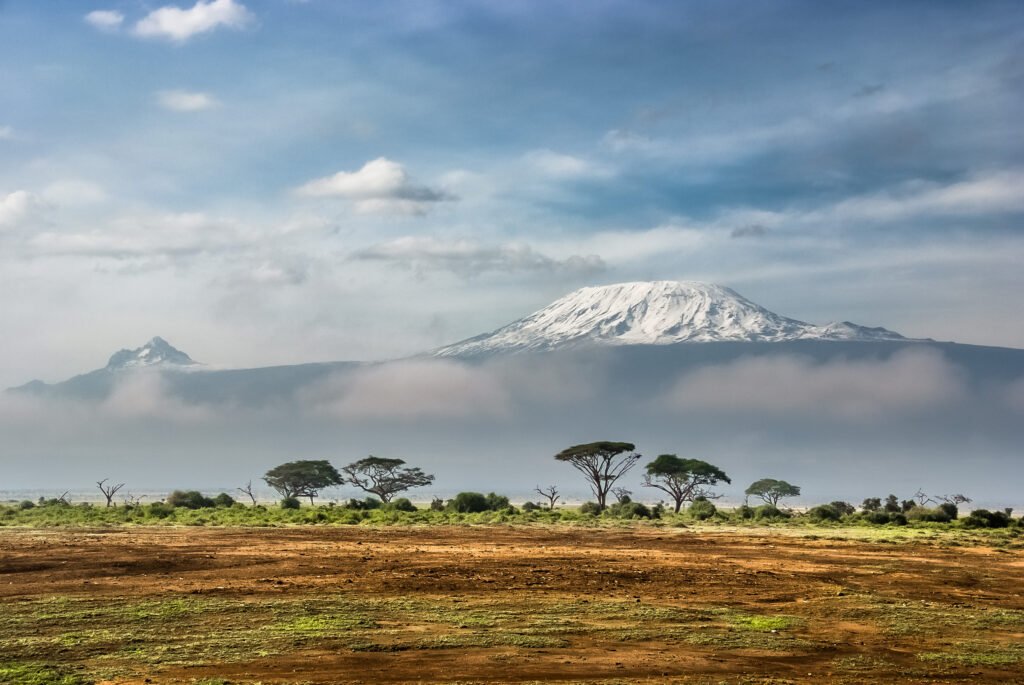
Tanzania is an East African country on the Indian Ocean coast, formed in 1964 from the union of mainland Tanganyika and the Zanzibar archipelago. It is home to Africa’s highest peak, Mount Kilimanjaro, and to some of the continent’s most celebrated wildlife landscapes, including the Serengeti.
Where Is Tanzania Located?
Tanzania lies on the eastern coast of Africa, bordered by Kenya and Uganda to the north, Rwanda, Burundi, and the Democratic Republic of the Congo to the west, Zambia, Malawi, and Mozambique to the south, and the Indian Ocean to the east. The Zanzibar archipelago, including the islands of Unguja and Pemba, lies off the coast and forms a semi-autonomous part of the union. Dodoma is the official capital, while Dar es Salaam, on the coast, remains the country’s largest city and commercial center.
Geography
Tanzania’s mainland geography ranges from the Indian Ocean coastal plain to a central plateau and highland areas in the north and south. Mount Kilimanjaro, a dormant volcano in the northeast, rises to 5,895 meters and is the highest point in Africa. The Great Rift Valley crosses the country, shaping dramatic landscapes including Lake Tanganyika, one of the world’s deepest and longest freshwater lakes, and Lake Victoria, Africa’s largest lake, which Tanzania shares with Kenya and Uganda. The Serengeti ecosystem in the north supports one of the largest overland animal migrations on Earth.
A Brief History of Tanzania
Precolonial and Colonial Periods
The Tanzanian coast was long linked to Indian Ocean trade networks, and Zanzibar in particular became a major center of the Swahili coast’s trade in spices, ivory, and, historically, enslaved people, under Omani Arab influence from the eighteenth century. Germany colonized the mainland as German East Africa in the late nineteenth century; after Germany’s defeat in World War I, the territory passed to British administration as Tanganyika under a League of Nations mandate and later a United Nations trust territory.
Independence and Union
Tanganyika gained independence in 1961 under Julius Nyerere, and Zanzibar became independent as a sultanate in 1963 before a revolution in January 1964 overthrew the sultan. Later in 1964, Tanganyika and Zanzibar merged to form the United Republic of Tanzania. Nyerere, as the country’s first president, pursued a socialist development program known as Ujamaa, emphasizing collective agriculture and self-reliance, before Tanzania shifted toward market-oriented reforms from the mid-1990s.
Government and Economy
Tanzania is a presidential republic in which Zanzibar retains its own president and legislature for internal affairs within the union. Economically, the World Bank classifies Tanzania as a lower-middle-income country, a status it reached in 2020, with a population of roughly 70.5 million in 2025 and a GDP per capita of about $1,400. Economic liberalization from the mid-1990s brought structural transformation and expanded public services, building on Tanzania’s geo-strategic location, fertile agricultural land, and significant mineral deposits. More recently, the government has launched Vision 2050, a long-term development strategy succeeding the earlier Vision 2025, aimed at guiding the country toward upper-middle-income status through more inclusive and resilient growth.
Culture and People
Tanzania is one of Africa’s most linguistically diverse countries, with more than 120 ethnic groups, yet it is unified by Swahili (Kiswahili), the national and widely spoken language, alongside English, used in government and higher education. Zanzibar’s culture reflects centuries of exchange between Africa, the Arabian Peninsula, and South Asia, visible in the architecture of Stone Town, its cuisine, and its Islamic traditions, while the mainland’s cultural life draws on its many Bantu-speaking ethnic groups alongside smaller Nilotic and Cushitic-speaking communities such as the Maasai and Iraqw.
What Is Tanzania Known For?
Tanzania is best known internationally for Mount Kilimanjaro, Africa’s highest mountain and one of the most climbed peaks in the world because its summit can be reached without technical climbing equipment. It is equally renowned for the Serengeti National Park and the annual wildebeest migration, for the white sand beaches and historic Stone Town of Zanzibar, a UNESCO World Heritage Site, and for Ngorongoro Crater, a vast volcanic caldera that supports one of Africa’s densest concentrations of wildlife.
Why Tanzania Matters
Tanzania’s combination of Africa’s highest peak, some of the continent’s richest wildlife ecosystems, and a historically significant Indian Ocean trading culture gives it a distinctive place in both African history and global conservation efforts. Its political history as a stable union of two formerly separate territories, sustained since 1964 despite the diversity of mainland and island political life, offers a notable example of state-building in postcolonial Africa, while its recent graduation to lower-middle-income status marks a significant milestone in its long-term development path.
Key Takeaways
- Tanzania was formed in 1964 from the union of mainland Tanganyika and the Zanzibar archipelago.
- Mount Kilimanjaro, at 5,895 meters, is Africa’s highest peak and one of the most climbed mountains in the world.
- The population reached approximately 70.5 million in 2025, and Tanzania attained lower-middle-income status in 2020.
- Swahili and English are the official languages, uniting more than 120 ethnic groups.
- Zanzibar’s Stone Town is a UNESCO World Heritage Site reflecting centuries of Indian Ocean trade.
- The government’s Vision 2050 strategy aims to guide Tanzania toward upper-middle-income status.
Sources
- World Bank, “Tanzania Overview” (2026) [1]: worldbank.org/en/country/tanzania/overview
- World Bank, “In Tanzania, Clean Water Improves Lives and Health Outcomes” (June 2026) [2]: worldbank.org
- World Bank Data360, Tanzania Economy Data [3]: data360.worldbank.org
- UNESCO World Heritage Centre, Stone Town of Zanzibar [4]: whc.unesco.org
Key facts
- Population: approximately 70.5 million (2025)13
- Formed in 1964 from the union of Tanganyika and Zanzibar
- Mount Kilimanjaro, 5,895 meters, is the highest point in Africa
- Reached lower-middle-income status in 2020, with 2025 GDP per capita of about $1,4001
- Stone Town of Zanzibar is a UNESCO World Heritage Site4
Quick checkIn what year did Tanganyika and Zanzibar unite to form Tanzania?Show answer
1964.
Sources
- World Bank. Tanzania Overview. 2026 (accessed Date accessed: 2026-10-04)
- World Bank. In Tanzania, Clean Water Improves Lives and Health Outcomes. 2026-06-08 (accessed Date accessed: 2026-10-04)
- World Bank Data360. Tanzania Economy Data. 2026 (accessed Date accessed: 2026-10-04)
- UNESCO World Heritage Centre. Stone Town of Zanzibar. Undated (accessed Date accessed: 2026-10-04)
Editorially reviewed by Specialty Digest Editorial TeamLast reviewed October 4, 2026Researched and drafted with AI assistanceReport an issue