Myanmar, also known as Burma, is a country in Southeast Asia bordered by India and Bangladesh to the west, China to the north and east, and Laos and Thailand to the east, with a long coastline on the Bay of Bengal and Andaman Sea to the south. With a population of roughly 54.9 million people, according to the World Bank, it is the largest country by land area on the Southeast Asian mainland, though decades of conflict and, more recently, political upheaval have repeatedly disrupted its development.
Where Is Myanmar Located?
Myanmar occupies the western edge of mainland Southeast Asia, spanning about 676,590 square kilometers, according to World Bank data. Its geography is dominated by the valley of the Irrawaddy River, which flows south through the country’s agricultural heartland toward a broad delta on the Andaman Sea, flanked by mountain ranges along its borders with India, China, and Thailand. The capital is Naypyidaw, a purpose built administrative city in the country’s interior, while Yangon, the former capital, remains its largest city and commercial center.
A Brief History of Myanmar
The region’s history includes powerful early kingdoms such as Bagan, which flourished from the ninth to thirteenth centuries and left thousands of Buddhist temples across the central plains, followed by successive Burmese dynasties and a series of Anglo-Burmese wars in the nineteenth century that led to full British colonial annexation by 1885. Myanmar gained independence from Britain in 1948. Much of its post-independence history has been dominated by military rule, punctuated by a democratic opening beginning in 2011 that led to competitive elections in 2015, before a military coup in February 2021 removed the elected civilian government and plunged the country back into conflict and instability, according to the World Bank, which describes an economy that has suffered significant reversals from multiple and overlapping crises since that period.
Government and Economy
Myanmar has been governed by a military administration since the February 2021 coup. The World Bank classifies Myanmar as a lower middle income economy and reports that the country’s outlook remains subdued, with growth projected at around 2 percent in the 2026 to 2027 fiscal year, following a period from 2011 to 2019 in which the economy had grown at an average of about 6 percent a year amid economic reforms and the lifting of international sanctions. Agriculture, natural gas exports, and garment manufacturing remain significant parts of the economy, though instability has constrained investment.
Culture and People
Burmese is the official language, and the country is home to well over a hundred recognized ethnic groups, including significant Shan, Karen, Rakhine, and other minority populations concentrated in the country’s border regions. Theravada Buddhism is practiced by the large majority of the population and shapes daily life to an unusually visible degree, with monasteries, pagodas, and the practice of temporary monkhood woven into Burmese social tradition from an early age.
What Is Myanmar Known For?
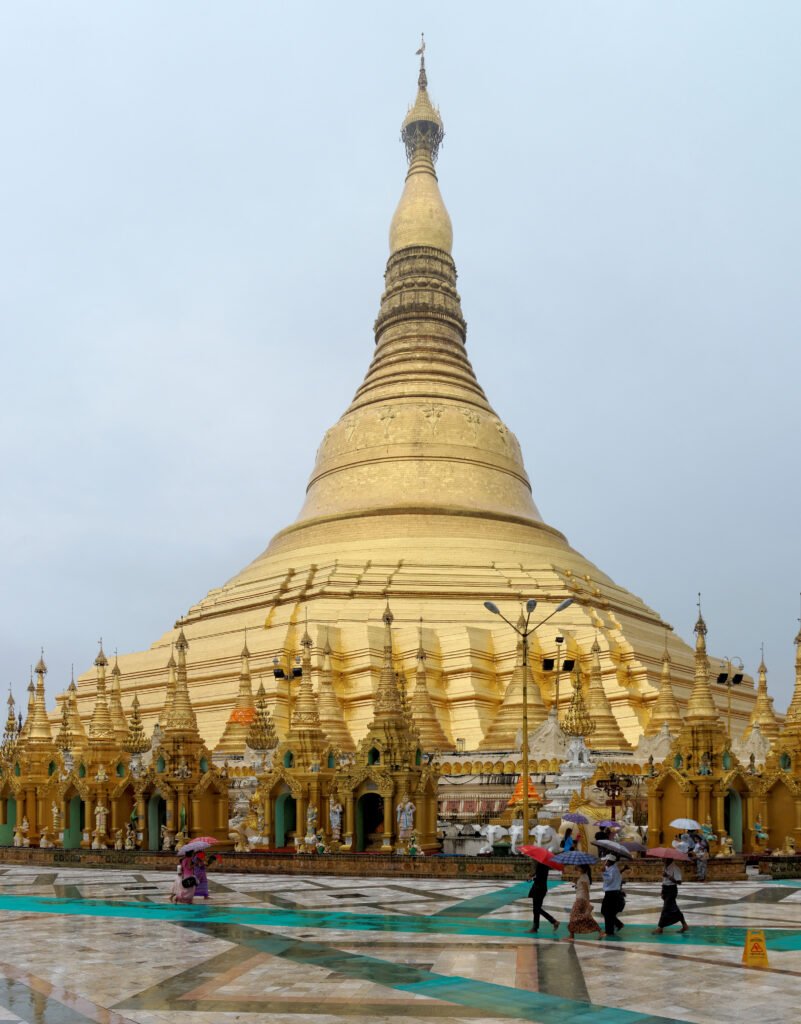
Myanmar’s single most recognizable landmark is the Shwedagon Pagoda in Yangon, a gilded Buddhist stupa that, according to tradition, has stood on Singuttara Hill for more than two thousand years, though most historians date the structure in its current form to a later period of repeated rebuilding and expansion. Rising nearly 100 meters and covered in gold leaf donated by worshippers, with its crown set with thousands of diamonds and other gems, Shwedagon is regarded as the most sacred Buddhist site in Myanmar and functions as the country’s defining religious and visual symbol, drawing pilgrims and visitors from across the Buddhist world.
Why Myanmar Matters
Myanmar’s position between India and China, its role as one of the last strongholds of continuous Theravada Buddhist tradition in the region, and its long running internal conflicts along its ethnically diverse borderlands make it a significant case study in Southeast Asian politics and religion alike. Its recent trajectory, from a democratic opening after 2011 to renewed military rule after 2021, has also made it a closely watched example of democratic backsliding.
Key Takeaways
- Myanmar is a Southeast Asian country of about 54.9 million people, the largest by land area on the mainland Southeast Asian peninsula.
- It gained independence from Britain in 1948 after decades of colonial rule.
- A military coup in February 2021 removed the elected civilian government, and the World Bank describes an economy still working through overlapping crises since then.
- The large majority of the population practices Theravada Buddhism, which shapes daily and social life across the country.
- The Shwedagon Pagoda in Yangon, a gilded stupa regarded as Myanmar’s most sacred Buddhist site, is its single most iconic landmark.
Sources
Key facts
Quick checkWhat is Myanmar's most sacred Buddhist site?Show answer
The Shwedagon Pagoda in Yangon.
Sources
- The World Bank. Myanmar Overview. Undated (accessed 2026-09-28)
- The World Bank. World Development Indicators, Myanmar. 2025 (accessed 2026-09-28)
Editorially reviewed by Specialty Digest Editorial TeamLast reviewed September 28, 2026Researched and drafted with AI assistanceReport an issue