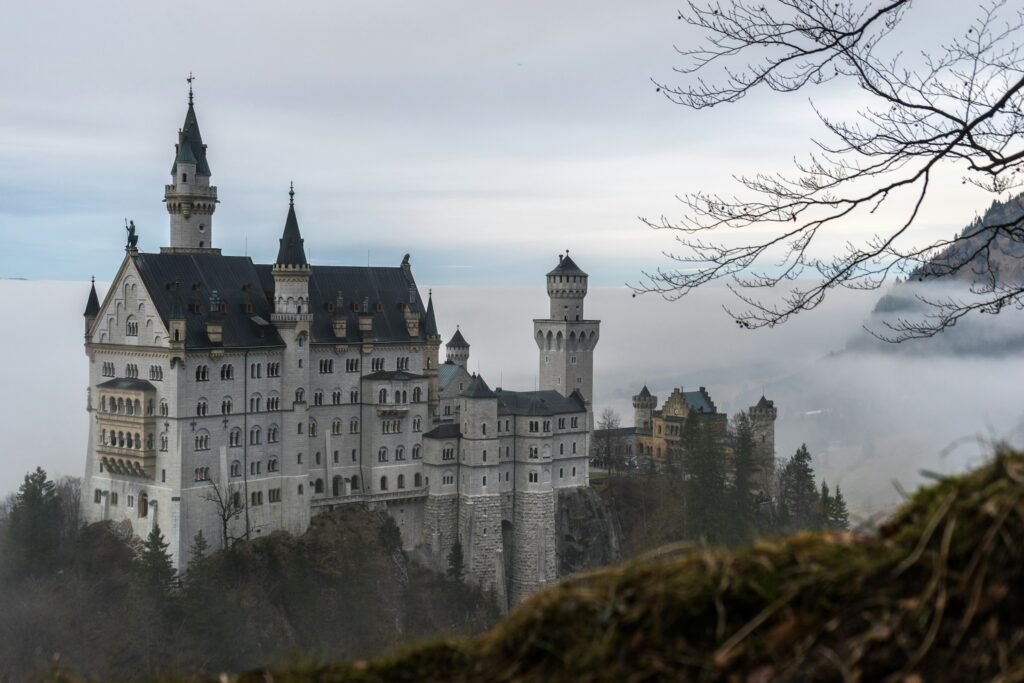
Germany is Central Europe’s most populous country and its largest economy, a federal republic whose 1990 reunification ended more than four decades of Cold War division. Its capital, Berlin, still carries the physical and symbolic marks of that division, but the country’s single most recognized image is Neuschwanstein Castle, the nineteenth century Bavarian palace whose turrets have influenced fairy-tale castle designs well beyond Germany’s borders.
Where Is Germany Located?
Germany sits in north-central Europe, bordered by nine countries, more than any other European state: Denmark to the north, Poland and the Czech Republic to the east, Austria and Switzerland to the south, and France, Luxembourg, Belgium, and the Netherlands to the west. Its coastline runs along the North Sea and the Baltic Sea, giving it maritime access alongside a position at the center of the continent’s road, rail, and river networks.
Geography of Germany
Germany’s terrain rises gradually from the flat North German Plain to the central uplands around the Rhine, Harz, and Thuringian ranges, and finally to the Bavarian Alps along the southern border with Austria, home to the country’s highest peak, the Zugspitze. The Rhine, Elbe, Danube, and Oder rivers cross the country and have shaped its settlement patterns and industry for centuries, while a temperate climate supports extensive agriculture alongside the country’s dense forests.
A Brief History of Germany
Fragmentation and Unification
For most of its history, the territory now called Germany was divided among hundreds of small kingdoms, duchies, and free cities loosely bound together first under the Holy Roman Empire and later the German Confederation. A united German nation in roughly its present form dates only to 1871, when Prussia, under Chancellor Otto von Bismarck, unified the German states into the German Empire following victory in the Franco-Prussian War.
The World Wars and Division
Germany’s defeat in the First World War led to the collapse of the empire and the establishment of the Weimar Republic, whose instability contributed to the Nazi Party’s rise to power in 1933 under Adolf Hitler. The regime’s aggression triggered the Second World War and carried out the Holocaust, the systematic murder of six million European Jews and millions of others. Germany’s defeat in 1945 left the country occupied and then divided into the democratic Federal Republic of Germany in the west and the Soviet-aligned German Democratic Republic in the east, a division made physical after 1961 by the Berlin Wall.
Reunification and Modern Germany
The Berlin Wall fell in November 1989 amid the wider collapse of Soviet-aligned governments across Eastern Europe, and Germany formally reunified on October 3, 1990, a date still marked as the country’s national holiday. Reunification brought five reconstituted eastern states, Brandenburg, Mecklenburg-Vorpommern, Saxony, Saxony-Anhalt, and Thuringia, along with a reunited Berlin, into the Federal Republic’s existing structure of states, bringing the total to sixteen.
Government and Economy
Germany is a federal parliamentary republic governed under the 1949 Basic Law, which divides power between a ceremonial president, elected for a five-year term, and a chancellor who holds executive authority and can be removed from office only through a constructive vote of no confidence, in which parliament must simultaneously elect a successor. The Bundestag is the primary legislative chamber, while the Bundesrat represents the sixteen states in federal lawmaking. The International Monetary Fund describes Germany as Europe’s largest economy, built on manufacturing, engineering, and export industries including automobiles and machinery, though the IMF has also flagged an aging population, labor shortages, and slowing growth as ongoing challenges.
Culture and People
German is the official language and one of the most widely spoken native languages in the European Union. The country has produced an outsized share of influential composers, philosophers, and writers, including Johann Sebastian Bach, Ludwig van Beethoven, Immanuel Kant, and Johann Wolfgang von Goethe, and its federal structure has left it with a dense network of regional cultural institutions rather than a single dominant capital of the arts. Germany’s Christian heritage, split historically between a largely Protestant north and a largely Catholic south and west, remains visible in the country’s architecture, including Cologne Cathedral, inscribed as a UNESCO World Heritage Site in 1996.
What Is Germany Known For?
Germany is known globally for its automotive and engineering industries, its beer and wine traditions, and its role at the center of the European Union alongside France. Neuschwanstein Castle, commissioned by King Ludwig II of Bavaria and begun in 1869 in the foothills of the Alps near Fussen, is the country’s most photographed landmark and is widely credited with influencing the look of fairy-tale castles built at theme parks elsewhere in the world.
Why Germany Matters
As the European Union’s most populous member state and largest economy, Germany’s fiscal and political decisions carry outsized weight across the bloc, from monetary policy to its approach toward Russia and European security. Its twentieth century history, from the Nazi era through division and reunification, continues to shape both its foreign policy caution and its domestic commitment to democratic institutions, making modern Germany a frequent reference point in debates over historical memory and the rebuilding of democracies after conflict.
Key Takeaways
- Germany borders nine countries, more than any other European nation, with coastlines on the North Sea and Baltic Sea.
- A unified German nation dates only to 1871, under Prussian leadership following the Franco-Prussian War.
- Nazi Germany’s regime triggered the Second World War and the Holocaust before Germany’s defeat and division in 1945.
- Germany reunified on October 3, 1990, after the fall of the Berlin Wall; the date is now its national holiday.
- Germany is a federal parliamentary republic of sixteen states under the 1949 Basic Law.
- The IMF identifies Germany as Europe’s largest economy, though it faces an aging population and slowing growth.
- Neuschwanstein Castle, begun in 1869, is Germany’s most internationally recognized landmark.
Sources
- World Bank, Germany Overview
- Encyclopaedia Britannica, Germany
- Encyclopaedia Britannica, Germany: Government and Society
- UNESCO World Heritage Centre, Cologne Cathedral
- IMF Finance and Development, Making Germany Grow Again
- Federal Statistical Office of Germany (Destatis), Current Population of Germany
Key facts
- A united German nation in its present form dates only to 1871, under Prussian leadership2
- Nazi Germany's regime triggered the Second World War and the Holocaust before its 1945 defeat2
- Germany reunified on October 3, 1990, after the fall of the Berlin Wall2
- The IMF identifies Germany as Europe's largest economy, built on manufacturing and exports5
- Cologne Cathedral was inscribed as a UNESCO World Heritage Site in 19964
Quick checkWhen did Germany formally reunify, and what event preceded it?Show answer
Germany reunified on October 3, 1990, following the fall of the Berlin Wall in November 1989.
Sources
- World Bank. Germany Overview. Undated (accessed 2026-09-23)
- Encyclopaedia Britannica. Germany. Undated (accessed 2026-09-23)
- Encyclopaedia Britannica. Germany: Government and Society. Undated (accessed 2026-09-23)
- UNESCO World Heritage Centre. Cologne Cathedral. 1996 (accessed 2026-09-23)
- IMF Finance and Development. Making Germany Grow Again. 2025-06 (accessed 2026-09-23)
- Federal Statistical Office of Germany (Destatis). Current Population of Germany. Undated (accessed 2026-09-23)
Editorially reviewed by Specialty Digest Editorial TeamLast reviewed September 23, 2026Researched and drafted with AI assistanceReport an issue