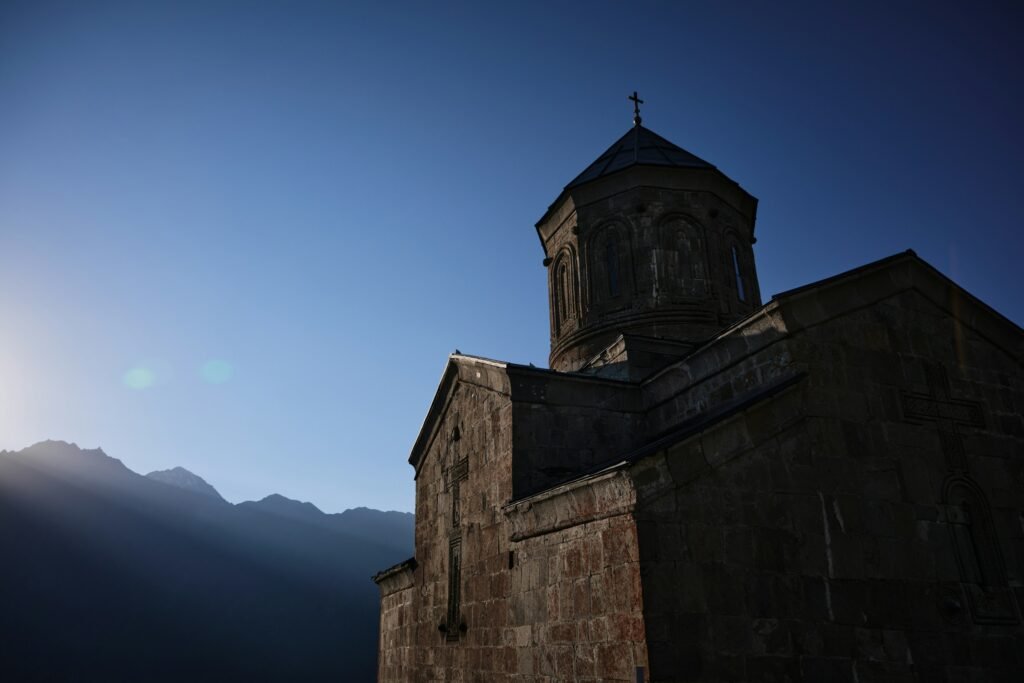
Georgia is a small nation in the South Caucasus, wedged between the Black Sea and the Greater Caucasus Mountains, where Eastern Europe meets Western Asia. Its capital, Tbilisi, sits on the Mtkvari River, but the country’s single most recognized image is Gergeti Trinity Church, a fourteenth century stone church set beneath the glaciated summit of Mount Kazbek. Georgia’s wine tradition, alphabet, and Christian heritage predate most of its modern European neighbors by well over a millennium, and its recent history, from Soviet rule to a stalled bid for European Union membership, remains unsettled.
Where Is Georgia Located?
Georgia sits in the South Caucasus, a region straddling Eastern Europe and Western Asia along the eastern shore of the Black Sea. It borders Russia to the north along the Greater Caucasus range, Azerbaijan to the southeast, Armenia to the south, and Turkey to the southwest. The country’s location made it a historic crossroads between the Persian, Ottoman, and Russian empires, and more recently a transit corridor for energy and trade linking Europe with Central Asia and the Caspian basin.
Geography of Georgia
Georgia’s terrain is dominated by the Greater Caucasus Mountains along its northern border, home to some of Europe’s highest peaks, including Mount Shkhara and the volcanic cone of Mount Kazbek, both above 5,000 meters. To the south, the lower Lesser Caucasus range separates Georgia from Armenia and Turkey, while the low-lying Kolkheti lowlands along the Black Sea coast support a humid subtropical climate distinct from the rest of the country. Between the mountain ranges lie the Mtkvari (Kura) river valley around Tbilisi and the plains of Kakheti in the east, the country’s principal wine-growing region.
A Brief History of Georgia
Ancient Kingdoms and the Adoption of Christianity
The territory of modern Georgia was home to two ancient kingdoms: Colchis along the Black Sea coast, linked in Greek mythology to the legend of the Golden Fleece, and Iberia in the east, centered on the Mtkvari valley. According to Georgian church tradition recorded by Encyclopaedia Britannica, the Georgians adopted Christianity as their state religion early in the fourth century through the missionary work of St. Nino, making Georgia one of the first nations in the world to do so. Archaeological research published in the Proceedings of the National Academy of Sciences identified pottery from Gadachrili Gora and Shulaveri Gora, two sites near Tbilisi, containing chemical traces of wine dating to roughly 6,000 BC, among the earliest confirmed evidence of winemaking found anywhere.
Medieval Kingdom, Russian Rule, and Soviet Georgia
A unified medieval Kingdom of Georgia emerged under the Bagrationi dynasty and reached its height in the late twelfth and early thirteenth centuries under Queen Tamar, before Mongol invasions fractured the kingdom into rival principalities. Squeezed between the Ottoman and Persian empires, the eastern Georgian kingdom of Kartli-Kakheti sought Russian protection under the 1783 Treaty of Georgievsk; the Russian Empire annexed it outright in 1801 and absorbed the rest of Georgian territory over the following decades. Georgia briefly regained independence as the Democratic Republic of Georgia in 1918, only for the Soviet Red Army to invade in 1921, incorporating the country into the Soviet Union as the Georgian Soviet Socialist Republic for the following seven decades.
Independence and Contemporary Georgia
Georgia regained independence in 1991 as the Soviet Union dissolved, but the 1990s were marked by civil conflict and armed disputes in the breakaway regions of Abkhazia and South Ossetia. The bloodless Rose Revolution of 2003 brought a reformist government to power and accelerated Georgia’s pro-Western foreign policy, a trajectory that contributed to a brief war with Russia over South Ossetia in August 2008. Georgia was granted European Union candidate status in December 2023, but according to the Council of the European Union, its accession process came to a de facto halt in 2024 amid disputes over domestic legislation the EU says conflicts with its democratic standards.
Government and Economy
Constitutional reforms completed in 2018 turned Georgia into a parliamentary republic, shifting most executive authority away from the presidency, now an indirectly elected and largely ceremonial post, to the prime minister and a unicameral parliament. The World Bank classifies Georgia as an upper-middle-income country: gross national income per capita rose from an estimated $3,036 in 2010 to roughly $6,535 in 2024, and unemployment fell from 20.6 percent in 2021 to 13.9 percent by the end of 2024. The economy rests on agriculture, notably wine and hazelnuts, tourism, and a growing role as a transit and logistics hub linking Europe, Turkey, and Central Asia.
The Status of Abkhazia and South Ossetia
Roughly one-fifth of the territory Georgia claims as its own, the regions of Abkhazia and South Ossetia, has been outside the control of Tbilisi’s government since wars in the early 1990s and again in 2008. Russian forces have maintained a military presence in both regions since the 2008 war, and Russia formally recognized them as independent states that year, a position shared by only a small number of other United Nations members. Georgia’s government does not accept this: its official state strategy describes both regions as occupied Georgian territory and states that Tbilisi’s sovereignty and internationally recognized borders “must be upheld,” while ruling out a military solution in favor of what it calls peaceful reintegration. The great majority of the international community, including the United Nations, the European Union, and the United States, continues to recognize Abkhazia and South Ossetia as part of Georgia.
Culture and People
Georgian, a language in the Kartvelian family unrelated to its Indo-European or Turkic neighbors, is written in a distinctive script whose three historical forms, Mrgvlovani, Nuskhuri, and Mkhedruli, were jointly inscribed on UNESCO’s Representative List of Intangible Cultural Heritage in 2016. The Georgian Orthodox Church remains central to national identity for most of the population, and the country’s cuisine, wine culture, and polyphonic singing traditions are regarded as distinct within the wider Caucasus and Black Sea region.
What Is Georgia Known For?
Georgia is best known internationally for its wine tradition, among the oldest documented anywhere, its mountain scenery in the Greater Caucasus, and its historic Orthodox churches and monasteries. Gergeti Trinity Church, a fourteenth century stone church set against the glaciated slopes of Mount Kazbek near the town of Stepantsminda, is the country’s most photographed and internationally recognized landmark, symbolizing the meeting point of Georgian Orthodox tradition and the high Caucasus.
Why Georgia Matters
Georgia’s location on Russia’s southern border, and its stated ambitions toward NATO and European Union membership, have made it a focal point of tension between Russia and the West since at least 2008. Its pipelines and transit routes carry Caspian energy supplies toward European markets while bypassing Russian territory, giving the country outsized geopolitical relevance for a nation of under four million people. The unresolved status of Abkhazia and South Ossetia, meanwhile, remains one of the active frozen conflicts on Europe’s immediate periphery.
Key Takeaways
- Georgia lies in the South Caucasus, bordered by Russia, Azerbaijan, Armenia, and Turkey.
- Georgia adopted Christianity as its state religion early in the 4th century, one of the first nations to do so.
- Archaeological finds near Tbilisi place the origins of winemaking in Georgia at roughly 6,000 BC.
- Georgia regained independence from the Soviet Union in 1991; constitutional reform made it a parliamentary republic in 2018.
- Russia and Georgia fought a war over South Ossetia in August 2008, and Abkhazia and South Ossetia remain outside Tbilisi’s control.
- Georgia gained EU candidate status in December 2023, but its accession process was effectively halted in 2024.
- Gergeti Trinity Church, beneath Mount Kazbek, is Georgia’s most iconic landmark.
Sources
- World Bank, Georgia Overview
- Encyclopaedia Britannica, Georgia
- Council of the European Union, Georgia
- UNESCO Intangible Cultural Heritage, Living Culture of Three Writing Systems of the Georgian Alphabet
- PNAS, Early Neolithic Wine of Georgia in the South Caucasus
- Government of Georgia, State Strategy on Occupied Territories
Key facts
- Georgia adopted Christianity as its state religion early in the 4th century, among the first nations to do so2
- Archaeological evidence places the origins of winemaking in Georgia at roughly 6,000 BC, near Tbilisi5
- Constitutional reforms completed in 2018 made Georgia a parliamentary republic with a largely ceremonial presidency2
- Russia and Georgia fought a war over South Ossetia in August 2008; Abkhazia and South Ossetia remain outside Tbilisi's control6
- Georgia gained EU candidate status in December 2023, but its accession process was effectively halted in 20243
Quick checkWhen did Georgia adopt Christianity as its state religion?Show answer
Early in the 4th century, through the missionary work of St. Nino, making Georgia one of the first nations to do so.
Sources
- World Bank. Georgia Overview. Undated (accessed 2026-09-23)
- Encyclopaedia Britannica. Georgia. Undated (accessed 2026-09-23)
- Council of the European Union. Georgia. Undated (accessed 2026-09-23)
- UNESCO Intangible Cultural Heritage. Living culture of three writing systems of the Georgian alphabet. 2016 (accessed 2026-09-23)
- Proceedings of the National Academy of Sciences (PNAS). Early Neolithic wine of Georgia in the South Caucasus. 2017-11-13 (accessed 2026-09-23)
- Government of Georgia, State Ministry for Reconciliation and Civic Equality. State Strategy on Occupied Territories. Undated (accessed 2026-09-23)
Editorially reviewed by Specialty Digest Editorial TeamLast reviewed September 23, 2026Researched and drafted with AI assistanceReport an issue