Where Burundi Is, and What Kind of Place It Is
Burundi is a small, landlocked country in East Africa’s Great Lakes region, bordered by Rwanda to the north, Tanzania to the east and south, and the Democratic Republic of the Congo to the west. Its southwestern edge runs along Lake Tanganyika, one of the world’s great rift lakes. With an estimated population of about 14.4 million people living in roughly 27,800 square kilometers, Burundi is one of the most densely populated countries on the continent, and by GDP per capita it ranks among the poorest countries in the world (World Bank). Its political capital is Gitega, while the larger city of Bujumbura, on the shore of Lake Tanganyika, remains the country’s commercial and diplomatic center.
Geography
Burundi sits astride the Albertine Rift, the western branch of the Great Rift Valley, which gives the country hilly, high-elevation terrain rather than the flat savanna often associated with East Africa. Most of the interior is a rolling central plateau at an average elevation above 1,700 meters, rising to Mount Heha, the country’s highest point at 2,685 meters. Because of that elevation, Burundi’s climate is milder than its equatorial latitude would suggest, with a long and a short rainy season each year.
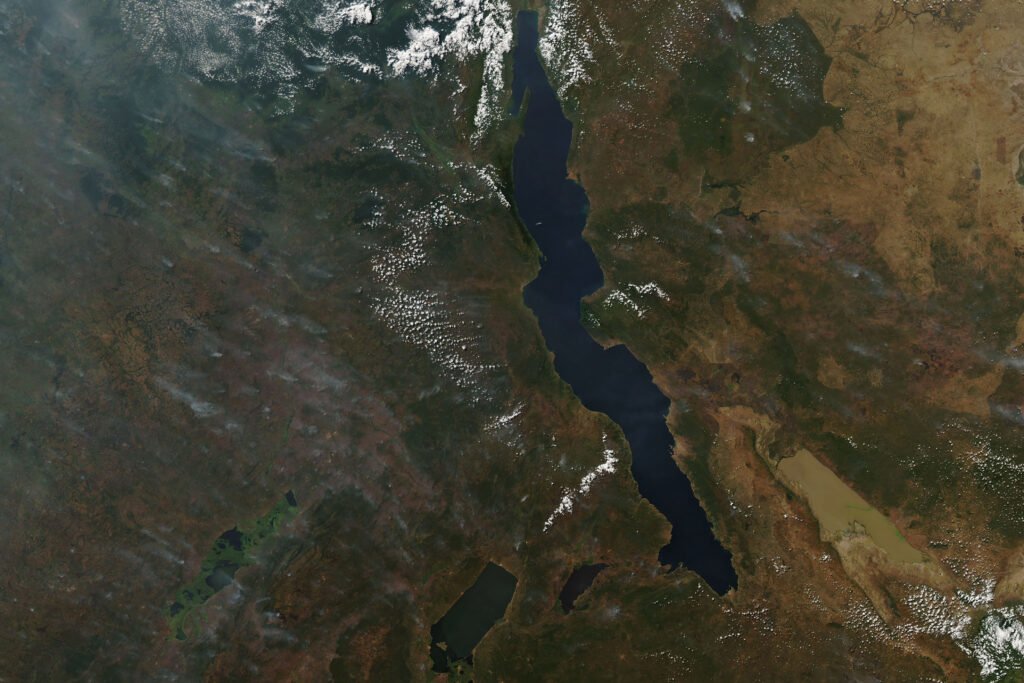
Lake Tanganyika dominates the country’s southwestern border and its economic geography. It is the world’s second-deepest freshwater lake, reaching about 1,436 meters, and one of its longest, stretching roughly 660 kilometers from north to south through territory shared with Tanzania, the Democratic Republic of the Congo, and Zambia (NASA Earth Observations). The lake’s isolation and depth have made it a hotspot for aquatic evolution, and it is the reason Bujumbura developed as a lake port rather than a coastal one; Burundi itself has no direct access to the sea. Burundi’s own government has proposed the lake for UNESCO World Heritage status, alongside several national parks and waterfalls, underscoring how central it is to the country’s natural identity (UNESCO World Heritage Centre).
A Brief History
The kingdom of Burundi existed as an organized state for centuries before European contact. It became part of German East Africa in 1890 and, after Germany’s defeat in World War I, was placed under Belgian administration as part of the territory of Ruanda-Urundi, governed jointly with neighboring Belgium‘s other Central African holdings until independence on July 1, 1962.
Independence did not bring stability. Political life in the following decades was repeatedly disrupted by violence between the country’s Hutu majority and Tutsi minority, categories that colonial administration had hardened into rigid, competing identities. The most severe of these episodes came in 1972, when an estimated 100,000 to 200,000 Hutu, along with an estimated 10,000 Tutsi, were killed in a wave of violence and reprisal that some historians classify as genocide against the Hutu population; the episode displaced well over 100,000 people and eliminated much of a generation of educated Hutu leadership (Encyclopaedia Britannica). A second, longer crisis followed the October 1993 assassination of Melchior Ndadaye, Burundi’s first democratically elected Hutu president, just months into his term. His killing, carried out by elements of the Tutsi-dominated army, triggered a civil war that lasted until 2005 and is estimated to have killed roughly 300,000 people, the large majority of them civilians. These events are documented and analyzed differently by different scholars and institutions, and estimates of casualties vary; they are presented here as historical background rather than settled judgments about any individual or group’s guilt.
The war ended through a negotiated settlement. The Arusha Peace and Reconciliation Agreement, signed in August 2000, established a transitional, power-sharing government and set out the principles later written into a new constitution approved by referendum in February 2005, with 92 percent support (Peace Accords Matrix, University of Notre Dame). An African Union and later United Nations peacekeeping presence helped stabilize the transition, and elections in 2005 marked the shift back to civilian government.
Government and Economy
Burundi is a presidential republic with a bicameral parliament, structured under the framework the Arusha accords put in place to guarantee ethnic and political representation in the legislature, the military, and the courts. Évariste Ndayishimiye has served as president since 2020 and currently also chairs the African Union (African Union).
Economically, Burundi remains one of the least developed countries in the world. Its GDP per capita was about $234 in 2025, among the lowest of any country tracked by the World Bank, and an estimated 74 percent of the population lived below the international poverty line of $3.00 a day as of 2020 (World Bank). Agriculture, mostly small-scale subsistence farming, employs the large majority of working Burundians and accounts for roughly a third of GDP; coffee and tea are the country’s dominant export crops and its main source of foreign currency. Chronic constraints, including limited electricity access, land pressure from high population density, and decades of conflict, have kept productivity low even as GDP growth has picked up in recent years.
Culture and People
Burundians are predominantly Christian, with large Catholic and Protestant populations, alongside smaller communities practicing Islam or traditional beliefs. Kirundi is the national language spoken across ethnic and regional lines, with French and, since 2014, English also serving as official languages, a legacy of the colonial administration and Burundi’s more recent turn toward regional East African integration.
The country’s best-known cultural export is its drumming tradition. The Ritual Dance of the Royal Drum, historically performed for the royal court and now for national celebrations and honored guests, combines synchronized drumming, dance, and traditional poetry; a troupe typically arranges a dozen or more drums, always an odd number, in a semicircle around a lead drummer. UNESCO added the practice to its Representative List of the Intangible Cultural Heritage of Humanity in 2014, describing it as a tradition the whole country considers central to its identity (UNESCO Intangible Cultural Heritage).
What Burundi Is Best Known For Globally
Outside the region, Burundi is most often recognized for two things that have little to do with each other: Lake Tanganyika, a defining feature of the African Great Lakes and one of the deepest and oldest lakes on Earth, and the country’s turbulent modern political history, particularly the 1972 violence and the 1993 to 2005 civil war. The royal drumming tradition is increasingly well known internationally through touring ensembles and its UNESCO recognition, and Burundi’s extreme poverty and low ranking on most global development indexes also shape how international organizations and media typically frame the country.
Why Burundi Matters
Burundi matters as a case study in how colonial-era policy can entrench ethnic division long after colonial rule ends, and in how a negotiated, power-sharing settlement, however imperfect, can end a long civil war. Its experience continues to inform how organizations such as the United Nations and African Union approach conflict prevention and post-conflict governance elsewhere in Africa’s Great Lakes region. Burundi also matters ecologically: as one of the countries bordering Lake Tanganyika, its land-use and fishing policies directly affect a body of water that holds a large share of the region’s fresh water and supports fish species found nowhere else on Earth. For a country of its size, Burundi’s history and geography carry outsized significance for regional stability and freshwater conservation alike.
Key facts
- Burundi's population was about 14.4 million in 2025, among Africa's most densely populated countries1
- GDP per capita was about $234 in 2025, one of the lowest in the world, with an estimated 74 percent of Burundians below $3.00 a day in 20202
- Lake Tanganyika, forming Burundi's southwestern border, is the world's second-deepest freshwater lake at about 1,436 meters7
- An estimated 100,000 to 200,000 Hutu and 10,000 Tutsi were killed in 1972; the 1993-2005 civil war that followed a later crisis killed roughly 300,00056
- UNESCO inscribed Burundi's Ritual Dance of the Royal Drum on its Representative List of Intangible Cultural Heritage in 20144
Quick checkWhat is the capital of Burundi?Show answer
Gitega is the political capital; Bujumbura, on Lake Tanganyika, is the country's largest city and economic center.
Sources
- World Bank. Burundi Overview. 2026 (accessed 2026-09-22)
- World Bank. World Development Indicators: Burundi. 2025 (accessed 2026-09-22)
- UNESCO World Heritage Centre. Burundi: States Parties (Tentative List). 2026 (accessed 2026-09-22)
- UNESCO Intangible Cultural Heritage. Ritual Dance of the Royal Drum. 2014 (accessed 2026-09-22)
- Peace Accords Matrix, Kroc Institute, University of Notre Dame. Arusha Peace and Reconciliation Agreement for Burundi. 2000 (accessed 2026-09-22)
- Encyclopaedia Britannica. Burundi: History. n.d. (accessed 2026-09-22)
- NASA Johnson Space Center, Earth Observations. Lake Tanganyika, Tanzania, Zaire, and Zambia (STS51G-34-12). 1985 (accessed 2026-09-22)
- NASA Earth Observatory. A Tale of Contrasting Rift Valley Lakes. 2019 (accessed 2026-09-22)
- African Union. AUC Chairperson conferred with H.E. Evariste Ndayishimiye, President of the Republic of Burundi. 2026 (accessed 2026-09-22)
Editorially reviewed by Specialty Digest Editorial TeamLast reviewed September 22, 2026Researched and drafted with AI assistanceReport an issue