The Democratic Republic of the Congo (DRC) is a country in Central Africa, the second-largest nation on the continent by area and home to the Congo Basin, the world’s second-largest expanse of tropical rainforest. Its capital, Kinshasa, sits on the Congo River directly across from Brazzaville, capital of the smaller, separate Republic of the Congo. The DRC holds some of the planet’s richest mineral deposits, producing about 74 percent of the world’s mined cobalt, yet more than eight in ten Congolese live in poverty, a contrast shaped by a violent colonial history and armed conflict that continues in the country’s eastern provinces today (World Bank; USGS).
Geography and Natural Environment
The DRC borders nine countries, more than almost any other nation in the world, including the Republic of the Congo, Angola, Zambia, Tanzania, Uganda, Rwanda, Burundi, South Sudan and the Central African Republic, and it touches the Atlantic Ocean along a narrow strip of coastline of roughly 40 kilometers (Britannica). Its dominant physical feature is the Congo River and its vast drainage basin, which supports around 145 million hectares of rainforest, the second-largest contiguous tropical forest on Earth after the Amazon (World Bank).
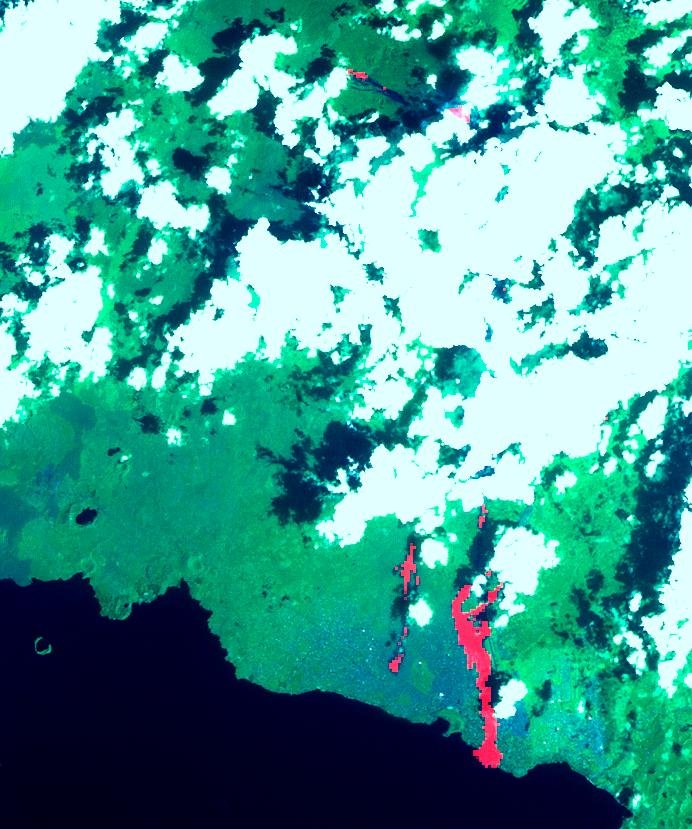
In the country’s mountainous east lies Virunga National Park, Africa’s oldest national park and a UNESCO World Heritage Site covering roughly 790,000 hectares. Virunga spans an extraordinary range of habitats, from swamps and savanna to the glaciated peaks of the Rwenzori Mountains above 5,000 meters, and it contains two of Africa’s most active volcanoes, Nyiragongo and Nyamuragira. The park shelters about a third of the world’s remaining mountain gorillas along with roughly 218 mammal species and more than 700 bird species, and about 10 percent of its more than 2,000 plant species are found nowhere else. Because of sustained threats from armed conflict, poaching and deforestation, Virunga has been listed as a World Heritage Site in Danger continuously since 1994 (UNESCO World Heritage Centre). Conservation partnerships across the wider Virunga Massif, which spans the DRC, Rwanda and Uganda, helped the region’s mountain gorilla count rise from 480 in 2010 to 604 in 2016, the largest total recorded to that point, even as habitat loss and insecurity remain constant pressures (UN Environment Programme).
A Brief History
The DRC’s modern history begins with one of colonialism’s most brutal chapters and runs through a difficult independence, three decades of authoritarian rule, and wars that still shape the country’s east.
The Congo Free State and Colonial Era
From 1885 to 1908, the territory was ruled not by Belgium but personally by Belgium’s King Leopold II as the “Congo Free State,” a private colonial enterprise built on forced labor to extract rubber and ivory. Leopold’s agents and the Force Publique enforced production quotas through violence, including mutilation, and the resulting death toll among the Congolese population is estimated in the millions by historians. International exposure of these abuses, driven in part by campaigners such as E.D. Morel and writers including Mark Twain, forced Belgium to annex the territory as the Belgian Congo in 1908, ending Leopold’s personal rule, though colonial administration continued for another half-century (Britannica).
Independence and the Mobutu Era
The Belgian Congo became independent on June 30, 1960, with Joseph Kasavubu as president and Patrice Lumumba as prime minister. The new state collapsed into crisis almost immediately: the army mutinied, the mineral-rich province of Katanga declared secession, and the United Nations authorized a peacekeeping intervention. Lumumba was removed from office and killed in January 1961 amid Cold War-era maneuvering that included involvement by the CIA (U.S. Department of State, Office of the Historian). Army chief Mobutu Sese Seko seized full power in a 1965 coup and ruled for roughly three decades, renaming the country Zaire and centralizing authority and wealth around his own rule before being ousted in a rebellion in 1997 (Britannica).
The Congo Wars and Ongoing Conflict
Mobutu’s fall touched off the First Congo War (1996-97) and the even deadlier Second Congo War (1998-2003), which drew in multiple African armies and is among the most lethal conflicts since World War II (Britannica). Formal war ended in 2003, but armed conflict never fully receded from the mineral-rich eastern provinces of North Kivu, South Kivu and Ituri. That conflict escalated sharply from 2022 as the M23 armed group expanded its territory, and by early 2025 M23 had seized Goma, the largest city in the east. The UN estimates nearly 6 million people are internally displaced within the DRC, more than 1 million Congolese have fled to neighboring countries, and over 21 million people across the country need humanitarian assistance, among the largest such caseloads in the world (UN Office for the Coordination of Humanitarian Affairs; UNHCR).
Government and Economy
The DRC is a semi-presidential republic; Felix Tshisekedi has served as president since 2019 (Britannica). The World Bank put the country’s population at roughly 112.8 million in 2025, growing about 3.2 percent a year, with gross domestic product of about $91 billion and GDP per capita of roughly $807, among the lowest in the world despite the country’s mineral wealth. The economy grew an estimated 5.5 to 5.8 percent in 2025, driven largely by mining, which expanded more than 10 percent on strong copper and cobalt production, while inflation eased sharply from 17.7 percent in 2024 to 7.5 percent in 2025 (World Bank). The DRC supplies about 74 percent of the world’s mined cobalt, a metal critical to rechargeable batteries and the global shift toward electric vehicles, giving the country outsized strategic importance in global supply chains even as most cobalt refining happens elsewhere (USGS). Despite this resource base, the World Bank estimates about 81 percent of Congolese live below $3 a day, only around 22.5 percent of the population has access to electricity, and life expectancy stands at about 62 years, reflecting the toll of conflict, weak infrastructure and limited public services (World Bank).
Culture and People
French is the DRC’s official language, a legacy of Belgian colonial rule, alongside national languages including Lingala, Kikongo, Swahili and Tshiluba that are widely used in daily life, media and popular music across different regions of this ethnically and linguistically diverse country. That musical life has produced one of Africa’s most influential cultural exports: Congolese rumba, a genre and dance tradition blending indigenous Congolese rhythms with Cuban and other influences, performed at celebrations, funerals and religious gatherings and passed down through neighborhood clubs and mentorship between musicians. In 2021, UNESCO inscribed Congolese rumba on its Representative List of the Intangible Cultural Heritage of Humanity, recognizing its role in reinforcing community identity both within the DRC and among the Congolese diaspora (UNESCO Intangible Cultural Heritage).
What the DRC Is Best Known For Globally
Internationally, the Democratic Republic of the Congo is best known for four things: the Congo River and its rainforest basin, among the largest and most biodiverse on Earth; Virunga National Park and its endangered mountain gorillas, an emblem of both conservation success and the toll of regional conflict; its position as the world’s dominant source of cobalt, a mineral central to modern batteries and electronics; and a history that runs from the recorded atrocities of the Congo Free State through decades of political instability to the ongoing crisis in its eastern provinces. Congolese rumba has also carried the country’s cultural influence across Africa and its diaspora, shaping popular music well beyond its borders.
Why the Democratic Republic of the Congo Matters
The DRC matters both for what it holds and for what happens within it. Its rainforest is one of the world’s most significant carbon sinks and centers of biodiversity, making its conservation a global environmental concern, not only a national one. Its mineral wealth, especially cobalt and copper, makes it indispensable to industries and supply chains far beyond Africa. At the same time, its unresolved cycle of conflict, displacement and humanitarian need, among the largest in the world by UN measures, makes the country a central test of how the international community responds to protracted crises in resource-rich but institutionally fragile states.
Key Takeaways
- The Democratic Republic of the Congo is a Central African country of about 112.8 million people, with Kinshasa as its capital and the Congo Basin rainforest as its defining natural feature.
- Virunga National Park, a UNESCO World Heritage Site in Danger since 1994, protects about a third of the world’s mountain gorillas and two of Africa’s most active volcanoes.
- The country’s history includes the forced-labor atrocities of King Leopold II’s Congo Free State (1885-1908), independence in 1960, the three-decade rule of Mobutu Sese Seko, and the First and Second Congo Wars.
- Armed conflict in the eastern provinces, intensified by the M23 group since 2022, has displaced nearly 6 million people within the country and driven a humanitarian crisis affecting more than 21 million.
- The DRC produces about 74 percent of the world’s mined cobalt, a metal essential to batteries, even though most of the population lives in poverty and lacks reliable electricity.
- Congolese rumba, recognized by UNESCO as Intangible Cultural Heritage in 2021, reflects the country’s broad cultural influence across Africa and its global diaspora.
Sources
- World Bank, Democratic Republic of Congo Overview
- World Bank, Congo, Dem. Rep. country data
- UNESCO World Heritage Centre, Virunga National Park
- UN Environment Programme, Number of Mountain Gorillas Rise in Virunga Massif
- U.S. Department of State, Office of the Historian, Congo, Decolonization, and the Cold War
- Encyclopaedia Britannica, History of the Democratic Republic of the Congo
- Encyclopaedia Britannica, Democratic Republic of the Congo
- Encyclopaedia Britannica, Mobutu Sese Seko
- UNESCO Intangible Cultural Heritage, Congolese Rumba
- UN Office for the Coordination of Humanitarian Affairs, Democratic Republic of Congo
- UNHCR, DR Congo Emergency
- U.S. Geological Survey, Mineral Commodity Summaries 2024: Cobalt
Key facts
- Capital: Kinshasa; population about 112.8 million in 20251
- Virunga National Park, a UNESCO World Heritage Site in Danger since 1994, holds about a third of the world's mountain gorillas2
- DRC produces about 74 percent of the world's mined cobalt3
- Ongoing conflict with the M23 armed group has displaced nearly 6 million people internally since 20224
- About 81 percent of Congolese live below $3 a day despite the country's mineral wealth1
Quick checkWhy is the Democratic Republic of the Congo strategically important to global battery and electronics supply chains?Show answer
Because it produces about 74 percent of the world's mined cobalt, a mineral essential to rechargeable batteries used in electric vehicles and electronics, according to the U.S. Geological Survey.
Sources
- World Bank. Democratic Republic of Congo Overview. Undated, accessed 2026 (accessed 2026)
- UNESCO World Heritage Centre. Virunga National Park. Undated, accessed 2026 (accessed 2026)
- U.S. Geological Survey. Mineral Commodity Summaries 2024: Cobalt. 2024 (accessed 2026)
- UN OCHA. Democratic Republic of Congo. Undated, accessed 2026 (accessed 2026)
- UNHCR. DR Congo Emergency. Undated, accessed 2026 (accessed 2026)
- U.S. Department of State, Office of the Historian. Congo, Decolonization, and the Cold War. Undated, accessed 2026 (accessed 2026)
- UNESCO Intangible Cultural Heritage. Congolese Rumba. 2021 (accessed 2026)
- UN Environment Programme. Number of Mountain Gorillas Rise in Virunga Massif. Undated, accessed 2026 (accessed 2026)
- Encyclopaedia Britannica. History of the Democratic Republic of the Congo. Undated, accessed 2026 (accessed 2026)
Editorially reviewed by Specialty Digest Editorial TeamLast reviewed September 22, 2026Researched and drafted with AI assistanceReport an issue