Mozambique is a country on the southeastern coast of Africa, bordering the Indian Ocean along a coastline of roughly 2,700 kilometers, according to the World Bank, and sharing land borders with six countries, including Tanzania, Malawi, Zambia, Zimbabwe, South Africa, and Eswatini. With a population of roughly 35.6 million people, it is one of the larger nations of Southern Africa, endowed with substantial natural resources but classified among the world’s low income economies.
Where Is Mozambique Located?
Mozambique stretches along the Indian Ocean coast of Southeast Africa, positioned to serve as a maritime gateway for several landlocked neighbors, according to the World Bank. Its geography includes low lying coastal plains, a network of major rivers including the Zambezi, and highlands further inland, with offshore gas reserves, mineral deposits, and hydropower potential among its significant natural assets. The capital, Maputo, sits in the far south of the country on a natural harbor.
A Brief History of Mozambique
The coast of Mozambique was a hub of Indian Ocean trade for centuries before Portuguese explorers arrived in the late fifteenth century, after which Portugal established Mozambique as a colony that endured for nearly five hundred years. Independence came in 1975 following an armed liberation struggle led by the Mozambique Liberation Front, or Frelimo. Independence was followed almost immediately by a prolonged civil war between the Frelimo government and the Mozambican National Resistance, or Renamo, that lasted from 1977 until a peace agreement in 1992, a conflict that severely damaged the country’s infrastructure and economy in its early decades of independence.
Government and Economy
Mozambique is a presidential republic. The World Bank classifies it as a low income economy, notwithstanding its vast natural assets, including offshore gas reserves, mineral deposits, arable land, hydropower potential, and a long coastline that positions it to serve landlocked neighboring states. Agriculture employs a large share of the population, while large scale natural gas development off the northern coast represents one of the country’s most significant long term economic prospects.
Culture and People
Portuguese is Mozambique’s official language, a legacy of nearly five centuries of colonial rule, though the majority of the population speaks Bantu languages such as Makhuwa, Sena, and Tsonga as a first language. Mozambican culture blends African, Arab, and Portuguese influences, particularly visible along the coast, where centuries of Indian Ocean trade left a lasting imprint on architecture, cuisine, and music, including genres such as marrabenta that emerged from this layered coastal heritage.
What Is Mozambique Known For?
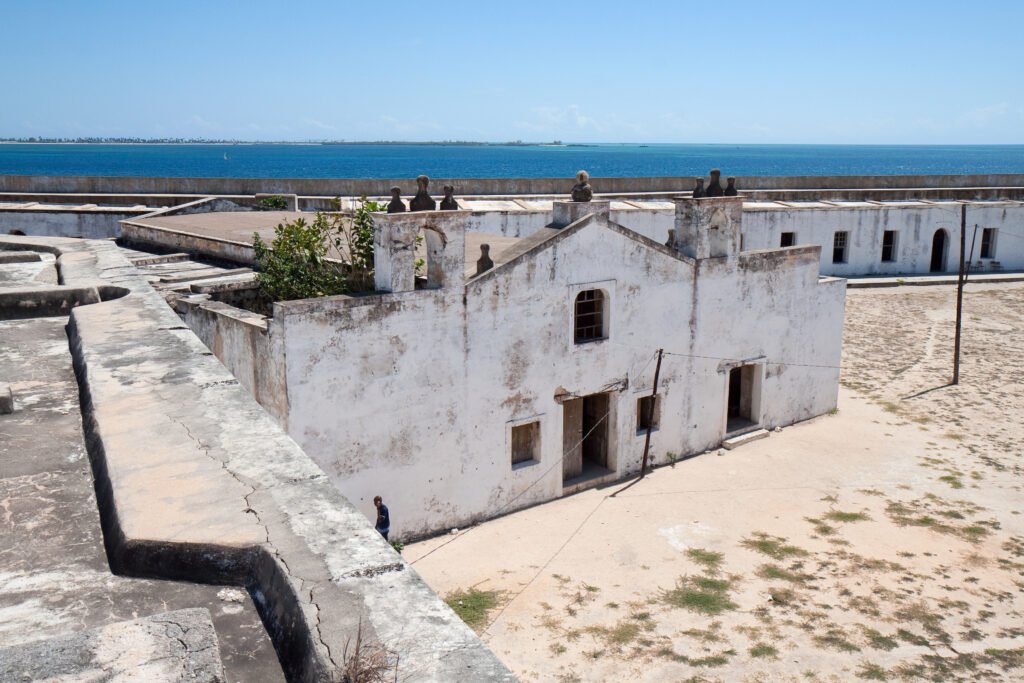
Mozambique’s single most recognizable historic landmark is the Island of Mozambique, a small coral island off the northern coast that served as the capital of Portuguese East Africa for close to four centuries and gave the entire country its name. The island’s Fort Sao Sebastiao, begun in 1558, is among the oldest surviving European fortifications in sub-Saharan Africa, and the island’s densely packed stone town and adjoining traditional Makuti town together preserve an exceptional record of the encounter between African, Arab, Persian, Indian, and European cultures along the Swahili coast. UNESCO recognizes the Island of Mozambique as a World Heritage Site.
Why Mozambique Matters
Mozambique’s long Indian Ocean coastline gives it strategic importance as a trade corridor for several landlocked Southern African states, while its emerging offshore natural gas sector has drawn significant international investment interest in recent years. Its history, from centuries as a Portuguese colonial hub to a hard fought independence and subsequent civil war, also makes it a widely studied case in African decolonization and post conflict recovery.
Key Takeaways
- Mozambique is a presidential republic on the southeastern coast of Africa with a population of about 35.6 million people.
- It was a Portuguese colony for nearly five hundred years before gaining independence in 1975.
- A civil war between Frelimo and Renamo lasted from 1977 until a 1992 peace agreement.
- The World Bank classifies Mozambique as a low income economy despite substantial natural gas, mineral, and hydropower resources.
- The Island of Mozambique, a UNESCO World Heritage Site anchored by Fort Sao Sebastiao, is the country’s single most iconic historic landmark.
Sources
- The World Bank: Mozambique Overview
- UNESCO World Heritage Centre: Island of Mozambique
- The World Bank: World Development Indicators, Mozambique
Key facts
- Population of approximately 35.6 million as of 20253
- Land area of about 799,380 square kilometers with a 2,700 km coastline13
- Capital is Maputo3
- Gained independence from Portugal in 1975 after nearly five centuries of colonial rule
- Island of Mozambique, anchored by Fort Sao Sebastiao, is a UNESCO World Heritage Site2
Quick checkWhat historic fort anchors the Island of Mozambique?Show answer
Fort Sao Sebastiao, begun in 1558.
Sources
- The World Bank. Mozambique Overview. Undated (accessed 2026-09-28)
- UNESCO World Heritage Centre. Island of Mozambique. Undated (accessed 2026-09-28)
- The World Bank. World Development Indicators, Mozambique. 2025 (accessed 2026-09-28)
Editorially reviewed by Specialty Digest Editorial TeamLast reviewed September 28, 2026Researched and drafted with AI assistanceReport an issue