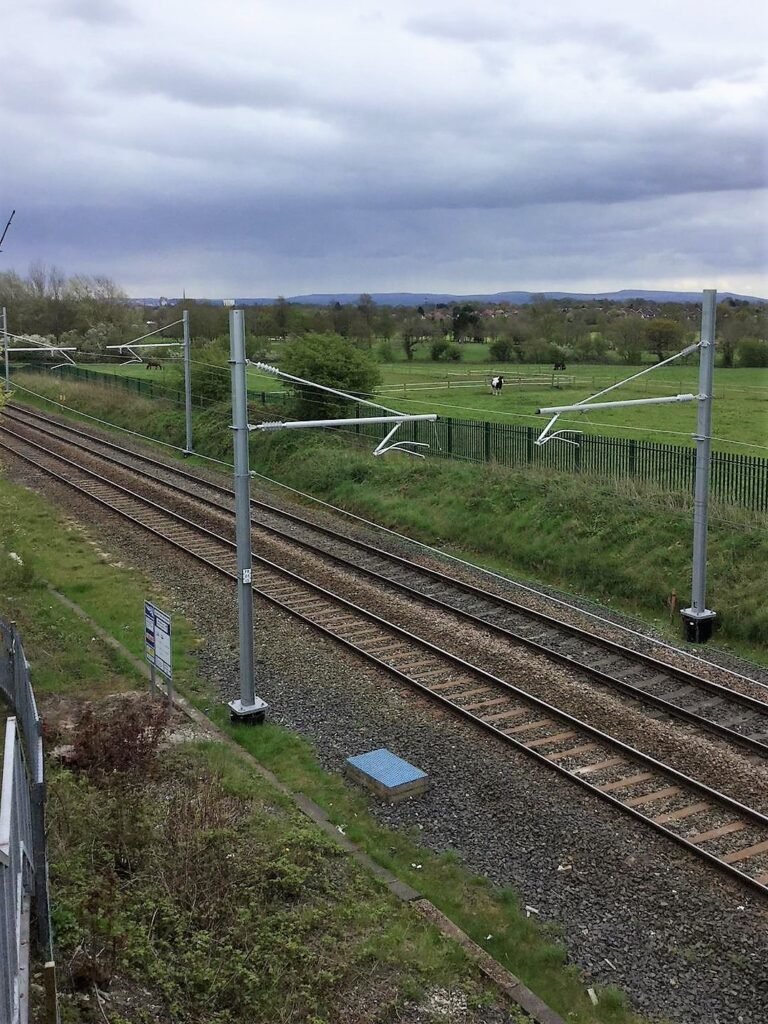
What Rail Electrification Means
Rail electrification converts a railway from diesel or other onboard fuel power to electric power delivered externally through overhead catenary wires or a ground-level third rail. Electric trains draw power continuously from this infrastructure rather than carrying their own fuel supply, fundamentally changing how the train itself is designed and powered.
Overhead Wire Versus Third Rail Systems
Overhead catenary electrification uses wires suspended above the track that trains access through a pantograph mounted on the train’s roof, commonly used for both freight and passenger railways including high-speed lines. Third rail systems instead run a separate electrified rail at ground level alongside the main track, more common on urban transit and metro systems where overhead clearance or safety considerations favor this approach.
Economic Case for Electrification
Electrified railways generally offer lower operating costs than diesel power on high-traffic lines, since electric motors are more energy efficient and electricity is often cheaper than diesel fuel on a per-mile basis, though the substantial upfront infrastructure investment required means electrification is typically justified only on lines with sufficient traffic volume to recover that investment over time.
Environmental Benefits of Electrification
Electrified railways produce no direct emissions from the train itself, shifting emissions to wherever the electricity is generated, which can represent a significant environmental improvement where electricity comes from low-carbon sources. This has made rail electrification an increasingly prominent part of national strategies to reduce transportation sector emissions.
Electrification and Train Performance
Electric trains generally offer faster acceleration and higher sustained speeds than diesel trains of comparable size, since electric motors can deliver power more efficiently across a range of speeds, an advantage that makes electrification particularly valuable for high-speed rail lines and busy commuter networks with frequent stops.
Partial Electrification Strategies
Many railways pursue partial electrification, converting only the busiest sections of their network while leaving lower-traffic branch lines on diesel power, using dual-mode locomotives capable of running on both electric and diesel power to provide seamless through-service across electrified and non-electrified sections of the same route.
Electrification Cost and Funding Challenges
The high upfront capital cost of electrification infrastructure, including overhead wire installation and often substantial electrical substation construction, has slowed electrification progress in some countries despite its long-term operating cost and environmental advantages, making electrification funding a recurring subject of transportation policy debate.
Early Electrification and Competing Standards
Railway electrification began in the late nineteenth century with short urban and mountain lines where electric traction solved specific problems, such as avoiding tunnel ventilation issues with steam locomotives or providing better traction on steep grades. As electrification spread to main lines in the twentieth century, different countries adopted different voltage and current standards largely for historical and industrial reasons, producing a patchwork that persists today: France and much of Western Europe favor 25 kV AC on main lines, parts of Central Europe use 15 kV AC at a lower frequency, and various networks retain older 1.5 kV or 3 kV DC systems from earlier electrification waves. This lack of a single global standard means international trains crossing certain borders must carry multi-system locomotives capable of switching between voltage and current types, adding cost and complexity that a unified standard would have avoided.
Third Rail Systems and Urban Networks
Many urban and suburban rail networks use third rail electrification instead of overhead catenary, running a conductor rail at low height alongside or between the running rails to supply direct current to trains through a sliding contact shoe. Third rail systems avoid the visual clutter and clearance requirements of overhead wires, making them well suited to tunnels and tightly built urban corridors, but they impose a lower practical voltage ceiling than overhead systems and raise safety concerns because the conductor rail sits close to track level. Many metro systems and some mainline commuter networks, including large parts of the London Underground and the Long Island Rail Road, rely on third rail power, while high-speed and long-distance electrified lines almost universally use overhead catenary because of its higher achievable voltage and the physical clearance it provides from track-level hazards.
Economic Case for New Electrification
Deciding whether to electrify a previously diesel-operated line involves weighing the substantial upfront capital cost of installing overhead wires or third rail infrastructure against long-term savings from lower energy costs, reduced locomotive maintenance, and emissions reductions, a calculation that typically favors electrification only on lines with high traffic density. Railways in regions with cheap, low-carbon electricity and heavy freight or passenger volumes have generally found electrification economically justified over a multi-decade asset life, while lightly used branch lines often remain diesel-operated indefinitely because the traffic volume cannot justify the fixed infrastructure investment electrification requires.
Regenerative braking on electrified trains, which feeds energy back into the overhead or third rail system when a train slows down, has become an increasingly important efficiency feature, particularly on networks with frequent stops such as metro and suburban commuter lines where braking events are common.
Maintenance of electrification infrastructure itself, including periodic wire tensioning and insulator replacement, represents an ongoing cost that railways must budget for across the multi-decade life of overhead line equipment.
Some rail networks use dual-voltage or multi-system rolling stock specifically to bridge gaps between electrification standards at national borders, avoiding the need for passengers or freight to change trains at the boundary itself.
Private freight operators sometimes resist electrification costs when traffic volumes remain uncertain over the long term, preferring diesel flexibility.
Government grants have offset much of this hesitancy in several national electrification programs launched in recent years.
Key facts
- Array
Quick checkWhat are the main benefits of rail electrification?Show answer
Lower operating costs, reduced emissions, and often better acceleration performance compared with diesel-powered trains, particularly valuable on high-traffic rail lines.
Sources
- Array
Editorially reviewed by Specialty Digest Editorial TeamLast reviewed November 4, 2026Researched and drafted with AI assistanceReport an issue