Extending the Reach of Transit Networks
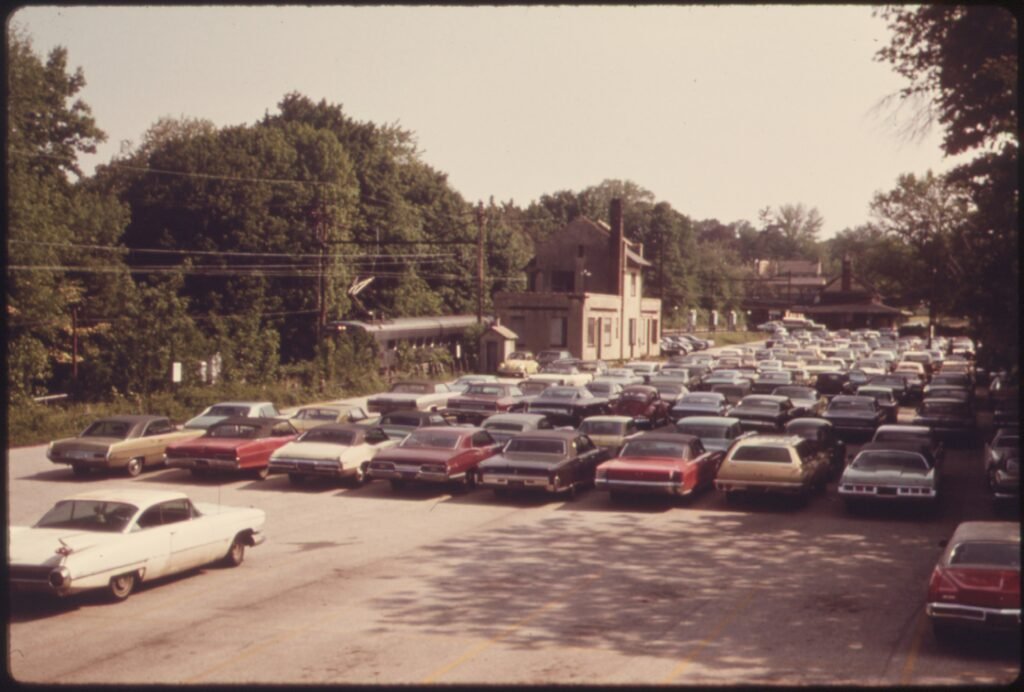
Park-and-ride facilities allow transit systems to effectively extend their catchment area far beyond walking distance from a station, since a commuter living too far from any transit stop to walk or bike can still drive a short distance to a park-and-ride lot and complete the remainder of their trip by rail or bus. This model has proven especially important for suburban and exurban commuters in regions with lower-density development patterns, where extending rail or dedicated bus lines directly into every residential neighborhood would be prohibitively expensive relative to the ridership such extensions would generate.
Land Use Trade-offs Near Stations
While park-and-ride lots increase transit ridership by capturing drivers who would otherwise commute entirely by car, the land consumed by surface parking lots or structures represents a significant opportunity cost, since that same land near a transit station could instead support higher-density housing, retail, or office development that would generate transit ridership without requiring any parking at all. This tension has led many transit agencies and municipalities to gradually convert older park-and-ride lots into structured parking garages, freeing surface land for transit-oriented development while preserving some parking capacity for commuters who still need it.
Financing and Operating Models
Park-and-ride facilities are financed and operated under varying models, ranging from free lots subsidized entirely by the transit agency or local government to encourage ridership, to paid facilities that charge a daily or monthly fee, sometimes bundled with a transit pass to simplify the commuter’s combined cost. Agencies that charge for parking must weigh the revenue and potential demand-management benefits of pricing against the risk that a parking fee discourages some commuters from using transit at all, particularly where free roadside or informal parking exists nearby as an alternative.
Pricing Strategies and Demand Management
Transit agencies that charge for park-and-ride parking must calibrate pricing carefully, since a fee set too high risks pushing commuters back into driving the entire distance by car rather than switching to transit partway, while free or underpriced parking can lead to lots filling before mid-morning, leaving later-arriving commuters without any parking option at all. Some agencies address this through pricing that varies by arrival time, charging less for earlier arrivals to encourage spreading demand across the morning peak rather than everyone arriving at the same popular hour.
Shared-use arrangements, where a park-and-ride lot also serves other purposes such as retail parking during midday hours when commuters are at work, have become an increasingly common strategy for extracting more value from the land a park-and-ride facility occupies.
Climate and Suburban Development Debates
Park-and-ride facilities occupy a contested position in contemporary transportation planning, praised by some as a pragmatic tool for extending transit’s reach into car-dependent suburbs built with little expectation of transit access, while criticized by others as effectively subsidizing continued low-density, car-oriented development patterns that make transit less efficient to serve in the long run. This tension has led some regions to pursue a dual strategy, maintaining or expanding park-and-ride capacity at outlying stations while actively encouraging denser, walkable development immediately around stations closer to the urban core.
Security concerns, including vehicle theft and vandalism in unstaffed park-and-ride lots, have prompted many agencies to invest in lighting, camera surveillance, and sometimes staffed attendants, particularly at facilities serving riders who leave vehicles for a full workday.
Electric Vehicle Charging Integration
As electric vehicle adoption has grown, many newly built or renovated park-and-ride facilities have added charging infrastructure, allowing commuters to charge their vehicles during the workday while they ride transit to their final destination, a combination that transportation planners increasingly view as complementary rather than competing policy goals. Some agencies have gone further, prioritizing charging-equipped spaces for electric vehicles or offering reduced parking fees as an incentive, reflecting a broader policy interest in supporting both transit ridership and vehicle electrification simultaneously rather than treating them as separate initiatives.
Shuttle bus connections from park-and-ride lots to station platforms, used where the lot itself is not immediately adjacent to boarding areas, add a further transfer step that planners try to minimize through careful site selection wherever possible.
Comparing Park-and-Ride to Walk-Up Ridership
Transportation researchers have found that stations relying heavily on park-and-ride access typically generate lower total ridership per dollar of transit investment than stations surrounded by dense, walkable development where most riders arrive on foot or by bike, since park-and-ride access is inherently capacity-limited by available parking spaces while walk-up catchment can in principle scale with surrounding density. This finding has reinforced planning preference for concentrating new transit investment where walkable density already exists or can be encouraged, reserving park-and-ride as a complementary rather than primary access strategy for most new transit lines.
Rural and Intercity Applications
Park-and-ride facilities also serve intercity and rural contexts beyond urban commuting, allowing residents of smaller towns to drive to a regional hub and continue by intercity bus or rail rather than driving the entire longer distance themselves, extending many of the same access and emissions benefits seen in urban park-and-ride applications to lower-density regional travel markets.
Bicycle parking facilities, including secure cages or lockers, are increasingly bundled alongside car parking at park-and-ride sites to accommodate riders arriving by bike as well as by car.
Snow removal and seasonal maintenance at park-and-ride lots in colder climates represents a recurring operating cost that agencies must budget for separately from core transit operations.
Signage directing drivers efficiently into available spaces reduces circling time during peak arrival periods.
Shared mobility hubs sometimes co-locate with park-and-ride lots to broaden onward travel options.
Key facts
- Array
Quick checkWhat is the main trade-off cities face with park-and-ride facilities?Show answer
Park-and-ride lots encourage transit use for longer commutes but consume land near stations that could otherwise support higher-density, transit-oriented development.
Sources
- Array
Editorially reviewed by Specialty Digest Editorial TeamLast reviewed November 4, 2026Researched and drafted with AI assistanceReport an issue