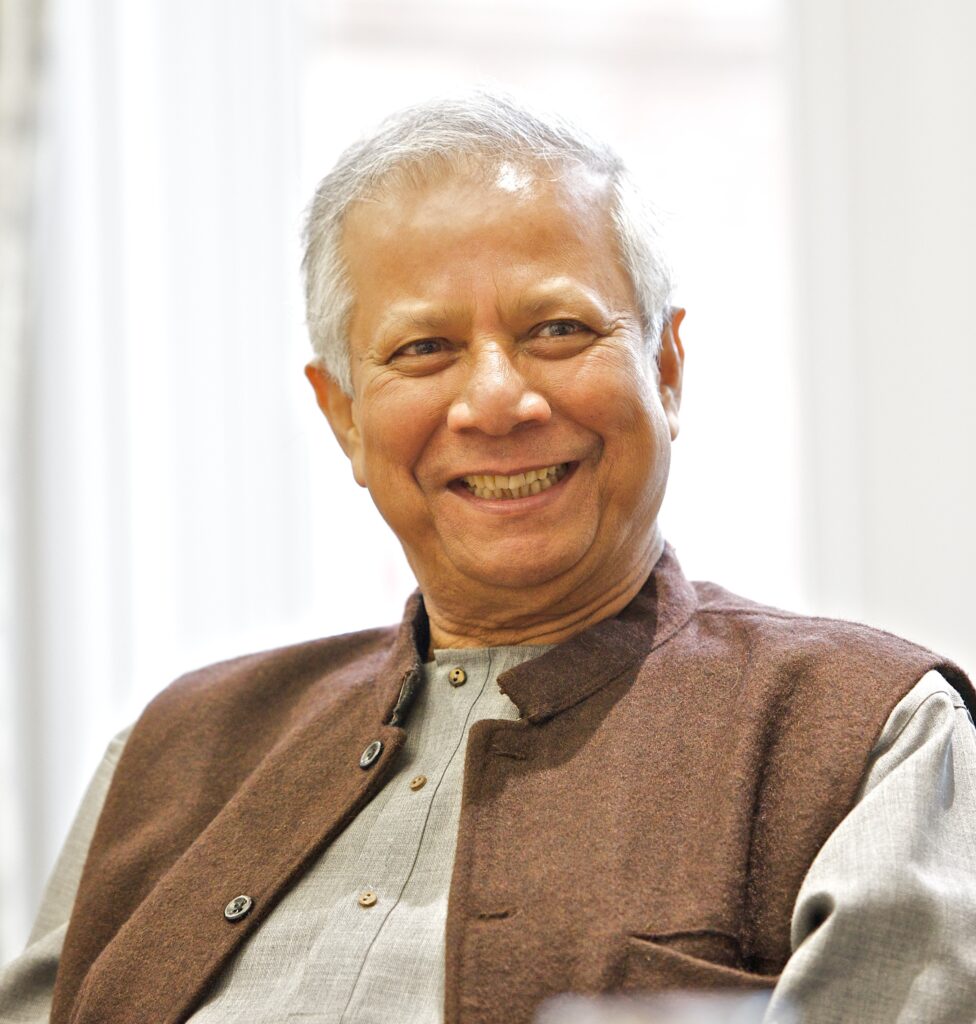
Muhammad Yunus (born 1940) is a Bangladeshi economist and social entrepreneur who pioneered the concepts of microcredit and microfinance, founding the Grameen Bank to provide small loans to impoverished individuals without requiring collateral. His innovative approach to poverty alleviation earned him and the Grameen Bank the Nobel Peace Prize in 2006, establishing him as one of the most influential figures in modern economic development and social business.
Muhammad Yunus at a Glance
| Full name | Muhammad Yunus |
| Born | June 28, 1940, Chittagong, Bengal (present-day Bangladesh) |
| Known for | Pioneering microcredit and founding the Grameen Bank |
| Occupation | Economist, social entrepreneur, banker |
| Major events | Founding of Grameen Bank 1983; Nobel Peace Prize 2006; head of Bangladesh’s interim government 2024 |
| Nationality | Bangladeshi |
Early Life and Education
Muhammad Yunus was born in Chittagong, in what was then British India and later became part of Bangladesh, to a family of modest means that valued education highly. He pursued economics at Dhaka University before continuing his graduate studies in the United States, where he earned a doctorate in economics from Vanderbilt University, building the academic foundation that would later inform his unconventional approach to development economics.
Return to Bangladesh and Academic Career
After completing his doctoral studies, Yunus returned to Bangladesh to teach economics, eventually becoming head of the economics department at Chittagong University. His academic work during this period increasingly focused on the practical challenges facing Bangladesh’s rural poor, particularly following the devastating famine of 1974, which profoundly shaped his thinking about poverty and economic development.
Origins of Microcredit
Yunus’s pioneering work in microcredit began in 1976 when he personally lent a small sum of money to a group of villagers in Jobra, near Chittagong University, allowing them to purchase materials for their small businesses without resorting to predatory moneylenders. This experimental loan, which was repaid in full, convinced Yunus that providing small amounts of credit to the poor, particularly women, could serve as a powerful tool for lifting families out of poverty.
Founding of the Grameen Bank
Building on the success of his initial experiments, Yunus established the Grameen Bank in 1983 as a formal banking institution dedicated to providing microloans to impoverished borrowers without requiring traditional collateral. The bank’s innovative lending model, which relied on group-based lending circles and peer accountability rather than conventional collateral requirements, achieved remarkably high repayment rates and became a model studied and replicated around the world.
Expansion of the Microfinance Model
Under Yunus’s leadership, the Grameen Bank grew substantially over the following decades, eventually serving millions of borrowers across Bangladesh, with the vast majority of loans extended to women in rural communities. The bank’s success demonstrated that poor individuals, when given access to appropriately structured credit, could reliably repay loans and use the capital to build sustainable livelihoods for themselves and their families.
Global Influence on Development Economics
Yunus’s microcredit model inspired the creation of similar microfinance institutions across the developing world, fundamentally influencing international approaches to poverty alleviation and economic development. His ideas challenged conventional banking practices that had historically excluded the poor from formal credit markets, demonstrating an alternative path to financial inclusion that numerous governments and development organizations subsequently adopted.
The Nobel Peace Prize
In 2006, Yunus and the Grameen Bank jointly received the Nobel Peace Prize in recognition of their efforts to create economic and social development from below through microcredit lending to the poor. The Nobel Committee specifically cited the role of microcredit in helping lift large numbers of people out of poverty, particularly emphasizing the empowerment of women borrowers that the Grameen model prioritized.
Concept of Social Business
Beyond microcredit, Yunus developed and promoted the broader concept of social business, which he described as a non-loss, non-dividend company designed to address a social objective rather than maximize profit for shareholders. He founded or co-founded numerous social business ventures in partnership with major international corporations, applying this model to address challenges in areas such as nutrition, healthcare, and renewable energy.
Writing and Advocacy
Yunus has authored several influential books articulating his economic philosophy and documenting the development of microcredit and social business, helping to popularize these concepts among policymakers, academics, and the general public worldwide. His writing and extensive public speaking engagements have made him one of the most recognized voices in global discussions of poverty alleviation and inclusive economic development.
International Recognition and Honors
In addition to the Nobel Peace Prize, Yunus has received numerous other honors throughout his career, including the Presidential Medal of Freedom and the Congressional Gold Medal from the United States, reflecting broad international recognition of his contributions to poverty alleviation and economic development. He has also received honorary degrees from universities around the world in recognition of his pioneering work.
Later Public Role
In 2024, Yunus was called upon to lead Bangladesh’s interim government following a period of significant political change in the country, marking a new chapter in his public life that extended his influence from economic development into national governance. This role placed him at the center of efforts to stabilize and reform the country’s institutions during a critical transitional period.
Institutional Legacy
The institutions and models Yunus pioneered, particularly the Grameen Bank and the broader concept of social business, continue to operate and expand, influencing microfinance practices and poverty alleviation strategies across dozens of countries. His work has inspired a generation of social entrepreneurs who have applied similar market-based approaches to addressing social and environmental challenges worldwide.
Approach to Rural Development
Yunus’s broader philosophy of rural development extended beyond lending alone, incorporating savings programs, insurance products, and educational initiatives designed to address the interconnected challenges facing impoverished rural communities. The Grameen Bank’s holistic model, which evolved over decades of practical experience, sought to build lasting financial independence among borrowers rather than offering only short-term relief from poverty.
Influence on Financial Inclusion Policy
Yunus’s demonstrated success with microcredit significantly influenced financial inclusion policy among national governments and international development institutions, prompting many to establish regulatory frameworks supportive of microfinance institutions. His advocacy helped shift mainstream development thinking toward recognizing financial access as a fundamental tool for poverty reduction rather than a peripheral concern.
Legacy
Muhammad Yunus remains one of the most influential figures in modern economic development, remembered for pioneering microcredit and demonstrating that innovative financial models could serve as powerful tools for poverty alleviation. His work with the Grameen Bank fundamentally transformed global approaches to development economics and financial inclusion, earning him recognition as one of the leading social innovators of his era.
References
- New World Encyclopedia – Muhammad Yunus
- History.com – Muhammad Yunus
- The Nobel Prize – Muhammad Yunus Facts
Frequently Asked Questions
What is Muhammad Yunus best known for? He is best known for pioneering microcredit and founding the Grameen Bank, which provides small loans to impoverished individuals without requiring collateral.
Why did Muhammad Yunus win the Nobel Peace Prize? He and the Grameen Bank jointly received the 2006 Nobel Peace Prize for their efforts to create economic and social development through microcredit lending to the poor.
What is social business according to Muhammad Yunus? He defines it as a non-loss, non-dividend company designed to address a social objective rather than maximize profit for shareholders.
What role did Muhammad Yunus take on in 2024? He was called upon to lead Bangladesh’s interim government following a period of significant political change in the country.
Editorially reviewed by Specialty Digest Editorial TeamLast reviewed November 29, 2026Researched and drafted with AI assistanceReport an issue