Devil’s club (Oplopanax horridus) is a spiny shrub of the ginseng family, Araliaceae, found in moist forests from Southcentral Alaska south to Oregon. It usually grows 1 to 1.5 metres tall, and in moist gullies it can reach 3 to 5 metres.[1]
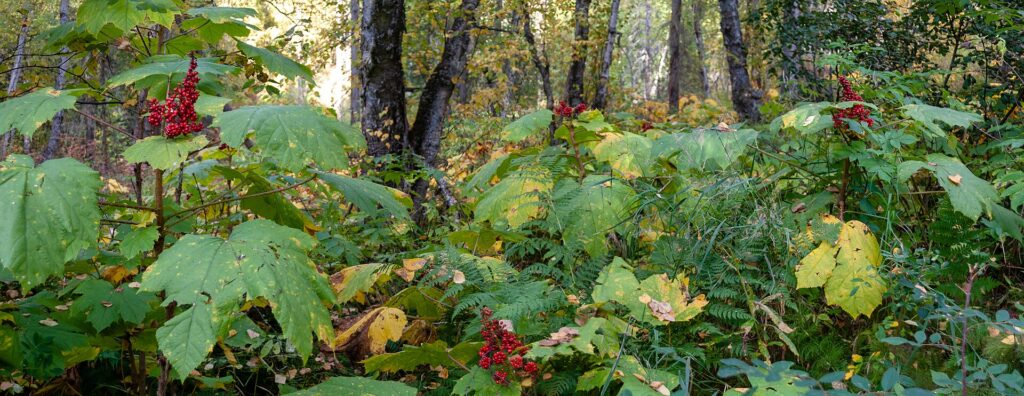
| Scientific name | Oplopanax horridus |
|---|---|
| Family | Araliaceae |
| Height | 1 to 1.5 m usually; up to 3 to 5 m |
| Leaves | 5 to 13 lobes, 20 to 40 cm across |
| Fruit | Red drupes, 4 to 7 mm |
| Range | Southcentral Alaska to Oregon and Montana |
Description
Spines cover the stems and the veins on both sides of the leaves. The leaves are spirally arranged, simple and palmately lobed with 5 to 13 lobes, measuring 20 to 40 centimetres across. Small greenish-white five-petalled flowers form dense umbels 10 to 20 centimetres across, followed by small red drupes 4 to 7 millimetres wide. Wildlife such as bears eat the berries, which are inedible to people, and touching the plant can cause irritation.[1]
Range and habitat
The species occurs from Southcentral Alaska south to Oregon and east to western Alberta and Montana, with separate populations on islands in Lake Superior in Michigan and Ontario. It is most abundant in old-growth conifer forests of the Pacific Northwest, in moist, dense forest.[1]
Ecology
Devil’s club grows slowly and takes many years to reach seed-bearing maturity. It spreads mainly through clonal colonies formed by rhizomes, so several apparent plants may come from one parent.[1]
Traditional use
The Tlingit, Haida and Tsimshian peoples have used the plant ceremonially and medicinally. Charcoal from the stalks was used for face paint, and a piece hung over a doorway was believed to ward off evil. It is sold as Alaskan ginseng, but it is not a true ginseng.[1]
FAQs
Is devil’s club a ginseng? It is in the same family but is not a true ginseng.
Where does it grow? In moist forests from Southcentral Alaska to Oregon and Montana.
Are the berries edible? They are not edible for people.
Sources
Key facts
- Leaves 20 to 40 cm across
- Spreads by rhizomes
Quick checkWhat is the scientific name of devil’s club?Show answer
Oplopanax horridus
Sources
- Wikipedia. Devil’s club. 2026 (accessed 2026-11-14)
Editorially reviewed by Specialty Digest Editorial TeamLast reviewed November 14, 2026Researched and drafted with AI assistanceReport an issue