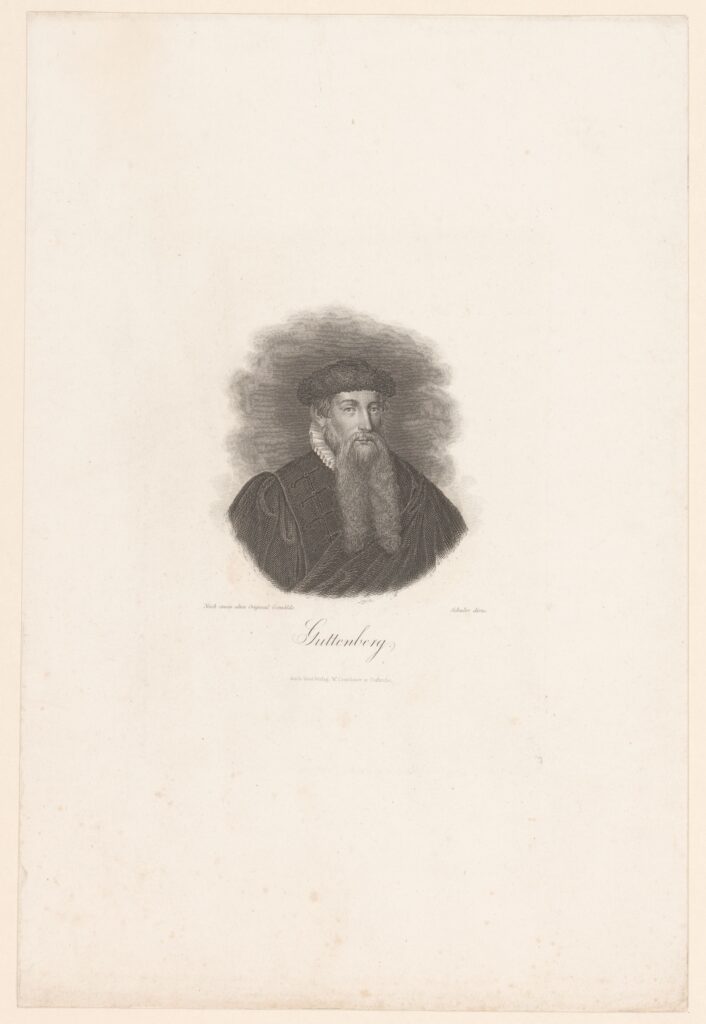
Johannes Gutenberg (c. 1400-1468) was a German inventor and craftsman credited with developing the printing press with movable metal type in Europe, a technological innovation that transformed the production and distribution of written material. His invention, first fully realized around 1450 in the city of Mainz, laid the technical foundation for the mass production of books and is widely regarded as one of the most consequential developments in the history of communication.
Johannes Gutenberg at a Glance
| Full name | Johannes Gensfleisch zur Laden zum Gutenberg |
| Born | c. 1400, Mainz, Holy Roman Empire |
| Died | February 3, 1468, Mainz |
| Known for | Inventing the movable-type printing press; printing the Gutenberg Bible |
| Occupation | Goldsmith, printer, inventor |
| Major events | Developed movable type printing c. 1440s; printed the Gutenberg Bible c. 1455 |
| Nationality | German |
Early Life and Training
Johannes Gutenberg was born in the city of Mainz, in what is now Germany, into a family associated with the local merchant class, and he received training as a goldsmith, a trade that gave him valuable technical skill in metalworking. This background in precise metal craftsmanship would later prove essential to his development of durable, reusable metal type, distinguishing his approach from earlier printing methods that relied on carved wooden blocks.
Development of Movable Type
During the 1440s, working first in Strasbourg and later in Mainz, Gutenberg began developing a system for casting individual metal letters that could be arranged, inked, and reused to print text, a significant departure from the labor-intensive woodblock printing that had previously dominated European book production. His innovation combined several technical elements, including a durable metal alloy for casting type, an oil-based ink suited to metal surfaces, and an adapted screw press mechanism, into a unified and repeatable printing process.
Financial Backing and Early Operations
To fund the considerable costs of developing and operating his printing workshop, Gutenberg entered into a financial partnership with a Mainz businessman named Johann Fust, who provided substantial loans to support the enterprise. This financial relationship, while initially productive, later became strained and eventually led to a legal dispute that significantly affected the ownership and operation of Gutenberg’s printing workshop.
The Gutenberg Bible
Around 1455, Gutenberg’s workshop completed printing of the Latin Vulgate Bible, now known as the Gutenberg Bible, widely regarded as the first major book printed in Europe using movable metal type. The production of this Bible, notable for its high typographic quality and the relatively large number of copies produced compared to hand-copied manuscripts, demonstrated the practical viability of movable-type printing as a method for producing books at a previously unattainable scale.
Legal Dispute and Loss of the Workshop
Following a legal dispute with his financial backer Johann Fust over the repayment of loans, Gutenberg lost control of much of his printing equipment and materials, with Fust and his son-in-law Peter Schoffer continuing to operate the printing business. Despite this significant setback, Gutenberg continued some printing work on a smaller scale during his remaining years, though the full extent of his later printing activities remains less thoroughly documented than his earlier achievements.
Spread of Printing Technology
Following the dispersal of Gutenberg’s workshop and the training of various associates in his printing methods, knowledge of movable-type printing spread rapidly across Europe during the following decades, as printers trained in the Mainz tradition established workshops in numerous other cities. This diffusion of printing technology occurred remarkably quickly, with printing presses operating in dozens of European cities within just a few decades of Gutenberg’s initial innovations in Mainz.
Recognition in Later Life
In his later years, Gutenberg received some recognition for his contributions, including an appointment to the court of the Archbishop of Mainz, which provided him with a measure of financial security and court-adjacent status. This recognition, however, came relatively late in his life and stood in some contrast to the financial difficulties and legal setbacks that had characterized much of his earlier printing career.
Technical Legacy of the Printing Press
Gutenberg’s combination of movable metal type, oil-based ink, and a mechanical press represented a complete printing system that proved remarkably durable, remaining the basic technological model for printing in the West for several centuries with relatively modest modifications. The fundamental principles he established, casting reusable individual letters and combining them with a mechanical press, continued to underpin printing technology long after his death.
Transformation of Information Access
The spread of printing technology that followed Gutenberg’s invention dramatically increased the availability and affordability of written material across Europe, contributing to rising literacy rates and the broader circulation of ideas, texts, and knowledge across geographic and social boundaries. This transformation in the production and distribution of written material is widely considered to have played a significant role in subsequent major intellectual and cultural developments across Europe, including the wider circulation of scholarly and religious texts.
Standardization of Texts
Printing with movable type also enabled a degree of textual standardization that had been difficult to achieve with hand-copied manuscripts, since each printed copy from a given typesetting was essentially identical, reducing the errors and variations that commonly arose through manual copying. This increased consistency had significant implications for fields that depended on precise and reliable texts, including scholarship, law, and religious study, where accurate textual transmission was of particular importance.
Commemoration and Historical Recognition
Gutenberg has been commemorated extensively in the centuries since his death, including through museums, monuments, and institutions bearing his name, most notably the Gutenberg Museum in Mainz, which houses an extensive collection related to the history of printing and preserves original copies of the Gutenberg Bible. His name has become closely associated with the broader concept of the printing revolution itself, reflecting the centrality of his contribution to the history of written communication.
Printing Beyond Mainz
Within a generation of Gutenberg’s original innovations, printing workshops modeled on his techniques had spread to major cities including Rome, Venice, Paris, and London, as craftsmen trained in the Mainz methods carried the technology across the continent. This rapid geographic expansion meant that printing quickly became a continent-wide enterprise rather than a localized craft, with different cities developing their own printing traditions while retaining the core technical principles Gutenberg had established. The speed of this spread is often cited by historians as evidence of how effectively Gutenberg’s system solved the practical challenges that had limited earlier approaches to reproducing text.
Legacy
Johannes Gutenberg remains one of the most historically significant inventors in the history of communication technology, remembered for developing the movable-type printing process that made the mass production of books possible for the first time in European history. His technical innovations fundamentally changed how information was produced, distributed, and preserved, establishing a printing model that remained foundational to the production of written material for centuries after his death.
References
- New World Encyclopedia – Johannes Gutenberg
- History.com – Johannes Gutenberg
- History.com – Printing Press
Frequently Asked Questions
What is Johannes Gutenberg best known for? He is best known for inventing the movable-type printing press in Europe and for printing the Gutenberg Bible, one of the first major books produced using this technology.
When did Johannes Gutenberg invent the printing press? He developed his movable-type printing process during the 1440s, with his famous Gutenberg Bible completed around 1455.
What made Gutenberg’s printing method different from earlier techniques? His method combined durable, reusable metal type, oil-based ink, and a mechanical screw press into a unified system, unlike the woodblock printing that preceded it.
What happened to Gutenberg’s printing workshop? Following a legal dispute with his financial backer Johann Fust, Gutenberg lost control of much of his printing equipment, though he continued smaller-scale printing work afterward.
Editorially reviewed by Specialty Digest Editorial TeamLast reviewed November 29, 2026Researched and drafted with AI assistanceReport an issue