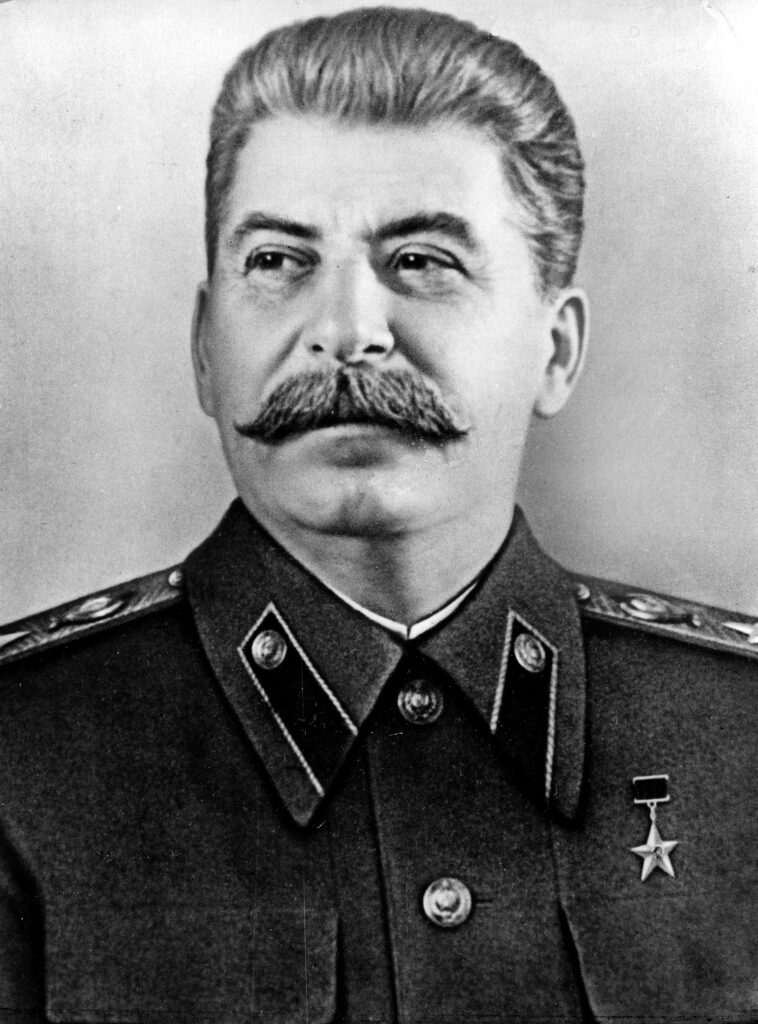
Joseph Stalin (1878-1953) was a Soviet politician who led the Soviet Union as General Secretary of the Communist Party from the mid-1920s until his death in 1953. His leadership oversaw the Soviet Union’s rapid industrialization and its decisive role in the Allied victory in World War II, alongside policies that resulted in widespread political repression and famine, making him one of the most consequential and historically significant leaders of the twentieth century.
Joseph Stalin at a Glance
| Full name | Joseph Vissarionovich Stalin (born Ioseb Jughashvili) |
| Born | December 18, 1878, Gori, Georgia (Russian Empire) |
| Died | March 5, 1953, Kuntsevo Dacha, near Moscow |
| Known for | Leader of the Soviet Union 1924-1953; led Soviet industrialization and World War II effort |
| Occupation | Politician, General Secretary of the Communist Party |
| Major events | Rose to Soviet leadership 1924; led Soviet Union through World War II 1941-1945; died 1953 |
| Nationality | Georgian-born Soviet/Russian |
Early Life
Joseph Stalin was born Ioseb Jughashvili in the town of Gori in Georgia, then part of the Russian Empire, the son of a shoemaker, and he attended a theological seminary in Tbilisi before being expelled for revolutionary activity. His early exposure to Marxist political thought during this period set him on a path toward involvement in the underground revolutionary movements that were active across the Russian Empire in the early twentieth century.
Early Revolutionary Activity
Stalin became involved with the Bolshevik faction of the Russian Social Democratic Labor Party in the early 1900s, participating in underground political organizing, propaganda distribution, and fundraising activities that at times involved direct confrontation with imperial authorities. He was arrested and exiled to Siberia multiple times during this period for his revolutionary activities, experiences that further embedded him within the Bolshevik political network led by Vladimir Lenin.
The Russian Revolution and Civil War
Following the Bolshevik seizure of power in the October Revolution of 1917, Stalin held several significant positions within the new Soviet government, and during the subsequent Russian Civil War he took on military and political roles that helped establish Bolshevik control over contested regions. His effectiveness in these roles, combined with his organizational work within the Communist Party apparatus, positioned him for increasing influence within Soviet leadership circles.
Rise to Supreme Leadership
In 1922, Stalin was appointed General Secretary of the Communist Party, a position that initially appeared administrative but that he used to build a substantial base of political support throughout the party apparatus. Following Lenin’s death in 1924, Stalin outmaneuvered rival Bolshevik leaders including Leon Trotsky through a combination of political alliances and strategic positioning, ultimately emerging by the late 1920s as the undisputed leader of the Soviet Union.
Industrialization and Collectivization
Stalin’s government pursued an ambitious program of rapid industrialization through a series of Five-Year Plans beginning in 1928, which transformed the Soviet Union from a largely agrarian economy into a major industrial power within roughly a decade. This industrialization was accompanied by the forced collectivization of agriculture, a policy that disrupted traditional farming practices and contributed to severe famines in the early 1930s, including the Holodomor famine that devastated Ukraine and other grain-producing regions.
Political Repression and the Great Purge
Throughout the 1930s, Stalin’s government conducted extensive political repression through a series of campaigns known collectively as the Great Purge, in which perceived political opponents, military officers, party officials, and ordinary citizens were arrested, imprisoned in the Gulag labor camp system, or executed on a massive scale. These campaigns, carried out through show trials and extrajudicial procedures, resulted in the deaths and imprisonment of millions of Soviet citizens and remain a central and extensively documented aspect of Stalin’s rule.
World War II Leadership
Following Germany’s invasion of the Soviet Union in 1941, Stalin assumed direct military leadership of Soviet forces, overseeing a war effort that, despite catastrophic early losses, ultimately resulted in the Soviet Union playing the decisive role in defeating Nazi Germany on the Eastern Front. Soviet victories at Stalingrad and Kursk marked turning points in the broader war, and the Soviet Union’s subsequent advance into Eastern Europe and Berlin established it as one of the two dominant global powers in the war’s aftermath.
Postwar Soviet Union and the Beginning of the Cold War
In the years following World War II, Stalin’s government consolidated Soviet control over Eastern European states, establishing communist governments aligned with Moscow and setting the stage for the decades-long Cold War rivalry with the United States and its Western allies. Domestically, Stalin’s government continued policies of political repression and ideological control, while also directing the Soviet Union’s postwar reconstruction and early development of nuclear weapons capability.
Death and Immediate Aftermath
Stalin died in March 1953 at his dacha near Moscow, after which a collective leadership initially governed the Soviet Union before Nikita Khrushchev emerged as his successor. Khrushchev’s 1956 “Secret Speech” to the Communist Party, which denounced aspects of Stalin’s rule including the purges and the cult of personality surrounding him, marked a significant turning point in Soviet political history and began a long process of historical reassessment of Stalin’s legacy.
Historical Assessment and Legacy
Joseph Stalin’s rule transformed the Soviet Union into a major industrial and military power while simultaneously producing immense human suffering through political repression, forced collectivization, and famine, a dual legacy that continues to be the subject of extensive historical scholarship and debate. His leadership during World War II secured the Soviet Union’s position as a global superpower, while the scale of the repression carried out under his government remains a central and extensively documented chapter in twentieth-century history.
Cult of Personality
Stalin’s government cultivated an extensive cult of personality that presented him as an infallible and paternal leader through state-controlled media, public monuments, and cultural production across the Soviet Union. This apparatus of glorification, maintained through strict censorship and propaganda, shaped Soviet public life for decades and significantly influenced how subsequent authoritarian states would later construct similar personality cults around their own leaders.
Postwar Historical Reckoning
In the decades since Stalin’s death, extensive archival research, particularly following the opening of Soviet state archives after the collapse of the Soviet Union in 1991, has allowed historians to document the scale and mechanisms of his rule with considerably greater precision than was previously possible. This body of scholarship has established Stalin’s era as one of the most intensively studied periods in modern history, informing ongoing historical and political debates about totalitarianism, state violence, and the long-term legacy of Soviet governance across the former Soviet republics and Eastern Europe.
References
- New World Encyclopedia – Joseph Stalin
- History.com – Joseph Stalin
- History.com – Joseph Stalin Topic Page
Frequently Asked Questions
What is Joseph Stalin known for? He is known as the leader of the Soviet Union from the mid-1920s until 1953, overseeing rapid industrialization and the Soviet role in defeating Nazi Germany, alongside extensive political repression.
How did Stalin rise to power? He was appointed General Secretary of the Communist Party in 1922 and, following Lenin’s death in 1924, outmaneuvered rival Bolshevik leaders to become the Soviet Union’s undisputed leader by the late 1920s.
What was the Great Purge? It refers to a series of political repression campaigns in the 1930s in which perceived opponents and ordinary citizens were arrested, imprisoned, or executed on a massive scale.
What role did Stalin play in World War II? He led Soviet forces after Germany’s 1941 invasion, and the Soviet Union’s subsequent victories played a decisive role in defeating Nazi Germany on the Eastern Front.
Editorially reviewed by Specialty Digest Editorial TeamLast reviewed November 29, 2026Researched and drafted with AI assistanceReport an issue