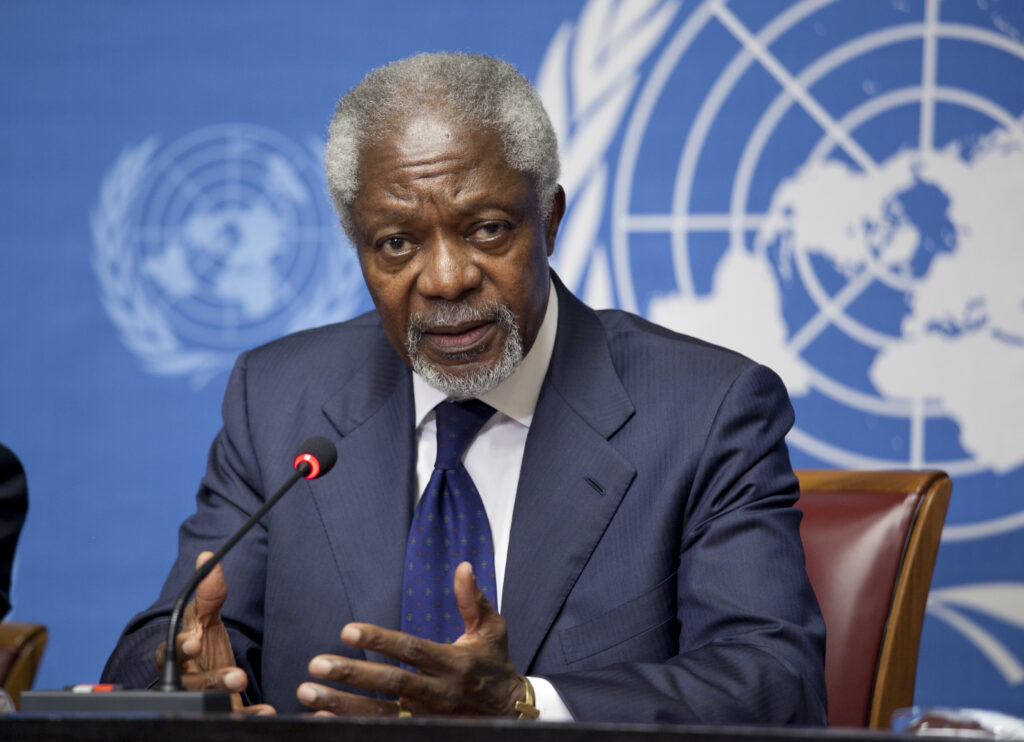
Kofi Annan (1938-2018) was a Ghanaian diplomat who served as the seventh Secretary-General of the United Nations from 1997 to 2006, becoming the first person from sub-Saharan Africa to hold the position and the first to rise to it through the ranks of the UN’s own staff. His tenure was marked by efforts to reform the United Nations, address global health crises, and promote human rights and development, work that earned him and the organization the Nobel Peace Prize in 2001.
Kofi Annan at a Glance
| Full name | Kofi Atta Annan |
| Born | April 8, 1938, Kumasi, Gold Coast (now Ghana) |
| Died | August 18, 2018, Bern, Switzerland |
| Known for | Serving as seventh Secretary-General of the United Nations; Nobel Peace Prize laureate 2001 |
| Occupation | Diplomat, international civil servant |
| Major events | Joined the UN 1962; became Secretary-General 1997; awarded Nobel Peace Prize 2001; founded the Kofi Annan Foundation 2007 |
| Nationality | Ghanaian |
Early Life and Education
Kofi Annan was born in Kumasi, in what was then the British colony of the Gold Coast, into a prominent family active in local civic life. He pursued higher education in economics in Ghana before continuing his studies in the United States and Switzerland, eventually earning a master’s degree in management from the Massachusetts Institute of Technology, an international academic background that would later inform his approach to global diplomacy and institutional management.
Early Career at the United Nations
Annan joined the United Nations system in 1962, beginning a career within the organization that would span more than four decades and take him through numerous departments and assignments across the UN’s administrative and operational structure. His early roles included work with the World Health Organization and various UN budgetary and personnel offices, experience that provided him with a comprehensive understanding of the organization’s internal workings well before he rose to its highest office.
Rise Through UN Leadership
Over the following decades, Annan steadily advanced through increasingly senior positions within the United Nations, including serving as Under-Secretary-General for Peacekeeping Operations during the early 1990s, a period that encompassed some of the organization’s most difficult peacekeeping challenges. This extensive administrative experience distinguished him as a candidate uniquely prepared for the organization’s top leadership role when the position became available in the mid-1990s.
Election as Secretary-General
In 1997, Annan was elected Secretary-General of the United Nations, becoming the first person to rise to the position from within the ranks of the organization’s own career staff and the first sub-Saharan African to hold the office. His selection was widely regarded as a recognition of his deep institutional knowledge and his reputation as a skilled and even-tempered diplomat capable of navigating the UN’s complex political environment.
Reform of the United Nations
During his tenure, Annan pursued significant institutional reforms aimed at making the United Nations more efficient, transparent, and responsive to emerging global challenges, including restructuring various UN agencies and streamlining administrative processes. These reform efforts reflected his conviction that the organization needed to modernize its operations in order to remain effective and relevant in addressing the complex international issues of the post-Cold War era.
Global Health and Development Initiatives
Annan placed considerable emphasis on global health and development during his time as Secretary-General, playing a central role in establishing the Global Fund to Fight AIDS, Tuberculosis and Malaria, an initiative that mobilized substantial international resources to combat these diseases in lower-income countries. His advocacy for the Millennium Development Goals, a set of international targets addressing poverty, education, and health, further established his legacy as a leader focused on practical, measurable progress on global development challenges.
The Nobel Peace Prize
In 2001, Annan and the United Nations were jointly awarded the Nobel Peace Prize in recognition of their work for a better organized and more peaceful world, an honor that reflected international recognition of his efforts to revitalize the organization and address pressing global challenges. The award highlighted his particular focus on combating the AIDS pandemic and his broader commitment to strengthening international cooperation on issues ranging from peacekeeping to human rights.
Peacekeeping and International Diplomacy
Throughout his tenure, Annan was deeply involved in international diplomatic efforts to resolve conflicts and strengthen peacekeeping operations around the world, often serving as a mediator in difficult negotiations between opposing parties in regional disputes. His approach to diplomacy emphasized dialogue and multilateral cooperation, principles that he continued to apply in his international work even after concluding his term as Secretary-General.
Later Diplomatic Work
After leaving the position of Secretary-General in 2006, Annan remained active in international diplomacy, taking on various mediation roles including serving as a special envoy for the United Nations and the Arab League on the Syrian conflict. His continued engagement in international affairs reflected his enduring commitment to conflict resolution and his standing as one of the most respected elder statesmen in global diplomacy.
The Kofi Annan Foundation
In 2007, Annan established the Kofi Annan Foundation, an organization dedicated to promoting better global governance, sustainable development, and peace, which continued much of the work he had championed during his time at the United Nations. Through the foundation, Annan remained engaged in efforts to strengthen democratic institutions and promote fair elections in various countries around the world, extending his influence well beyond his formal diplomatic career.
Rwanda and Institutional Reflection
During his tenure as Secretary-General, Annan oversaw a period of considerable institutional reflection within the United Nations regarding the organization’s response to major humanitarian crises of the 1990s, including commissioning formal independent inquiries into the UN’s conduct during the Rwandan genocide and the fall of Srebrenica. This willingness to support candid institutional self-examination, even when the findings were uncomfortable for the organization itself, was widely regarded as a hallmark of his leadership and contributed to subsequent reforms in UN peacekeeping doctrine.
Global Compact and Private Sector Engagement
Annan was instrumental in launching the United Nations Global Compact in 2000, an initiative encouraging businesses worldwide to adopt sustainable and socially responsible policies in areas including human rights, labor standards, and environmental protection. This effort to engage the private sector directly in advancing UN principles reflected his broader belief that addressing global challenges required cooperation extending well beyond traditional diplomatic channels to include businesses, civil society organizations, and other non-governmental actors.
Legacy
Kofi Annan remains one of the most significant figures in the history of the United Nations, remembered for his pioneering leadership as the first career UN staff member to become Secretary-General and for his sustained efforts to modernize the organization and address pressing global health and development challenges. His Nobel Peace Prize and decades of diplomatic service established a legacy of principled, pragmatic internationalism that continued to influence global governance discussions well beyond his time in office.
References
Frequently Asked Questions
What is Kofi Annan best known for? He is best known for serving as the seventh Secretary-General of the United Nations and for being awarded the Nobel Peace Prize in 2001.
Was Kofi Annan the first African Secretary-General of the UN? He was the first Secretary-General from sub-Saharan Africa and the first to have risen through the ranks of the organization’s own career staff.
Why did Kofi Annan win the Nobel Peace Prize? He and the United Nations jointly received the prize in 2001 for their work toward a better organized and more peaceful world, including efforts to combat the AIDS pandemic.
What did Kofi Annan do after leaving the United Nations? He remained active in international diplomacy, including mediation work on the Syrian conflict, and founded the Kofi Annan Foundation to promote global governance and sustainable development.
Editorially reviewed by Specialty Digest Editorial TeamLast reviewed November 29, 2026Researched and drafted with AI assistanceReport an issue