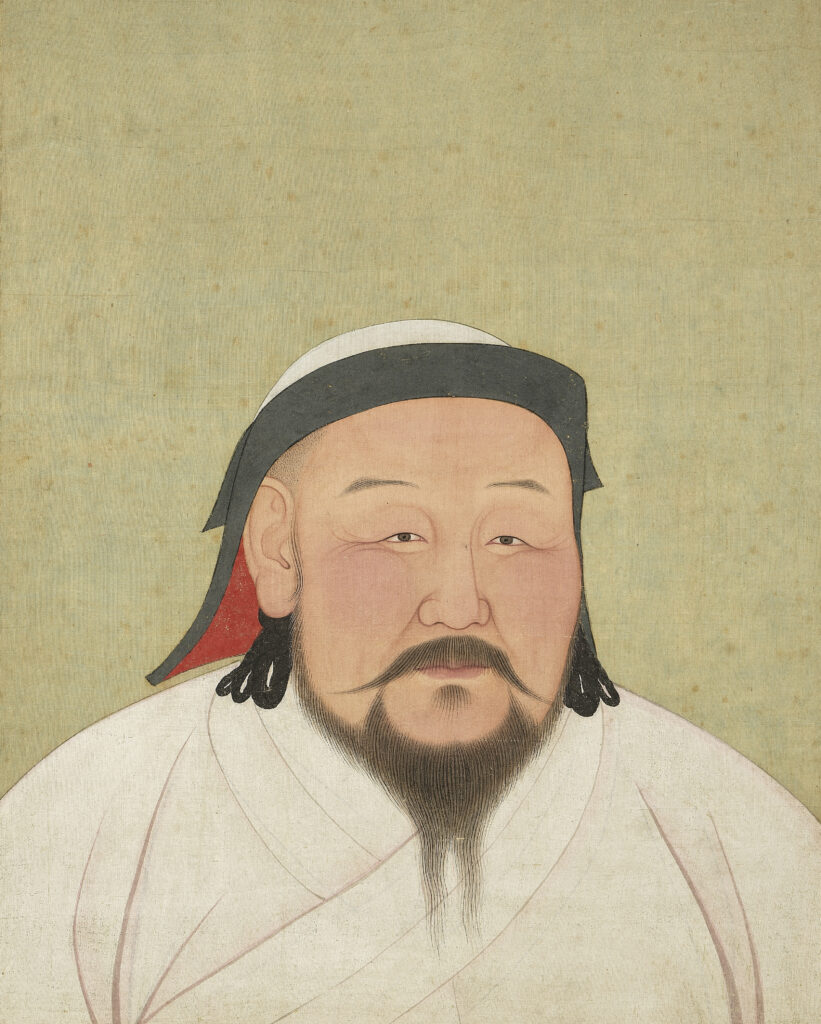
Kublai Khan (1215 – 1294) was the fifth Great Khan of the Mongol Empire and the founder of the Yuan dynasty, ruling as Emperor of China from 1271 until his death in 1294 and completing the Mongol conquest of China begun by his grandfather Genghis Khan. His reign marked the first time a foreign dynasty ruled the whole of China, and his governance blended Mongol military organization with Chinese administrative traditions to create one of the largest and most influential empires in world history.
Kublai Khan at a Glance
| Full name | Kublai Khan (temple name Emperor Shizu of Yuan) |
| Born | September 23, 1215, Mongol Empire |
| Died | February 18, 1294, Khanbaliq (modern Beijing) |
| Known for | Founder of the Yuan dynasty; completion of the Mongol conquest of China; patron of Marco Polo |
| Occupation | Monarch |
| Major events | Election as Great Khan in 1260; conquest of the Southern Song dynasty in 1279; founding of the Yuan dynasty |
| Nationality | Mongol |
Early Life and Family Background
Kublai was born as a grandson of Genghis Khan, the founder of the Mongol Empire, and received an upbringing that combined traditional Mongol military training with exposure to Chinese culture and administration through his mother’s influence and his own governance of territories in northern China. His early career included significant administrative experience governing Chinese territories on behalf of his brother, the Great Khan Mongke, which shaped his later approach to imperial governance.
Rise to the Khanate
Kublai was elected Great Khan of the Mongol Empire in 1260 following the death of his brother Mongke, though his succession was contested by his younger brother Ariq Boke, leading to a civil war within the Mongol ruling family that lasted several years. Kublai’s eventual victory in this succession conflict secured his position as Great Khan, though the broader Mongol Empire increasingly fragmented into semi-independent khanates during and after this period of internal conflict.
Conquest of Southern China
Kublai Khan completed the Mongol conquest of China by defeating the Southern Song dynasty in a protracted military campaign that concluded with Song surrender in 1279, unifying all of China under Mongol rule for the first time. This conquest required the development of new Mongol naval capabilities and siege warfare techniques, as the mounted cavalry tactics that had proven so effective on the open steppes needed significant adaptation to overcome the fortified cities and waterways of southern China.
Founding the Yuan Dynasty
Kublai Khan formally established the Yuan dynasty in 1271, adopting a Chinese dynastic name and style of imperial governance while retaining Mongol military and administrative structures, creating a hybrid system of rule over his vast Chinese territories. This dynastic founding represented a deliberate strategy to legitimize Mongol rule in the eyes of the Chinese population by adopting familiar imperial symbols and institutions alongside continued Mongol military dominance.
Administrative Governance
Kublai Khan developed a sophisticated administrative system that combined Mongol military governance with traditional Chinese bureaucratic institutions, relying heavily on foreign administrators, including Central Asian Muslims and some Europeans, to help manage the empire’s Chinese territories. This approach reflected his strategy of maintaining Mongol control while utilizing the administrative expertise available from across his vast multicultural empire, though it also generated resentment among segments of the Chinese population excluded from higher administrative positions.
Capital at Khanbaliq
Kublai Khan established his capital at Khanbaliq, the site of modern Beijing, constructing an impressive imperial city that served as the political and cultural center of the Yuan dynasty and symbolized the fusion of Mongol and Chinese imperial traditions. The city’s grand palaces and urban planning reflected both Mongol and Chinese architectural influences, and it became a significant center of trade and cultural exchange along the broader networks connecting Asia and Europe during this period.
Relations with Marco Polo and Europe
Kublai Khan’s court became famous in European history through the accounts of the Venetian traveler Marco Polo, who claimed to have served the Mongol emperor for an extended period and later wrote detailed descriptions of Yuan China that profoundly shaped European perceptions of Asia for centuries. These accounts, whatever their precise historical accuracy, reflected the broader pattern of expanded trade and diplomatic contact between the Mongol Empire and distant regions that characterized this period of Eurasian history.
Failed Military Campaigns
Kublai Khan launched several ambitious but ultimately unsuccessful military campaigns beyond China, including two failed invasions of Japan in 1274 and 1281 that were significantly disrupted by typhoons the Japanese later termed kamikaze, or divine wind. His military ventures into Southeast Asia, including campaigns against Vietnam and Java, similarly met with limited success, demonstrating the practical limits of Mongol military expansion beyond the continental terrain where their cavalry-based tactics proved most effective.
Economic and Trade Policy
Kublai Khan’s government actively promoted trade and commerce throughout the empire, maintaining and expanding the networks of overland and maritime trade routes that connected China with Central Asia, the Middle East, and ultimately Europe. His administration introduced paper currency on a scale not previously attempted, facilitating commerce across the vast empire, though the system eventually faced significant challenges related to inflation and currency management in his later years.
Religious Tolerance and Patronage
Kublai Khan maintained a policy of general religious tolerance throughout his reign, patronizing Buddhist, Confucian, Daoist, and other religious traditions while personally favoring Tibetan Buddhism, which he promoted as a unifying religious framework for his diverse multiethnic empire. This tolerant religious policy, consistent with broader Mongol imperial traditions, helped maintain stability across an empire that encompassed numerous distinct religious and cultural communities.
Cultural Patronage
Kublai Khan was a significant patron of the arts and sciences, supporting astronomers, physicians, and scholars from across his empire and sponsoring significant advances in cartography, astronomy, and medicine that drew on both Chinese and foreign knowledge traditions. His court attracted talented individuals from across Eurasia, reflecting the broader cosmopolitan character of the Mongol Empire at the height of its power and influence.
Later Years and Succession
Kublai Khan’s later reign was marked by personal losses, including the deaths of his favorite wife and his chosen heir, which contributed to a decline in his health and vigor during his final years as emperor. His death in 1294 led to a succession process that, while initially stable, eventually contributed to the gradual weakening of Yuan dynasty authority over the following decades as subsequent emperors struggled to match his administrative and military achievements.
Legacy
Kublai Khan remains one of the most significant figures in both Mongol and Chinese history, remembered for completing the Mongol conquest of China and establishing the Yuan dynasty as the first foreign dynasty to rule the entirety of the Chinese empire. His reign facilitated unprecedented levels of trade and cultural exchange across Eurasia, and his administrative innovations, blending Mongol and Chinese traditions, influenced Chinese governance even after the Yuan dynasty’s eventual collapse less than a century after his death.
References
Frequently Asked Questions
What is Kublai Khan best known for? He is best known as the founder of the Yuan dynasty who completed the Mongol conquest of China and became the first foreign ruler of the entire Chinese empire.
What was Kublai Khan’s connection to Marco Polo? The Venetian traveler Marco Polo claimed to have served at Kublai Khan’s court and later wrote influential accounts of Yuan China that shaped European views of Asia.
Did Kublai Khan’s invasions of Japan succeed? No, both his 1274 and 1281 invasions of Japan failed, significantly disrupted by typhoons the Japanese called kamikaze, or divine wind.
What was the Yuan dynasty? It was the Chinese dynasty Kublai Khan founded in 1271, blending Mongol military rule with traditional Chinese imperial governance.
Editorially reviewed by Specialty Digest Editorial TeamLast reviewed November 29, 2026Researched and drafted with AI assistanceReport an issue