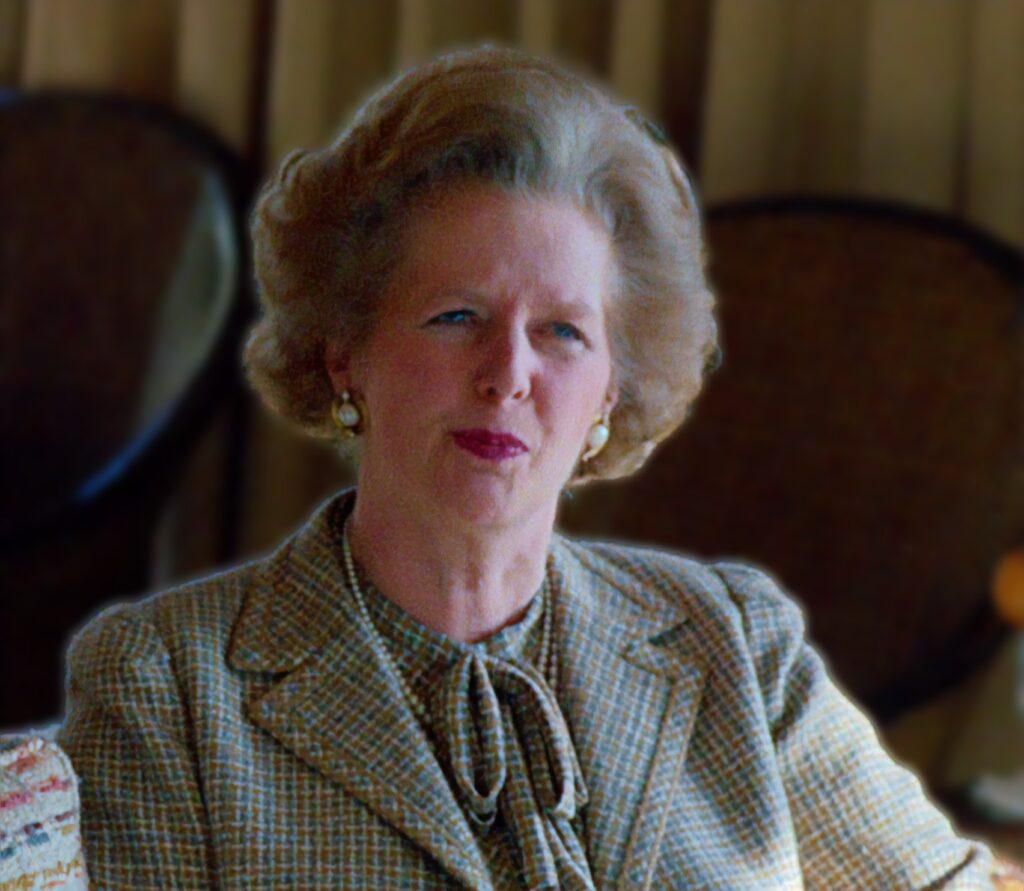
Margaret Thatcher (1925 – 2013) was a British politician who served as Prime Minister of the United Kingdom from 1979 to 1990, becoming the first woman to hold the office and one of the longest-serving British prime ministers of the twentieth century. Known as the “Iron Lady” for her uncompromising political style, she implemented sweeping free-market economic reforms that fundamentally reshaped British politics and society.
Margaret Thatcher at a Glance
| Full name | Margaret Hilda Thatcher |
| Born | October 13, 1925, Grantham, Lincolnshire, England |
| Died | April 8, 2013, London, England |
| Known for | First female British Prime Minister; the Iron Lady; Thatcherism economic reforms |
| Occupation | Politician, chemist, barrister |
| Major events | Falklands War of 1982; privatization program; miners’ strike of 1984-1985 |
| Political party | Conservative |
| Nationality | British |
Early Life and Education
Thatcher was born in Grantham, Lincolnshire, the daughter of a grocer who also served as a local alderman and Methodist lay preacher, growing up with strong values of self-reliance and hard work. She studied chemistry at Somerville College, Oxford, working briefly as a research chemist before training as a barrister and developing an early interest in Conservative Party politics.
Entry into Parliament
Thatcher was elected to the House of Commons in 1959 as the Member of Parliament for Finchley, beginning a parliamentary career that would eventually lead to the highest office in British politics. She served in several junior ministerial roles during the 1960s before being appointed Secretary of State for Education and Science in Edward Heath’s government in 1970.
Becoming Conservative Party Leader
Thatcher challenged and defeated Edward Heath for the leadership of the Conservative Party in 1975, becoming the first woman to lead a major British political party. Her victory reflected growing dissatisfaction within the party over Heath’s handling of economic difficulties and set the stage for her eventual rise to the premiership.
Becoming Prime Minister
Thatcher led the Conservative Party to victory in the 1979 general election, becoming Britain’s first female Prime Minister amid widespread public frustration with labor unrest and economic stagnation under the previous Labour government. Her election marked a significant turning point in British politics, introducing a new era of free-market economic policy.
Economic Policy and Thatcherism
Thatcher implemented a program of free-market economic reforms that became known as Thatcherism, including reducing the power of trade unions, cutting government spending, and promoting individual enterprise over state intervention. These policies fundamentally transformed the British economy, though they also generated significant controversy over their social and economic impact on industrial regions.
Privatization Program
Thatcher oversaw an extensive privatization program that transferred numerous state-owned industries into private ownership, including British Telecom, British Gas, and British Airways, significantly reducing the size of the public sector. This privatization agenda became one of the most influential and widely imitated aspects of her economic legacy, inspiring similar reforms in other countries around the world.
The Falklands War
Thatcher authorized a military response after Argentina invaded the British territory of the Falkland Islands in April 1982, leading to a brief but intense conflict that ended in British victory within ten weeks. The successful outcome of the Falklands War significantly boosted her domestic popularity and contributed to her decisive re-election victory in 1983.
The Miners’ Strike
Thatcher’s government confronted a prolonged and bitter strike by coal miners from 1984 to 1985, led by the National Union of Mineworkers in opposition to planned pit closures, which became one of the most significant labor disputes in modern British history. The government’s eventual victory over the strike significantly weakened the power of British trade unions and marked a turning point in industrial relations.
Relationship with the United States
Thatcher developed a close political partnership with United States President Ronald Reagan, sharing similar conservative economic philosophies and coordinating closely on foreign policy matters throughout the 1980s. This transatlantic relationship became one of the defining diplomatic partnerships of the late Cold War period, particularly in dealings with the Soviet Union.
European Policy
Thatcher maintained a cautious and often skeptical approach toward European integration throughout her premiership, negotiating a significant rebate on Britain’s contributions to the European Community budget while resisting further moves toward political and monetary union. Her euroskeptic positions would later influence British political debates about the European Union for decades afterward.
Resignation from Office
Thatcher resigned as Prime Minister in November 1990 after losing the support of her own party amid internal disputes over European policy and the unpopular poll tax, ending more than eleven years as Britain’s longest-serving twentieth-century prime minister. Her departure followed a leadership challenge that revealed significant divisions within the Conservative Party over her leadership style and policies.
Later Years and Retirement
Thatcher remained active in public life after leaving office, serving in the House of Lords and continuing to comment on political affairs through speeches and writings, including her published memoirs. Her health declined in her later years, and she gradually withdrew from public engagements before her death in 2013.
Deregulation of Financial Markets
Thatcher’s government carried out a significant deregulation of the City of London’s financial markets in 1986, an event widely known as the “Big Bang,” which removed longstanding restrictions on stock trading and opened the sector to greater international competition. This deregulation helped transform London into one of the world’s leading global financial centers, a position it would maintain for decades afterward.
Education and Early Cabinet Career
Thatcher’s tenure as Secretary of State for Education and Science from 1970 to 1974 proved controversial, particularly her decision to end free milk for schoolchildren aged seven to eleven, a policy that generated significant public criticism despite being driven by budgetary constraints. This period gave her valuable cabinet-level experience and public visibility that contributed to her later rise to the party leadership.
Role in Ending the Cold War
Thatcher played a notable diplomatic role in the final years of the Cold War, building a working relationship with Soviet leader Mikhail Gorbachev after declaring in 1984 that she could “do business” with him, a judgment that helped pave the way for improved East-West relations. Her efforts to bridge communication between Western leaders and the reforming Soviet government contributed to the broader diplomatic thaw that preceded the fall of communism in Eastern Europe.
Legacy
Margaret Thatcher remains one of the most consequential and polarizing figures in modern British political history, remembered for fundamentally transforming the British economy through free-market reforms and for breaking significant barriers as the country’s first female Prime Minister. Her economic policies continue to shape debates about the role of government and markets in Britain and influenced similar reform movements internationally throughout the late twentieth century.
References
- New World Encyclopedia – Margaret Thatcher
- History.com – Margaret Thatcher
- History.com – Margaret Thatcher (Women’s History)
Frequently Asked Questions
What is Margaret Thatcher best known for? She is best known as the first female British Prime Minister and for implementing sweeping free-market economic reforms known as Thatcherism.
Why was Thatcher called the Iron Lady? The nickname, originally coined by Soviet media, reflected her uncompromising political style and firm stance against communism and trade union power.
What was the Falklands War? It was a 1982 conflict between Britain and Argentina over the Falkland Islands, which ended in a British military victory and boosted Thatcher’s popularity.
Why did Thatcher resign as Prime Minister? She resigned in November 1990 after losing support within her own Conservative Party over European policy and the unpopular poll tax.
Editorially reviewed by Specialty Digest Editorial TeamLast reviewed November 29, 2026Researched and drafted with AI assistanceReport an issue