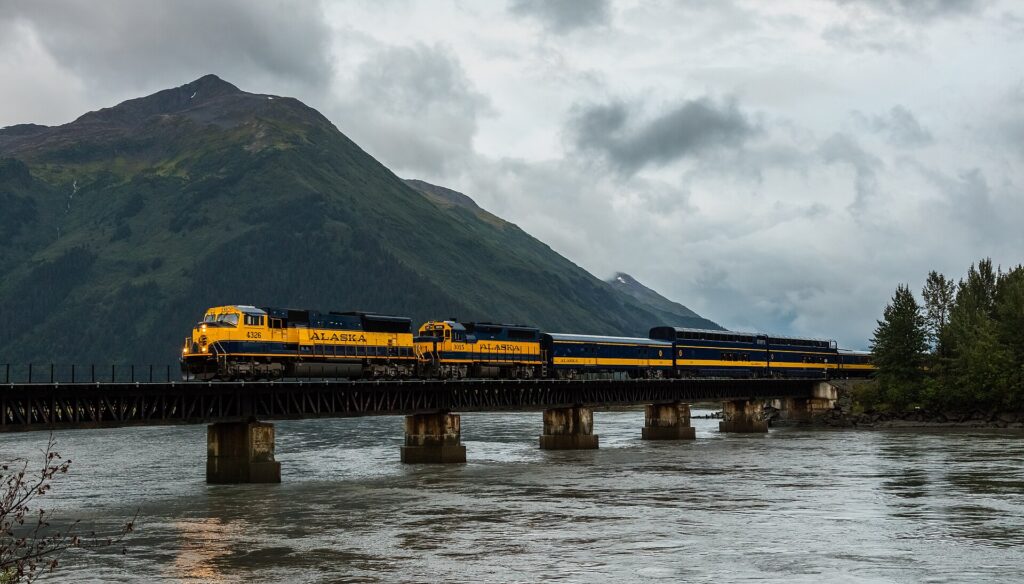
The Railbelt is the name for the area served by the Alaska Railroad and for the electrical grid that covers it. It runs from Fairbanks through the Kenai Peninsula, taking in Anchorage and the Matanuska-Susitna Valley, and holds about 70 percent of Alaska’s population.[1]
| Extent | Fairbanks to the Kenai Peninsula |
|---|---|
| Includes | Anchorage, Mat-Su Valley |
| Share of population | About 70% |
| Share of electricity use | About 80% |
| Electric utilities | Six (GVEA, MEA, CEA, HEA, ML&P, SES) |
| Grid study | 2007 state study, $800,000 |
Meaning of the term
Railbelt refers either to the area served by the Alaska Railroad or to the electrical grid across that area. The region runs from Fairbanks through the Kenai Peninsula and includes Anchorage and the Matanuska-Susitna Valley.[1]
Population and electricity
The Railbelt is home to about 70 percent of Alaska’s population and uses about 80 percent of the state’s electricity.[1]
Electric utilities
Six utilities serve the grid: GVEA, MEA, CEA, HEA, ML&P and SES. They are relatively small, which the source links to higher Railbelt electricity costs. A 2007 state-commissioned study costing $800,000 examined possible generation mixes over the next 50 years.[1]
FAQs
What is the Railbelt? The area served by the Alaska Railroad and its electrical grid.
How many Alaskans live there? About 70 percent.
How many utilities serve it? Six.
Sources
Key facts
- About 70% of population
- Six utilities
Quick checkWhat share of Alaskans live in the Railbelt?Show answer
About 70 percent
Sources
- Ground Truth Alaska. Railbelt Electrical Grid. 2026 (accessed 2026-11-13)
Editorially reviewed by Specialty Digest Editorial TeamLast reviewed November 13, 2026Researched and drafted with AI assistanceReport an issue