An activation function is a mathematical function applied to the output of a neuron in a neural network. The neuron first computes a weighted sum of its inputs plus a bias, and the activation function then transforms that number into the neuron’s final output. Its most important job is to add nonlinearity. Without it, a
Activation Function Read More »
An activation function is a mathematical function applied to the output of a neuron that introduces nonlinearity, which lets neural networks learn complex patterns.
Active learning is a machine learning approach in which the model itself chooses which unlabeled examples should be labeled next by a human expert. Labels are often the most expensive part of building a supervised learning system, because a radiologist, lawyer or linguist must review each example. Active learning reduces that cost. Instead of labeling
Active Learning Read More »
Active learning is a machine learning approach in which the model chooses which unlabeled examples a human should label next, so that it learns more from fewer labels.
An artificial neuron is the basic computing unit of an artificial neural network. It takes several numerical inputs, multiplies each by a weight that reflects its importance, adds the results together with a bias and passes the total through a function that decides what to output. Billions of these small units, wired together in layers,
Artificial Neuron Read More »
An artificial neuron is the basic computing unit of a neural network, which multiplies its inputs by weights, adds a bias and passes the result through an activation function.
Batch learning is a method in machine learning in which a model is trained on the whole available dataset at once, then put into use without learning anything further. Because the model is trained offline, the approach is also called offline learning. If new data arrive and the model needs to reflect them, engineers train
Batch Learning Read More »
Batch learning is a machine learning method in which a model is trained on the entire available dataset at once, then deployed and later retrained from scratch or in scheduled updates.
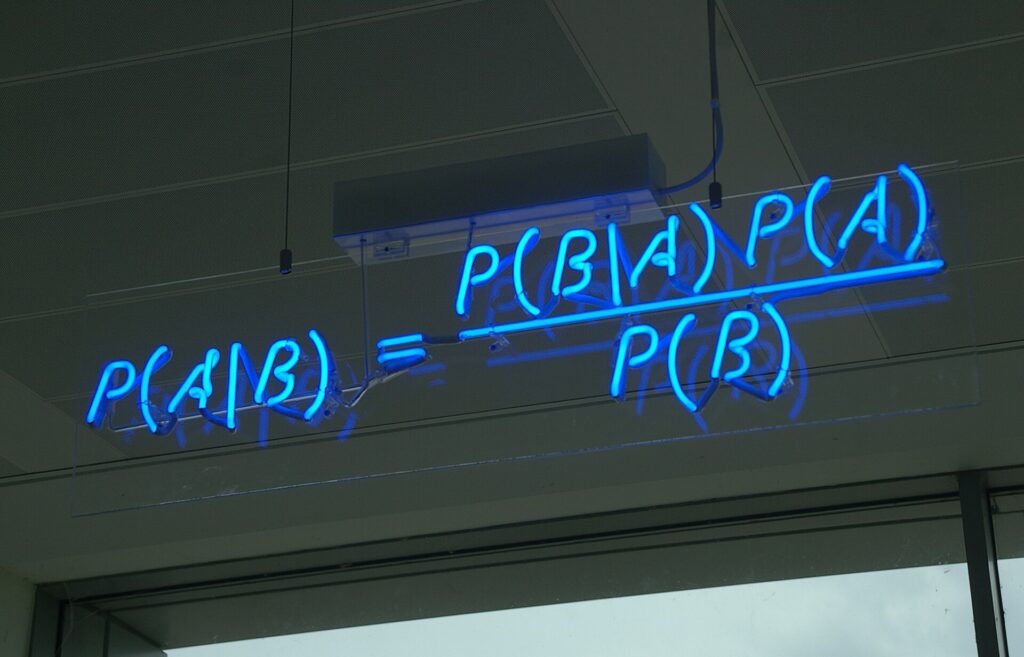
Bayesian learning is an approach to machine learning in which a model’s beliefs are expressed as probabilities and updated with Bayes theorem as new data arrive. Instead of finding a single best set of parameters, a Bayesian method keeps a whole distribution over plausible parameters, so it can say not only what it predicts but
Bayesian Learning Read More »
Bayesian learning is an approach to machine learning that uses Bayes theorem to update beliefs about models or parameters as data arrive, expressing uncertainty as probabilities.
Classification is a task in supervised learning in which a model learns to assign each input to one of several predefined categories, called classes. Deciding whether an email is spam, whether a tumor is benign or malignant, which digit a handwritten character represents or whether a customer will cancel a subscription are all classification problems.
Classification (Machine Learning) Read More »
Classification is a supervised machine learning task in which a model assigns each input to one of several predefined categories, such as spam or not spam.
Clustering is a task in unsupervised learning in which an algorithm groups data points so that items in the same group, called a cluster, are more similar to one another than to items in other groups. No labels tell the algorithm what the groups should be. It discovers them from the data alone. Clustering is
Clustering Read More »
Clustering is an unsupervised machine learning task that groups data points so that items in the same group are more similar to each other than to items in other groups.
Continual learning is a machine learning approach in which a model learns from a stream of tasks or data over time, adding new knowledge while keeping what it learned before. People do this naturally. A person who learns to ride a bicycle does not forget how to walk. Neural networks, by contrast, tend to lose
Continual Learning Read More »
Continual learning is a machine learning approach in which a model learns from a sequence of tasks or data over time while retaining what it learned earlier.
A decision tree is a supervised machine learning model that predicts an outcome by following a series of questions about the input, arranged like the branches of a tree. Each internal node asks a question about one feature, such as whether income is above fifty thousand. Each branch is an answer, and each leaf at
Decision Tree Read More »
A decision tree is a supervised machine learning model that makes predictions by following a series of yes-or-no questions about the input, arranged like branches of a tree.
Deep reinforcement learning is a branch of artificial intelligence that combines reinforcement learning, in which an agent learns by trial and error from rewards, with deep learning, in which multilayer neural networks learn patterns from raw data. The neural network lets the agent handle complex inputs such as images, sound or sensor readings, instead of
Deep Reinforcement Learning Read More »
Deep reinforcement learning combines reinforcement learning with deep neural networks so that an agent can learn good behavior directly from high-dimensional inputs such as images.