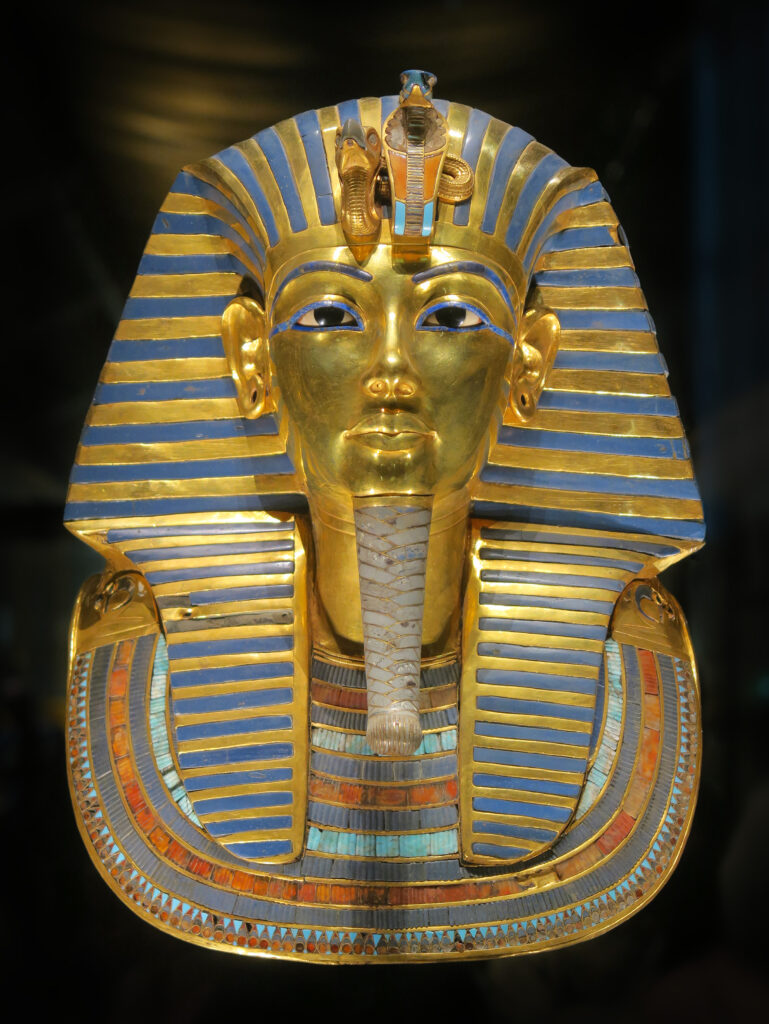
Tutankhamun (circa 1341-1323 BCE) was a pharaoh of ancient Egypt’s Eighteenth Dynasty who reigned from approximately 1332 to 1323 BCE. Although his reign was brief and he came to the throne as a child, Tutankhamun became one of the most famous rulers in history following the 1922 discovery of his nearly intact tomb, which revealed an extraordinary collection of royal artifacts and transformed modern understanding of ancient Egyptian civilization.
Tutankhamun at a Glance
| Full name | Tutankhamun (originally Tutankhaten) |
| Born | Circa 1341 BCE, Egypt |
| Died | Circa 1323 BCE, Egypt |
| Known for | Pharaoh of the Eighteenth Dynasty; restoration of traditional religion; the 1922 discovery of his intact tomb |
| Occupation | Pharaoh |
| Major events | Accession circa 1332 BCE; restoration of Amun worship; discovery of his tomb by Howard Carter in 1922 |
| Nationality | Ancient Egyptian |
Early Life and Royal Lineage
Tutankhamun was born during a period of significant religious upheaval in ancient Egypt, widely believed by historians and archaeologists to be the son of Pharaoh Akhenaten, who had controversially shifted Egyptian religious practice toward the worship of a single sun disk deity called the Aten. Genetic studies of royal mummies have supported this lineage, though the identity of Tutankhamun’s mother remains a subject of ongoing scholarly research and debate among Egyptologists.
Accession to the Throne
Tutankhamun ascended to the Egyptian throne at approximately nine years of age following the death of his predecessor, making him one of the youngest pharaohs in recorded Egyptian history to assume full royal authority. Given his young age, it is widely believed that powerful advisors and officials, including the courtier Ay and the military commander Horemheb, exercised substantial influence over state affairs during the early years of his reign.
Restoration of Traditional Religion
One of the most significant acts of Tutankhamun’s reign was the reversal of his predecessor’s religious reforms, restoring the traditional worship of Amun and the broader Egyptian pantheon that Akhenaten had suppressed in favor of the Aten. This restoration included changing his own name from Tutankhaten, meaning living image of the Aten, to Tutankhamun, meaning living image of Amun, a symbolic act that signaled the return to established religious and political order.
Rebuilding Egyptian Institutions
Tutankhamun’s government undertook significant efforts to restore temples, religious institutions, and priesthoods that had been neglected or dismantled during the preceding Amarna period, work documented on the Restoration Stela erected during his reign. These restoration efforts aimed to repair relationships with the powerful priesthood of Amun and stabilize a kingdom that had experienced considerable religious and administrative disruption in the years before his accession.
Marriage and Family
Tutankhamun married Ankhesenamun, who was likely his half-sister in keeping with Egyptian royal tradition, and the couple is known to have had at least two daughters who were stillborn, their mummified remains discovered within his tomb. The absence of surviving children meant that Tutankhamun’s lineage ended with his death, contributing to the eventual transition of power to non-royal officials in the dynasty that followed.
Military and Foreign Relations
Although Tutankhamun’s reign was relatively brief, surviving artifacts including painted chests and ceremonial objects depict the young pharaoh in martial imagery, reflecting the traditional role of the Egyptian king as a military leader and protector of the state’s borders. Diplomatic correspondence and objects found within his tomb also indicate continued relations with neighboring kingdoms, including Nubia and various Near Eastern powers, during this period of Egyptian history.
Death and Burial
Tutankhamun died at approximately eighteen or nineteen years of age, and the exact cause of his death has been the subject of extensive scientific investigation, including CT scans and genetic analysis that have explored possibilities ranging from a leg injury complicated by infection to inherited health conditions within the royal family. He was buried in a relatively modest tomb in the Valley of the Kings, a location that, somewhat paradoxically, likely contributed to its preservation by keeping it hidden beneath the debris of later construction for more than three thousand years.
Discovery of the Tomb
British archaeologist Howard Carter, funded by Lord Carnarvon, discovered Tutankhamun’s nearly intact tomb in November 1922 after years of searching the Valley of the Kings, uncovering a burial chamber filled with thousands of objects including the now-iconic solid gold funerary mask. The discovery was one of the most significant archaeological events of the twentieth century, as the tomb had largely escaped the ancient grave robbery that affected most other pharaonic burial sites.
The Treasures of the Tomb
The artifacts recovered from Tutankhamun’s tomb, including elaborate furniture, jewelry, chariots, weapons, and the nested golden coffins that housed his mummy, provided unprecedented insight into royal Egyptian craftsmanship and burial practices during the New Kingdom period. These objects, now housed primarily in the Grand Egyptian Museum, remain among the most studied and exhibited collections of ancient artifacts in the world, drawing millions of visitors to view them each year.
Impact on Egyptology
The discovery of Tutankhamun’s tomb dramatically advanced the field of Egyptology, providing scholars with an extraordinarily detailed and well-preserved record of royal material culture that informed decades of subsequent research into ancient Egyptian religion, art, and daily life. The find also sparked widespread international popular fascination with ancient Egypt, a phenomenon sometimes referred to as Tutmania, that influenced art, architecture, and popular culture throughout the twentieth century.
Scientific Study of the Mummy
Modern scientific techniques, including radiological imaging and DNA analysis conducted in the early twenty-first century, have allowed researchers to study Tutankhamun’s physical condition and family relationships with far greater precision than was previously possible. These studies have revealed evidence of several health conditions, including a club foot and other skeletal abnormalities, that may have required the young pharaoh to use walking canes, several of which were found among his tomb’s grave goods.
Succession and the End of a Dynasty
Following Tutankhamun’s death, his advisor Ay assumed the throne, followed shortly after by the military commander Horemheb, whose reign effectively marked the end of the Eighteenth Dynasty’s Amarna-era lineage and the beginning of a new line of pharaohs. Horemheb’s subsequent efforts to erase the memory of the Amarna period, including Tutankhamun’s immediate predecessors, inadvertently contributed to Tutankhamun’s tomb remaining hidden and protected from later construction activity in the Valley of the Kings.
Legacy
Tutankhamun remains one of the most widely recognized figures from ancient Egypt, a reputation built not on the political significance of his brief reign but on the extraordinary preservation and richness of his tomb’s contents. His golden funerary mask has become perhaps the single most iconic image associated with ancient Egyptian civilization, and his story continues to captivate public imagination and drive scholarly research into the ancient world nearly a century after his tomb’s discovery.
References
- New World Encyclopedia – Tutankhamun
- History.com – Tutankhamun
- History.com – Tutankhamun (Ancient History)
Frequently Asked Questions
What is Tutankhamun best known for? He is best known for the 1922 discovery of his nearly intact tomb by Howard Carter, which revealed an extraordinary collection of royal Egyptian artifacts including his iconic gold funerary mask.
How old was Tutankhamun when he became pharaoh? He became pharaoh at approximately nine years of age and reigned for about a decade before his death at eighteen or nineteen.
Why did Tutankhamun change his name? He changed his name from Tutankhaten to Tutankhamun to signal the restoration of traditional Amun worship after his predecessor had promoted worship of the Aten.
Where are Tutankhamun’s tomb treasures kept today? Most of the artifacts recovered from his tomb are housed in the Grand Egyptian Museum, where they remain among the most visited archaeological collections in the world.
Editorially reviewed by Specialty Digest Editorial TeamLast reviewed November 29, 2026Researched and drafted with AI assistanceReport an issue