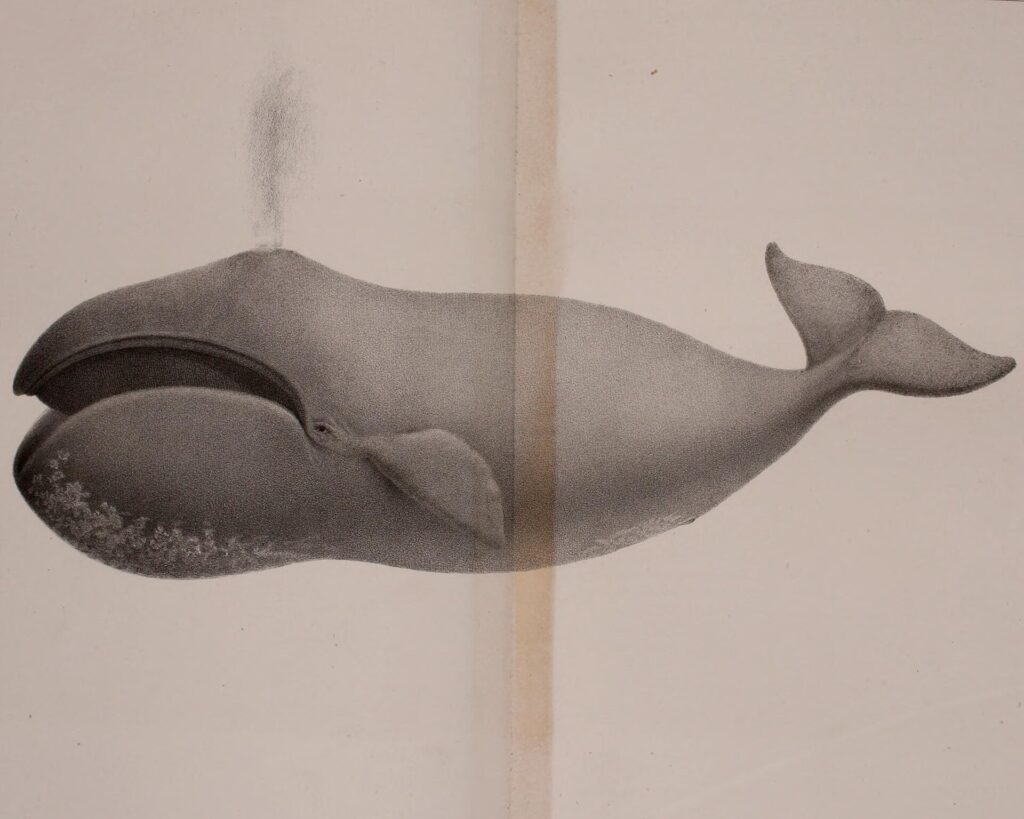
The bowhead whale (Balaena mysticetus) is a large Arctic baleen whale and the official marine mammal of Alaska, designated in 1983. It is the only baleen whale that spends its entire life in Arctic and subarctic waters, and it is considered the longest-living mammal, with individuals living over 200 years. The Bering-Chukchi-Beaufort population, which migrates along Alaska’s coast, was estimated at 12,505 whales in a 2019 survey [1][2].
| State marine mammal since | 1983 |
|---|---|
| Length | 14–18 m (46–59 ft) |
| Weight | 75–100 tonnes |
| Blubber | About 40 cm or more |
| Lifespan | Over 200 years |
| Alaska population (2019) | 12,505 |
| Native harvest | 14–72 whales a year |
Description
Adults usually measure 14 to 18 meters and weigh 75 to 100 tonnes. Females are typically larger, reaching 16 to 18 meters, while males average 14 to 16 meters. Newborn calves are about 4 to 4.5 meters long and weigh roughly 1,000 kilograms. About 40 centimeters or more of blubber protects the whale from cold Arctic water [1].
Longevity
Bowheads are considered the longest-living mammals, with individuals living over 200 years. A male estimated at 211 years old was among those aged in 1978–1996, and CSIRO researchers estimated a maximum natural lifespan of 268 years from genetic analysis [1].
Feeding
Bowheads are filter feeders that eat mostly zooplankton, including krill, copepods, mysids and amphipods, and consume about 1.8 tonnes of food per day [1].
Range and Migration
The Bering-Chukchi-Beaufort population winters in the southwestern Bering Sea and moves north in spring into the Chukchi and Beaufort seas, following openings in the ice [1].
Population
A 2019 survey estimated 12,505 whales, down from 16,820 in 2011, though surveyors believed there was no significant decline over that period. The population grew by 3.7 percent per year from 1978 to 2011 and may be near its precommercial whaling level. It is listed as lower risk, conservation dependent, on the IUCN Red List [1].
Subsistence Hunting
Alaska Native communities continue small subsistence harvests, taking 14 to 72 whales a year, or about 0.1 to 0.5 percent of the population. The Alaska Eskimo Whaling Commission co-manages the harvest with NOAA, and the International Whaling Commission set a strike quota for the population in 1978, which has been 67 strikes per year since 1998 [1]. Whaling is central to celebrations such as Nalukataq, described in the entry on the culture of Alaska.
State Symbol
Alaska named the bowhead whale its state marine mammal in 1983 [2].
FAQs
What is the Alaska state marine mammal? The bowhead whale, designated in 1983.
How long do bowhead whales live? Over 200 years, making them the longest-living mammals.
How many bowhead whales are in the Alaska population? A 2019 survey estimated 12,505.
What do bowhead whales eat? Zooplankton such as krill, copepods and amphipods.
Do Alaska Natives hunt bowhead whales? Yes, small subsistence harvests of 14 to 72 whales a year are co-managed with NOAA.
Sources
More in Biology
Key facts
Quick checkHow long can bowhead whales live?Show answer
Over 200 years
Sources
- Wikipedia. Bowhead whale. 2026 (accessed 2026-11-12)
- Wikipedia. List of Alaska state symbols. 2026 (accessed 2026-11-12)
Editorially reviewed by Specialty Digest Editorial TeamLast reviewed November 12, 2026Researched and drafted with AI assistanceReport an issue