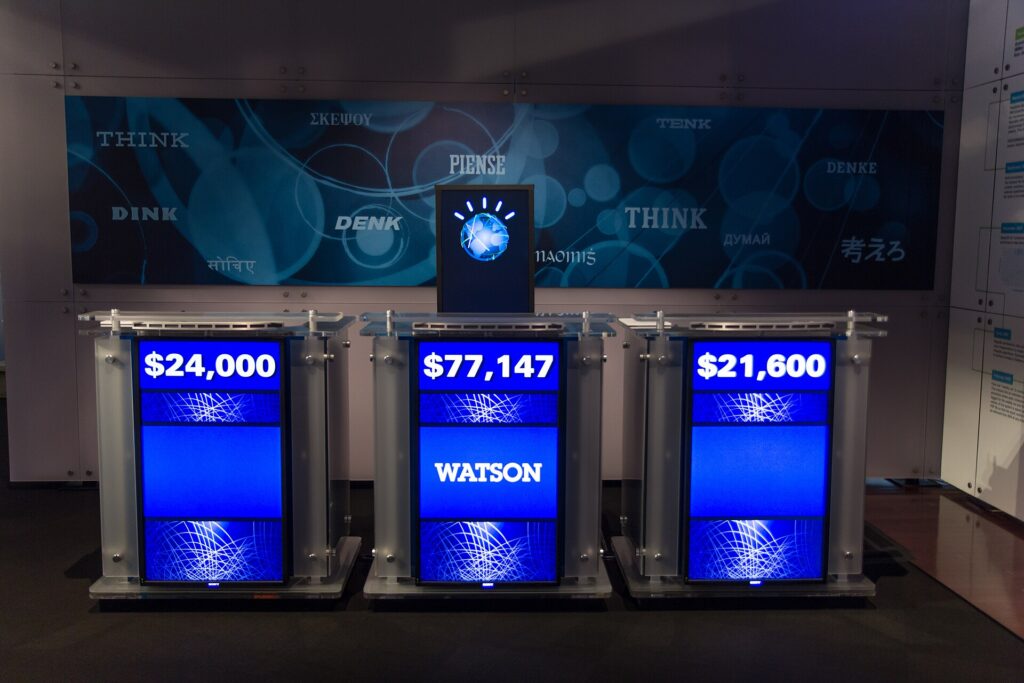
Cognitive computing is a term for computer systems designed to simulate aspects of human thinking, such as understanding language, learning from experience and reasoning under uncertainty, in order to help people make complex decisions. It is closely tied to artificial intelligence and is used mostly in business settings. The phrase became widely known through IBM, which applied it to its Watson system after that machine beat former champions on the quiz show Jeopardy in 2011. Unlike a traditional program that follows fixed instructions, a cognitive system is meant to interact with people, handle ambiguity and improve over time.
History of cognitive computing
The ideas behind cognitive computing draw on decades of research in artificial intelligence, cognitive science and neuroscience. The modern use of the term was popularized by IBM in the early 2010s. In February 2011, Watson competed on Jeopardy against Ken Jennings and Brad Rutter and won, demonstrating that a machine could parse a clue written in natural language, search large collections of text and answer with calibrated confidence. IBM then moved Watson into healthcare, finance and customer service. The company later reorganized its offerings, and the term faded in marketing as terms such as AI and generative AI took over, but the concepts it described remain in use.
Key features of cognitive computing
Descriptions of cognitive computing often list four qualities.
- Adaptive: the system learns as information, goals and context change.
- Interactive: it communicates with people and other systems in natural language or through visual interfaces.
- Iterative and stateful: it can ask questions and refine its understanding, remembering earlier steps in an exchange.
- Contextual: it takes account of time, location, user profile and the type of task.
These qualities describe an assistant that works with a person instead of a tool that simply executes commands.
How cognitive computing works
Cognitive systems combine several technologies. Natural language processing lets them read and interpret text and speech. Machine learning lets them detect patterns and improve from data. Knowledge representation and reasoning let them store facts and draw conclusions. Information retrieval finds relevant passages in large collections of documents. In a typical workflow, the system ingests a body of content, such as medical literature, builds an index and a knowledge structure, takes a question from a user, retrieves and scores candidate answers and presents the best ones with supporting evidence and a confidence level. A person then reviews and decides.
Applications of cognitive computing
Healthcare has been a major focus. Systems have been used to summarize research, match patients to clinical trials and suggest treatment options for clinicians to consider. In finance, they support risk analysis, compliance checking and customer advice. Customer service teams use them to answer questions and route requests. Legal and regulatory teams use them to search large collections of documents. Retailers use them to personalize recommendations, and manufacturers use them to analyze equipment data. In every case the intended role is decision support, with a person staying accountable for the outcome.
Cognitive computing vs. artificial intelligence
The two overlap, and the distinction is partly one of emphasis and marketing. Artificial intelligence is the broad field that includes any method that lets machines perform tasks associated with intelligence. Cognitive computing usually refers to a style of system that mimics human reasoning and collaborates with people on complex judgments, often in a specific profession. Many writers treat it as a subset or a brand of AI, and today’s conversational and generative systems fulfil much of the original cognitive computing vision.
Advantages and challenges
Cognitive systems can read more material than any person and surface relevant evidence quickly. They can help experts avoid overlooked information and keep consistent standards. Challenges include the cost of preparing data, the need for expert review, difficulty explaining how a recommendation was reached and the risk of error when training material is incomplete or biased. Some high-profile healthcare projects fell short of early promises, a reminder that deploying such systems in real clinical settings is hard. Privacy and accountability are further concerns when personal information is involved.
A healthcare example
Healthcare shows both the promise and the difficulty of cognitive computing. Medical knowledge is enormous and grows constantly, and no clinician can read all of it. A cognitive system can ingest journals, guidelines and patient records, then answer a question such as which treatments have evidence for a particular patient profile. It lists options with the evidence behind each and a confidence score, and the physician decides what to do. In practice, projects have run into obstacles. Hospital data is messy and stored in incompatible formats, local practice differs from published guidelines, and clinicians need to understand why a suggestion was made before trusting it. The lesson drawn by many organizations is that these tools work best when they are tightly focused and built into existing workflows.
Ethical and privacy considerations
Because cognitive systems often work with personal data, privacy and security matter from the start. Developers must protect records, limit access and comply with laws such as the European Union’s General Data Protection Regulation and, for health data in the United States, HIPAA. Transparency is another concern: users should know when they are interacting with a machine, what evidence it used and how certain it is. Bias in source material can lead to skewed recommendations, so organizations test systems on varied groups and keep people accountable for final decisions. Clear limits on what the system may recommend, and a process for reporting errors, are standard safeguards.
FAQs
Is cognitive computing the same as AI? It is closely related. Cognitive computing is usually presented as AI applied to support human judgment, with a stress on natural interaction and learning.
Does cognitive computing think like a human? No. It aims to mimic some functions of human thinking, but it works through statistics and rules, not through human-style understanding.
Who uses cognitive computing? Organizations in healthcare, finance, law, customer service and research use systems of this kind to analyze large volumes of information.
More in Artificial Intelligence
Key facts
- IBM's Watson system defeated two former champions on the quiz show Jeopardy in February 2011, a public showcase of cognitive computing.1
- Cognitive computing systems are usually described as adaptive, interactive, iterative and contextual.2
- The term is used mainly in business and marketing and overlaps heavily with artificial intelligence.3
Related concepts
Quick checkWhich 2011 public event is most associated with the rise of the term cognitive computing?Show answer
IBM Watson's win against former champions on the quiz show Jeopardy in February 2011.
Sources
- IBM, What is cognitive computing?, https://www.ibm.com/think/topics/cognitive-computing
- Wikipedia, Cognitive computing, https://en.wikipedia.org/wiki/Cognitive_computing
- Wikipedia, Watson (computer), https://en.wikipedia.org/wiki/Watson_(computer)
Editorially reviewed by Specialty Digest Editorial TeamLast reviewed November 17, 2026Researched and drafted with AI assistanceReport an issue