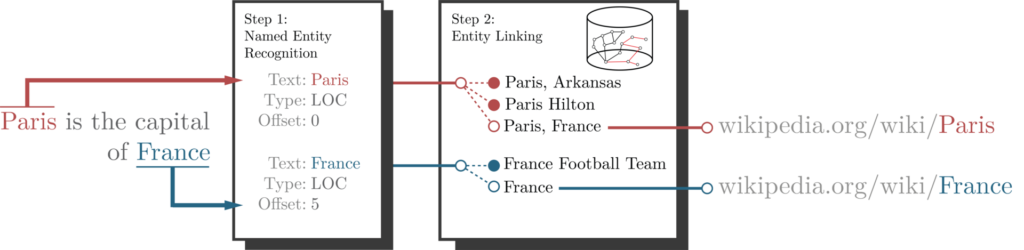
Named entity recognition (NER), also called entity extraction or entity identification, is a task in natural language processing that locates mentions of specific real-world items in text and assigns each one a category. In the sentence “Marie Curie won the Nobel Prize in Paris in 1911,” an NER system would label “Marie Curie” as a person, “Nobel Prize” as an award, “Paris” as a location and “1911” as a date. The output turns unstructured text into structured data that other software can search, count and link. NER is a core component of natural language understanding and of knowledge extraction.
Overview
The term “named entity” came out of the Sixth Message Understanding Conference in 1995, a research evaluation that defined a task of recognizing names of people, organizations and places, along with dates and quantities [1]. Since then it has grown to cover many entity types, depending on the domain: genes and proteins in biomedical text, drug names in clinical notes, case citations in legal documents, product names in reviews and so on.
NER usually involves two sub-problems. Detection finds the boundaries of an entity mention in the text, which may span several words, as in “University of Cape Town.” Classification decides what type of entity it is. A closely related step, entity linking, goes further and connects each mention to a unique entry in a knowledge base, so that “Paris” is resolved to the French capital and not Paris, Texas.
Entity types
Common categories include:
- Person. Individuals, real or fictional.
- Organization. Companies, institutions, agencies and teams.
- Location. Countries, cities, rivers and addresses.
- Date and time. Calendar dates, durations and times.
- Quantities. Money, percentages, measurements and counts.
- Miscellaneous. Events, works of art, products, laws and similar items.
The CoNLL-2003 shared task, whose data set became a standard benchmark, used four types: person, organization, location and miscellaneous [2]. Domain-specific systems define their own sets of labels.
Representing the output
Most systems treat NER as sequence labeling: each word receives a tag. The popular BIO scheme marks the first word of an entity with B, later words inside it with I, and words that are not part of any entity with O, with a type attached, as in B-PER or I-LOC [3]. This lets a model mark entities that cover several words and entities that sit next to each other.
Methods
### Rule-based and dictionary approaches
Early systems relied on hand-written patterns, capitalization rules and lists of known names, called gazetteers. They are transparent and precise for narrow cases, but need constant maintenance and miss new or unusual names.
### Statistical sequence models
In the 2000s, models such as hidden Markov models, maximum entropy models and conditional random fields learned from labeled text. They used features such as word shape, prefixes, neighboring words and gazetteer matches.
### Neural models
Neural networks replaced manual feature design. Bidirectional LSTM networks with a conditional random field layer became a strong approach, using word embeddings as input. Transformer models such as BERT, fine-tuned on labeled entity data, set new accuracy levels and are now common.
### Large language models
General-purpose language models can extract entities from instructions and a few examples, and can return results in a fixed format using structured output. This is flexible for new entity types without new training data, but may be slower and costlier than a dedicated model, and it can produce incorrect or invented entities, a form of hallucination.
Evaluation
NER is scored by comparing predicted entities with a human-annotated reference. A prediction usually counts as correct only if both the boundaries and the type match exactly, and results are reported as precision, recall and F1. Strict matching can be harsh, so some evaluations also report partial-match scores. Results on clean news text are high, while scores drop on social media, historical documents, and specialized fields where entity names are unusual and annotation is expensive.
Applications
- Search and information retrieval. Indexing documents by the people, places and organizations they mention, supporting semantic search.
- Knowledge graphs. Extracting entities and relations to populate a knowledge graph.
- News and media monitoring. Tracking mentions of companies and public figures.
- Healthcare. Finding diseases, drugs and dosages in clinical notes and research papers, with strict privacy controls.
- Legal and financial documents. Identifying parties, dates, amounts and clauses in contracts and filings.
- Privacy and compliance. Detecting personal data so that it can be redacted or protected.
- Chatbots and assistants. Filling slots such as dates and destinations from a user’s request in conversational AI.
Challenges
- Ambiguity. “Washington” may be a person, a city, a state or an organization, and context decides.
- Nested and overlapping entities. “Bank of China Tower” contains an organization inside a location name.
- New and rare entities. New companies, products and people appear constantly.
- Domain adaptation. A model trained on news may perform poorly on tweets or on medical text.
- Multilingual coverage. Capitalization cues that help in English are absent in some scripts, and low-resource languages have little annotated data.
- Annotation cost. Producing labeled data needs expert effort and clear guidelines.
- Bias. Systems can be less accurate on names from some cultures, which can lead to unequal treatment.
Relationship to other extraction tasks
NER is usually the first step in a longer information extraction pipeline. Relation extraction identifies how entities are connected, for example that a person founded a company or that a drug treats a disease. Event extraction finds occurrences such as acquisitions or elections together with their participants, dates and places. Coreference resolution links different mentions of the same entity, such as “the company” and “it.” Together these steps convert text into structured facts that can be stored in a graph database and queried, which is how many organizations turn large document collections into searchable knowledge.
Practical tips
Teams starting an NER project should define a small, clear set of entity types, write annotation guidelines with edge cases, and have more than one person label a sample so that disagreement shows up early. Starting from a pretrained model and fine-tuning it on a few hundred well-chosen examples is often enough for a first useful system. Active learning, which asks annotators to label the examples the model finds most uncertain, can reduce labeling effort; see active learning. In sensitive domains, a human reviewer should check the extracted entities before they are used for decisions, and personal data found by NER should be handled under applicable privacy rules.
FAQs
What is named entity recognition? It is the task of finding mentions of specific things in text, such as people, organizations, places and dates, and labeling each with its type.
What is the difference between NER and entity linking? NER detects and classifies entity mentions. Entity linking goes further and connects each mention to a specific entry in a knowledge base.
What is the BIO tagging scheme? It labels each word as the beginning of an entity, inside an entity or outside any entity, so that multi-word entities can be represented.
Which models are best for NER? Fine-tuned transformer models are widely used and accurate. Large language models offer flexibility with little data, while rule-based methods still suit narrow, high-precision tasks.
What is NER used for? It is used for search, knowledge graphs, document analysis, compliance and information extraction in many industries.
More in Natural Language Processing
Key facts
- The term named entity was coined for the Sixth Message Understanding Conference (MUC-6) in 1995, which defined a shared task on recognizing names of people, organizations and locations1.
- The CoNLL-2003 shared task provided a widely used English and German data set annotated with person, location, organization and miscellaneous entities2.
- Entity labels are often encoded using the BIO scheme, which marks the beginning, inside and outside of each entity span3.
Related concepts
Quick checkWhat is named entity recognition?Show answer
Named entity recognition (NER) is a natural language processing task that locates mentions of specific real-world items in text, such as people, organizations, places, dates and amounts, and assigns each a category.
Sources
- Ralph Grishman and Beth Sundheim, Message Understanding Conference-6: A Brief History, COLING 1996, https://aclanthology.org/C96-1079/
- Erik Tjong Kim Sang and Fien De Meulder, Introduction to the CoNLL-2003 Shared Task: Language-Independent Named Entity Recognition, https://aclanthology.org/W03-0419/
- Daniel Jurafsky and James H. Martin, Speech and Language Processing, Chapter 17, Stanford University, https://web.stanford.edu/~jurafsky/slp3/
Editorially reviewed by Specialty Digest Editorial TeamLast reviewed November 17, 2026Researched and drafted with AI assistanceReport an issue