Conversational modeling is the area of natural language processing and artificial intelligence that builds models able to take part in coherent, multi-turn dialogue with people. A conversational model reads what a user says, keeps track of the conversation so far and produces a fitting reply. It underlies chatbots, voice assistants, customer-service agents and the chat
Conversational Modeling Read More »
Conversational modeling is the area of natural language processing that builds models able to carry on coherent, multi-turn dialogue with people.
Language detection, also called language identification or LangID, is the task of automatically determining which natural language a text or speech sample is in. A system reads a few words or sentences and returns a language label, often with a confidence score. It is usually the first step in a multilingual pipeline, because later processing
Language Detection Read More »
Language detection, also called language identification, is the task of automatically determining which natural language a piece of text or speech is written or spoken in.
Machine translation (MT) is the use of computer software to translate text or speech from one human language into another. Systems range from simple word-substitution programs to large neural networks that read a whole sentence and write its translation. Machine translation is one of the oldest problems in artificial intelligence and in natural language processing,
Machine Translation Read More »
Machine translation is the use of software to translate text or speech from one human language to another without direct human translation.
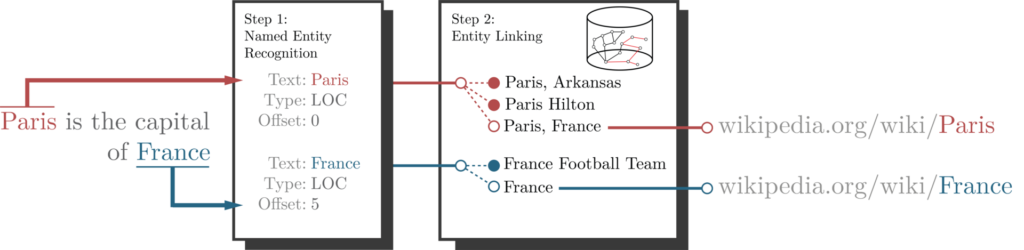
Named entity recognition (NER), also called entity extraction or entity identification, is a task in natural language processing that locates mentions of specific real-world items in text and assigns each one a category. In the sentence “Marie Curie won the Nobel Prize in Paris in 1911,” an NER system would label “Marie Curie” as a
Named Entity Recognition Read More »
Named entity recognition (NER) is the natural language processing task of finding and classifying names of people, organizations, places and other specific items in text.
Natural language generation (NLG) is the field of artificial intelligence concerned with producing written or spoken language that people can read or hear naturally. The input may be a table of numbers, a database record, a logical form or a short prompt, and the output is a sentence, paragraph or full document. NLG is the
Natural Language Generation Read More »
Natural language generation (NLG) is the area of artificial intelligence concerned with producing readable human language from data, meaning representations or prompts.
Natural language understanding (NLU) is the branch of artificial intelligence concerned with enabling computers to interpret the meaning of human language. Where simple text processing might count words or match patterns, NLU tries to work out what a sentence says, what the speaker wants and how the parts of a message relate to each other.
Natural Language Understanding Read More »
Natural language understanding (NLU) is the area of artificial intelligence concerned with enabling machines to interpret the meaning, intent and context of human language.
Part-of-speech tagging (POS tagging), also called grammatical tagging, is the task of labeling each word in a text with its grammatical category, such as noun, verb, adjective, adverb or preposition. The label depends on both the word itself and its context. The word “book” is a noun in “I read a book” and a verb
Part-of-Speech Tagging Read More »
Part-of-speech tagging is the task of labeling each word in a text with its grammatical category, such as noun, verb or adjective, based on its definition and context.
Semantic analysis is the part of language processing that interprets meaning. Where lexical analysis splits text into words and syntactic analysis works out grammatical structure, semantic analysis asks what the words and sentences actually mean and how their meanings combine. The goal is a representation of meaning, such as the sense of each word, the
Semantic Analysis Read More »
Semantic analysis is the process of interpreting the meaning of words, phrases and sentences in context, so that a computer can represent what a text says.
Sentiment analysis, also called opinion mining, is the use of natural language processing to identify, extract and classify the opinions, attitudes and emotions expressed in text. The simplest form assigns a label such as positive, negative or neutral to a review, post or message. More advanced forms identify the object being discussed, the strength of
Sentiment Analysis Read More »
Sentiment analysis is the use of natural language processing to identify and classify opinions, emotions and attitudes expressed in text.
Speech recognition, also known as automatic speech recognition (ASR) or speech to text, is the technology that converts spoken language into written text. A speech recognizer takes an audio recording or a live audio stream, analyzes the sound and produces the sequence of words it believes the speaker said. It is the front end of
Speech Recognition Read More »
Speech recognition is the technology that converts spoken language into written text, using acoustic and language models to identify the words a person says.