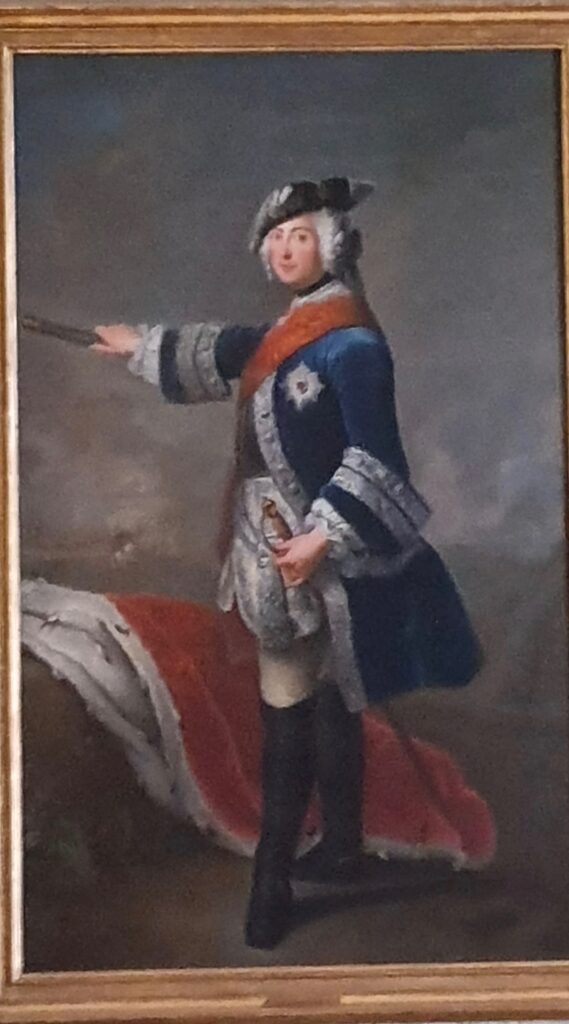
Frederick the Great (1712-1786) was King of Prussia from 1740 until his death in 1786, a reign during which he transformed Prussia into a major European military and cultural power. Known for his military campaigns, administrative reforms, and patronage of the Enlightenment, Frederick II established Prussia as one of the leading states of eighteenth-century Europe.
Frederick the Great at a Glance
| Full name | Frederick II of Prussia |
| Born | January 24, 1712, Berlin, Prussia |
| Died | August 17, 1786, Potsdam, Prussia |
| Known for | King of Prussia 1740-1786; conquest of Silesia; patronage of the Enlightenment |
| Occupation | Monarch |
| Major events | Accession in 1740; War of the Austrian Succession 1740-1748; Seven Years’ War 1756-1763 |
| Nationality | Prussian |
Early Life and Difficult Relationship with His Father
Frederick was born in Berlin, the son of King Frederick William I of Prussia, whose harsh and militaristic approach to his son’s upbringing created significant tension, particularly given young Frederick’s strong interests in music, philosophy, and literature rather than military affairs. This conflict culminated in Frederick’s attempted flight from Prussia in 1730, which his father punished severely, including forcing the young prince to witness the execution of his close friend who had assisted in the escape attempt.
Accession and Early Reign
Frederick became king in 1740 upon his father’s death, inheriting a well-disciplined army and strong treasury that his father’s austere policies had built, resources that Frederick would soon put to use in pursuit of territorial expansion. Shortly after his accession, Frederick launched an invasion of the Austrian province of Silesia, taking advantage of the disputed succession of Maria Theresa to the Habsburg throne and beginning the War of the Austrian Succession.
The Conquest of Silesia
Frederick’s successful conquest of Silesia during the War of the Austrian Succession significantly expanded Prussian territory and established Frederick’s reputation as a formidable military commander, despite Austria’s repeated attempts to recover the province. This territorial gain roughly doubled Prussia’s population and resources, transforming the kingdom into a more significant power on the European stage.
The Seven Years’ War
Frederick’s determination to retain Silesia led to the Seven Years’ War, a global conflict beginning in 1756 in which Prussia faced a coalition of Austria, France, Russia, and other powers in a struggle for survival. Despite facing overwhelming odds and several near-catastrophic defeats, Frederick’s military skill and a fortuitous change in Russian leadership allowed Prussia to emerge from the war with its territory intact, cementing its status as a major European power.
Enlightened Absolutism
Frederick governed according to principles often described as enlightened absolutism, combining strong centralized royal authority with reforms influenced by Enlightenment philosophy, including greater religious tolerance, legal codification, and support for education and the arts. He corresponded extensively with prominent Enlightenment thinkers, including Voltaire, who spent time at Frederick’s court at Sanssouci Palace near Potsdam.
Legal and Administrative Reforms
Frederick’s government undertook significant legal reforms, including efforts to codify Prussian law that would eventually culminate in a comprehensive legal code completed shortly after his death, work that reflected his interest in rational, systematic governance. He also reformed the Prussian civil administration and judiciary, reducing corruption and increasing the efficiency of state institutions throughout his territories.
Economic and Agricultural Policy
Frederick implemented policies aimed at strengthening the Prussian economy, including agricultural improvements such as the introduction of the potato as a staple crop to improve food security, land reclamation projects, and support for manufacturing industries. These economic initiatives helped Prussia recover from the devastation of the Seven Years’ War and built a foundation for continued growth in the decades following his reign.
Military Innovations
Frederick developed innovative military tactics and organizational methods that influenced European warfare for generations, including advances in infantry drill, artillery deployment, and the oblique order of battle that allowed numerically inferior Prussian forces to defeat larger armies. His military writings and reputation as a tactical innovator made him a model studied by military leaders well into the nineteenth century.
Cultural and Intellectual Patronage
Frederick was an accomplished musician and composer who played the flute and maintained an active court musical life, while also writing extensively on philosophy, history, and political theory throughout his reign. His palace at Sanssouci became a center of intellectual and artistic activity, reflecting his personal commitment to the cultural values of the Enlightenment even as he pursued an aggressive military and territorial policy.
Later Reign and Death
Frederick’s final years were marked by continued attention to domestic administration and diplomacy, including his role in the First Partition of Poland in 1772, which further expanded Prussian territory through a coordinated agreement with Austria and Russia. He died in 1786 without direct heirs, having never married in a conventional sense, and was succeeded by his nephew, Frederick William II.
Religious Tolerance
Frederick extended a notable degree of religious tolerance throughout his territories, welcoming Protestant refugees, Catholics, and Jews, and famously declaring that in his kingdom everyone could seek salvation in their own way, a position unusual among eighteenth-century European monarchs. This tolerance served both his personal Enlightenment convictions and practical state interests, as Prussia benefited economically from skilled immigrants and religious minorities who settled within its borders seeking refuge from persecution elsewhere in Europe.
Diplomatic Relationships and European Balance of Power
Frederick’s reign required constant attention to shifting alliances among the major European powers, as Prussia’s newfound prominence following the Silesian wars made it both a valuable ally and a significant threat to its neighbors. His skillful diplomacy in the years following the Seven Years’ War helped stabilize Prussia’s position within the European balance of power, securing the territorial gains his military campaigns had achieved through subsequent decades of careful statecraft.
Architectural Patronage
Frederick commissioned extensive building projects throughout his reign, most notably the Rococo palace of Sanssouci in Potsdam, which he designed in close collaboration with his architect and intended as a personal retreat from the formal ceremony of the Berlin court. These architectural projects, pursued alongside his military campaigns, reflected Frederick’s broader ambition to establish Prussia as a center of European culture to match its growing military and political significance.
Legacy
Frederick the Great remains one of the most significant monarchs in European history, remembered for transforming Prussia from a secondary power into a major European state through military success, administrative efficiency, and support for Enlightenment ideals. His reign laid important groundwork for Prussia’s later role in the unification of Germany in the nineteenth century, and his military and administrative innovations influenced European governance for generations.
References
- New World Encyclopedia – Frederick II of Prussia
- History.com – Frederick the Great
- History.com – Frederick the Great (Germany)
Frequently Asked Questions
What is Frederick the Great best known for? He is best known for his conquest of Silesia, his successful defense of Prussia during the Seven Years’ War, and his support for Enlightenment ideals and reforms.
Why did Frederick the Great invade Silesia? He invaded the Austrian province of Silesia shortly after becoming king in 1740, taking advantage of the disputed succession of Maria Theresa to significantly expand Prussian territory.
What was Frederick the Great’s relationship with Voltaire? Frederick corresponded extensively with the Enlightenment philosopher Voltaire, who spent time at Frederick’s court at Sanssouci Palace near Potsdam.
What happened in the First Partition of Poland? In 1772, Frederick participated in a coordinated agreement with Austria and Russia that further expanded Prussian territory by partitioning Polish lands.
Editorially reviewed by Specialty Digest Editorial TeamLast reviewed November 29, 2026Researched and drafted with AI assistanceReport an issue