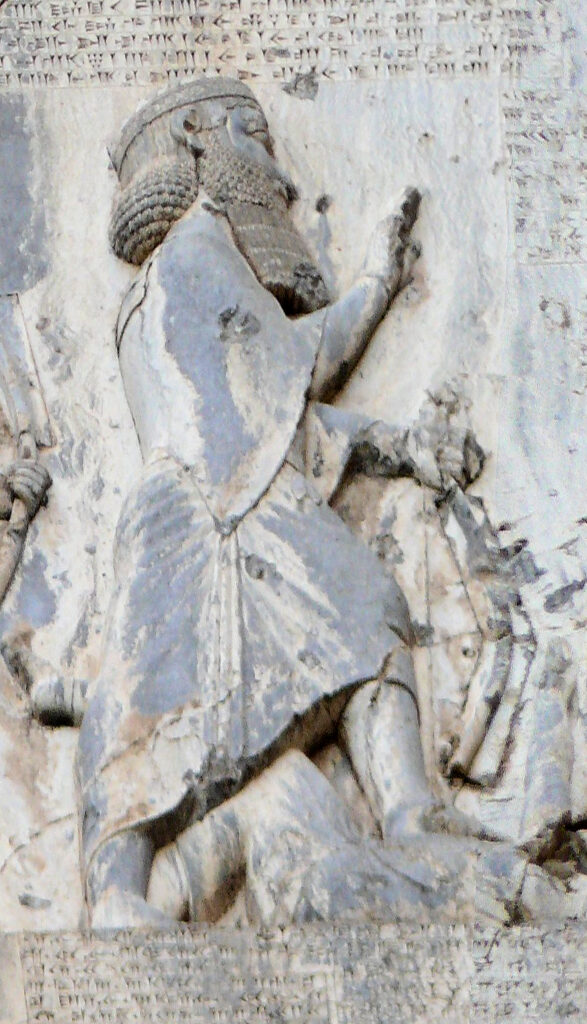
Darius the Great (circa 550-486 BCE) was King of the Achaemenid Persian Empire from 522 to 486 BCE, a reign during which he expanded Persian territory to its greatest extent and established an administrative system that became a model for later empires. Known for his military campaigns, infrastructure projects, and the famous Behistun Inscription that records his rise to power, Darius I is widely regarded as one of the most effective rulers of the ancient world.
Darius the Great at a Glance
| Full name | Darius I of Persia |
| Born | Circa 550 BCE, Persia |
| Died | 486 BCE, Persia |
| Known for | King of the Achaemenid Empire 522-486 BCE; administrative reforms; the Behistun Inscription |
| Occupation | Monarch |
| Major events | Accession in 522 BCE; construction of the Royal Road; the Battle of Marathon in 490 BCE |
| Nationality | Persian |
Early Life and Rise to Power
Darius was born into a noble branch of the Achaemenid family and served as a member of the royal guard before ascending to the Persian throne under contested circumstances following the death of King Cambyses II. His accession involved overthrowing a figure named Gaumata, who had claimed the throne, an event that Darius later described in detail on the Behistun Inscription to legitimize his rule and establish his connection to the royal Achaemenid line.
Consolidating the Empire
Upon taking power, Darius faced numerous rebellions across the vast Persian territories, and his early reign was dominated by military campaigns to suppress uprisings in Babylon, Egypt, and other provinces that had seized on the succession crisis to assert independence. Through a combination of military force and diplomatic settlement, Darius successfully reunified the empire within his first few years as king, establishing the stability that would define the remainder of his reign.
Administrative Reforms
Darius implemented a sophisticated administrative system that divided the Persian Empire into provinces called satrapies, each governed by an official known as a satrap who was responsible for collecting taxes and maintaining order while reporting to the central government. This system, which balanced local autonomy with central oversight, became a model of imperial administration that influenced governance structures in the ancient world for centuries afterward.
The Behistun Inscription
Darius commissioned the Behistun Inscription, a massive trilingual relief and text carved into a cliff face in western Iran that recounts his rise to power and military victories in Old Persian, Elamite, and Babylonian cuneiform script. This inscription later proved instrumental to nineteenth-century scholars in deciphering cuneiform writing, making it one of the most historically significant archaeological sources for understanding the ancient Near East.
Infrastructure and the Royal Road
Darius oversaw the construction of the Royal Road, a major highway system stretching over fifteen hundred miles that connected the empire’s major cities and dramatically improved communication and troop movement across Persian territory. He also commissioned significant irrigation projects and canal construction, including work on a waterway connecting the Nile River to the Red Sea, which facilitated trade between Persia and Egypt.
Economic Policy
Darius standardized currency throughout the Persian Empire with the introduction of the gold daric and silver siglos coins, creating a more unified economic system that facilitated trade across the empire’s diverse regions. His economic reforms also included a standardized system of weights and measures, further integrating the vast and culturally diverse territories under Persian rule into a more cohesive economic unit.
Religious Policy
Darius generally continued the Persian tradition of religious tolerance established by his predecessors, permitting conquered peoples to maintain their own religious practices while he himself followed Zoroastrianism and credited the god Ahura Mazda for his successes. This policy of tolerance, documented in his support for the rebuilding of the Jewish temple in Jerusalem, helped maintain stability across an empire that encompassed numerous different cultures and religious traditions.
Construction of Persepolis
Darius began construction of the ceremonial capital of Persepolis, an elaborate palace complex that would be expanded by his successors and that served as a showcase for the wealth and artistic achievement of the Persian Empire. The site’s monumental architecture and detailed relief carvings, depicting representatives from across the empire bringing tribute to the Persian king, remain among the most important surviving examples of Achaemenid art and architecture.
Military Campaigns in the West
Darius extended Persian control into Europe through campaigns in Thrace and Macedonia, and his reign is particularly remembered for the First Persian invasion of Greece, which culminated in the Persian defeat at the Battle of Marathon in 490 BCE. Although this military setback prevented further Persian expansion into mainland Greece during his lifetime, it did not significantly diminish the overall strength and stability of the vast empire he had built.
Military Organization
Darius reorganized the Persian military, establishing a standing army that included the elite unit known as the Immortals, and developed a system of garrisons stationed throughout the empire’s provinces to maintain order and respond to threats. These military reforms provided the Achaemenid Empire with the organizational capacity to project power across its enormous territory, which stretched from the Indus Valley to the Aegean Sea.
Later Reign and Death
In his final years, Darius continued to govern an empire that remained largely stable despite the setback at Marathon, and he began preparations for a renewed invasion of Greece before his death in 486 BCE. He was succeeded by his son Xerxes I, who inherited both the vast administrative and infrastructure achievements of his father’s reign and the unresolved conflict with the Greek city-states.
Diplomatic and Cultural Exchange
Darius presided over an empire that functioned as a crossroads for diplomatic and cultural exchange, with envoys, merchants, and craftsmen traveling across its territories along routes made safer and more efficient by his infrastructure projects. Persepolis itself reflected this cosmopolitan character, incorporating architectural and artistic influences from Egypt, Mesopotamia, and the Greek world alongside distinctly Persian elements, a synthesis that illustrated the empire’s role in connecting diverse ancient civilizations.
Governance of Egypt
Following his suppression of the Egyptian rebellion early in his reign, Darius took a particular interest in Egyptian affairs, commissioning temple construction and presenting himself in Egyptian artistic conventions as a legitimate pharaoh in the eyes of his Egyptian subjects. This approach of adapting his royal image to local traditions, rather than imposing a uniform Persian identity across the empire, characterized his broader strategy for maintaining control over culturally diverse territories.
Legacy
Darius the Great remains one of the most significant rulers in ancient history, remembered for transforming the Achaemenid Empire from a loosely connected territory into a highly organized and administratively sophisticated state. His innovations in governance, infrastructure, and economic policy established enduring models that influenced subsequent empires, and the Behistun Inscription he commissioned remains an invaluable historical and linguistic resource for understanding the ancient world.
References
- New World Encyclopedia – Darius I of Persia
- History.com – Darius the Great
- History.com – Darius the Great (Ancient History)
Frequently Asked Questions
What is Darius the Great best known for? He is best known for expanding the Achaemenid Persian Empire to its greatest extent, implementing sweeping administrative reforms, and commissioning the Behistun Inscription.
What was the Behistun Inscription? It was a massive trilingual relief and text carved into a cliff face that recounted Darius’s rise to power, later proving crucial to scholars in deciphering ancient cuneiform script.
Why is Darius the Great associated with the Battle of Marathon? His invasion of Greece culminated in the Persian defeat at the Battle of Marathon in 490 BCE, a significant setback during his otherwise expansive reign.
What administrative system did Darius the Great introduce? He divided the Persian Empire into provinces called satrapies, each governed by an official called a satrap, creating a model of imperial administration used for centuries.
Editorially reviewed by Specialty Digest Editorial TeamLast reviewed November 29, 2026Researched and drafted with AI assistanceReport an issue