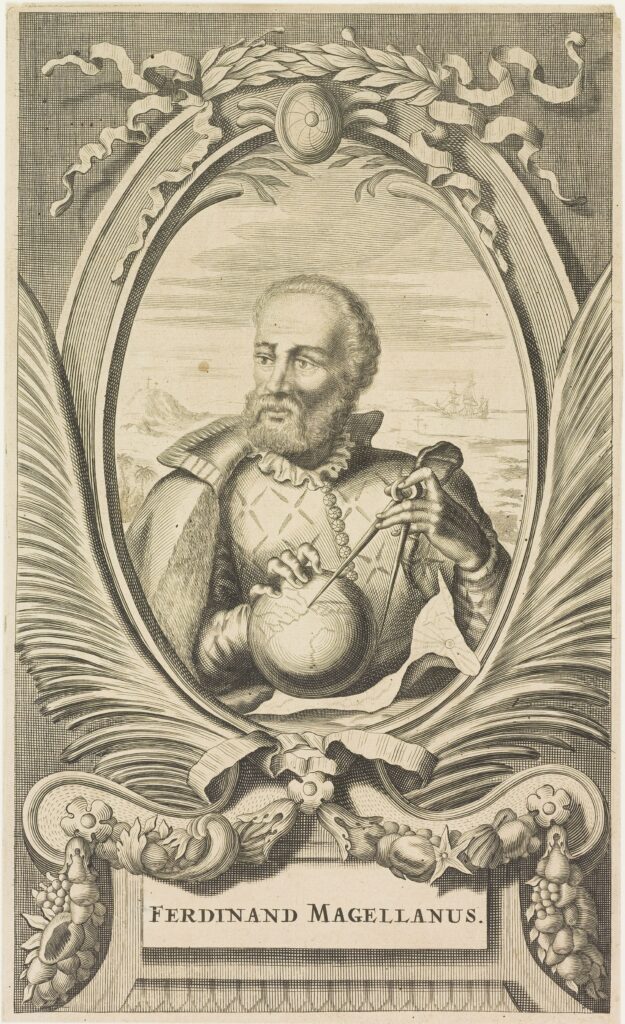
Ferdinand Magellan (circa 1480-1521) was a Portuguese explorer who organized and led the Spanish expedition that became the first to sail across the Pacific Ocean and set in motion the first circumnavigation of the globe. Though Magellan himself died before the voyage’s completion, his navigational planning and leadership through the most difficult stretches of the journey earned him lasting recognition as one of history’s most consequential maritime explorers.
Ferdinand Magellan at a Glance
| Full name | Fernao de Magalhaes (Ferdinand Magellan) |
| Born | Circa 1480, Sabrosa or Porto, Portugal |
| Died | April 27, 1521, Mactan, Philippines |
| Known for | Leading the expedition that achieved the first circumnavigation of the globe, 1519-1522 |
| Occupation | Explorer, naval commander |
| Major events | Departure from Spain 1519; discovery of the Strait of Magellan 1520; first Pacific crossing 1520-1521; death at Mactan 1521 |
| Nationality | Portuguese, sailing under the Spanish crown |
Early Life and Portuguese Service
Magellan was born into a minor noble family in Portugal and served as a young page at the royal court before joining Portuguese naval expeditions to India and Southeast Asia in his twenties. These voyages gave him firsthand experience with the spice trade, the geography of the Indian Ocean, and the navigational challenges of long-distance sea travel, knowledge that would prove essential to his later ambitions.
Turning to Spain
After a falling out with the Portuguese crown over matters of pay and recognition, Magellan renounced his Portuguese nationality and offered his services to King Charles I of Spain, proposing an expedition that would reach the Spice Islands of Southeast Asia by sailing west around South America rather than east around Africa. The Spanish crown, eager to find a route to the spice trade that did not infringe on Portuguese claims under the Treaty of Tordesillas, agreed to sponsor the ambitious voyage.
Departure and the Atlantic Crossing
Magellan departed Spain in September 1519 with a fleet of five ships and approximately two hundred seventy men, sailing across the Atlantic and down the coast of South America in search of a passage to the Pacific Ocean. The fleet endured a difficult winter along the Patagonian coast, including a serious mutiny among several ship captains that Magellan suppressed through decisive and firm action, reasserting control over the expedition before continuing southward.
Discovery of the Strait of Magellan
In October 1520, Magellan’s fleet discovered the narrow, treacherous waterway at the southern tip of South America that would later bear his name, the Strait of Magellan, successfully navigating its difficult currents and unpredictable weather over several weeks. This passage provided the first known sea route connecting the Atlantic and Pacific Oceans, a geographic breakthrough that confirmed the Americas were a distinct landmass separate from Asia.
The Pacific Crossing
Emerging into the ocean he named the Pacific for its apparent calm, Magellan led his remaining three ships on an arduous crossing that lasted nearly four months without reliable resupply, during which many crew members suffered severely from scurvy and starvation. The crossing proved far longer than Magellan had anticipated, as he had significantly underestimated the vast size of the Pacific Ocean, but his navigational calculations ultimately brought the fleet safely to the islands of present-day Guam and then the Philippines in March 1521.
Arrival in the Philippines
Upon reaching the Philippine archipelago, Magellan established relationships with several local rulers and participated in negotiations and alliances that were intended to secure safe passage and resupply for his expedition. His engagement with local political dynamics in the islands, including alliances with some chieftains and conflicts with others, ultimately led to his involvement in a battle on the island of Mactan in April 1521, where he was killed.
Completion of the Circumnavigation
Following Magellan’s death, command of the expedition passed through several officers before Juan Sebastian Elcano ultimately led the sole surviving ship, the Victoria, back to Spain in September 1522, completing the first circumnavigation of the globe with a crew reduced to just eighteen of the original roughly two hundred seventy men. The voyage’s completion, though achieved under Elcano’s leadership rather than Magellan’s own, is historically credited to the expedition Magellan conceived, organized, and led through its most perilous stages.
Navigational and Scientific Significance
The expedition provided Europe with its first empirical proof of the Earth’s spherical nature achieved through direct circumnavigation, along with crucial new geographic knowledge about the true size of the Pacific Ocean and the layout of the world’s continents and oceans. The voyage’s surviving records and logs, particularly those kept by the Italian scholar Antonio Pigafetta who sailed with the expedition, became invaluable sources of geographic, ethnographic, and navigational information for subsequent generations of European explorers.
Strategic Impact on Global Trade
Magellan’s expedition demonstrated a viable westward sea route to the Spice Islands, strengthening Spain’s position in the competition with Portugal for control of lucrative Asian trade routes and contributing to the broader European age of maritime exploration and expansion. The strait and route he pioneered, though difficult and rarely used for regular commercial traffic due to its treacherous conditions, remained strategically and symbolically significant for centuries afterward.
Legacy in Geography and Nomenclature
Magellan’s name has been permanently attached to numerous geographic features and scientific phenomena, most notably the Strait of Magellan and the Magellanic Clouds, two dwarf galaxies visible from the Southern Hemisphere that were documented in European astronomical records following his voyage. This enduring nomenclature reflects the profound and lasting impact his expedition had on European understanding of global geography and the cosmos.
Commemoration
Magellan has been honored throughout the centuries since his death with numerous memorials, including ships, research vessels, space missions, and institutions named in his honor, reflecting his status as one of the most celebrated figures of the Age of Discovery. Museums and historical societies across Portugal, Spain, and the Philippines continue to study and commemorate the expedition’s historic achievement.
Provisioning and Fleet Management
Throughout the expedition, Magellan faced the constant logistical challenge of provisioning five ships for a voyage of unprecedented length and uncertainty, a task complicated by the limited food storage technology of the era and the impossibility of predicting how long the Pacific crossing would ultimately take. His careful management of supplies during the harsh Patagonian winter, including strict rationing measures, helped preserve enough of the fleet’s resources to attempt the crossing that followed, even though the Pacific voyage itself still brought the crew to the edge of starvation.
Legacy
Ferdinand Magellan remains one of the most significant figures in the history of exploration, remembered for conceiving and leading the expedition that achieved humanity’s first circumnavigation of the globe. Although he did not live to see the voyage’s completion, his navigational vision, his discovery of the strait that bears his name, and his leadership through the expedition’s most difficult stretches secured his place among history’s most consequential explorers.
References
- New World Encyclopedia – Ferdinand Magellan
- History.com – Ferdinand Magellan
- History.com – Ferdinand Magellan (Exploration)
Frequently Asked Questions
What is Ferdinand Magellan best known for? He is best known for organizing and leading the expedition that achieved the first circumnavigation of the globe between 1519 and 1522.
Did Ferdinand Magellan complete the circumnavigation himself? No, Magellan died in the Philippines in April 1521; the voyage was completed under Juan Sebastian Elcano’s leadership in September 1522.
What is the Strait of Magellan? It is the narrow sea passage at the southern tip of South America that Magellan discovered in 1520, connecting the Atlantic and Pacific Oceans.
Why did Magellan sail for Spain instead of Portugal? After a dispute with the Portuguese crown over pay and recognition, he renounced his Portuguese nationality and secured Spanish sponsorship for his westward expedition.
Editorially reviewed by Specialty Digest Editorial TeamLast reviewed November 29, 2026Researched and drafted with AI assistanceReport an issue