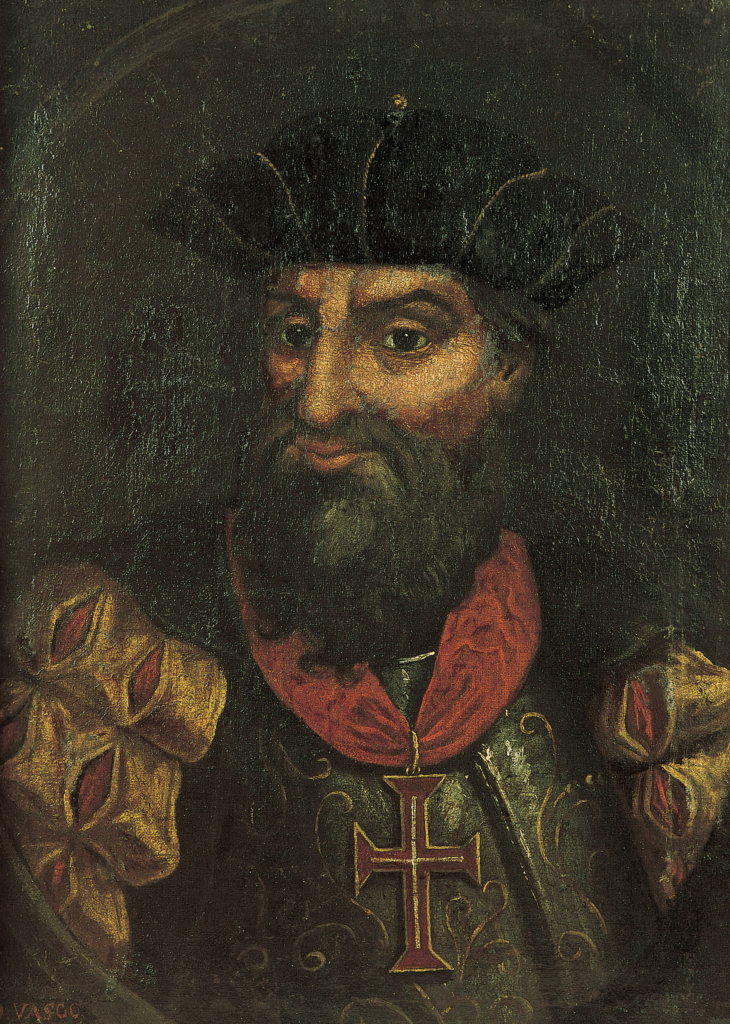
Vasco da Gama (circa 1460-1524) was a Portuguese explorer who led the first European expedition to reach India by sea, establishing a direct maritime trade route between Europe and Asia around the southern tip of Africa. Known for his landmark 1497-1499 voyage, da Gama’s achievement opened the Age of Discovery’s most consequential trade corridor and laid the foundation for centuries of Portuguese commercial and colonial influence in the Indian Ocean.
Vasco da Gama at a Glance
| Full name | Vasco da Gama |
| Born | Circa 1460, Sines, Portugal |
| Died | December 24, 1524, Kochi, India |
| Known for | First European sea voyage to India 1497-1499; establishing the Cape Route |
| Occupation | Explorer, naval commander |
| Major events | First voyage to India 1497-1499; second voyage 1502-1503; appointment as Viceroy of India in 1524 |
| Nationality | Portuguese |
Early Life and Naval Background
Vasco da Gama was born into a noble family in the coastal town of Sines, Portugal, where his father had served as a commander in the military Order of Santiago, providing young Vasco with connections to the Portuguese court and naval establishment. Little is documented about his early education, but by the time he reached adulthood he had developed the navigational and military skills that would later qualify him for the crown’s most ambitious maritime undertaking.
Portuguese Ambitions in the Indian Ocean
By the late fifteenth century, Portugal had invested decades in exploring the African coastline in hopes of finding a sea route to the lucrative spice markets of Asia, building on the earlier voyages of explorers such as Bartolomeu Dias, who had rounded the Cape of Good Hope in 1488. King Manuel I selected da Gama to lead the expedition intended to complete this long-sought goal, entrusting him with a fleet of four ships and a crew of approximately one hundred seventy men.
The First Voyage to India
Departing from Lisbon in July 1497, da Gama’s fleet rounded the Cape of Good Hope and, with the assistance of an Indian Ocean pilot secured along the East African coast, successfully reached the port city of Calicut on the southwestern coast of India in May 1498. This voyage represented the first time a European expedition had sailed directly from Europe to Asia by sea, bypassing the overland and Mediterranean trade routes that had previously been controlled by Arab and Venetian intermediaries.
Challenges at Calicut and the Return Voyage
Da Gama’s initial reception at Calicut proved complicated, as local rulers and merchants were unimpressed by the relatively modest trade goods the Portuguese had brought, and tensions arose with established Arab merchants who viewed the newcomers as commercial rivals. Despite these difficulties, da Gama secured a quantity of valuable spices before departing, and his return voyage to Portugal in 1499, though costly in terms of ships and crew lost to disease and hardship, confirmed the viability of the sea route to India.
Recognition and Rewards
Upon his triumphant return to Portugal, da Gama received substantial honors and rewards from King Manuel I, including the title of Admiral of the Indian Seas and significant financial compensation that reflected the enormous strategic and commercial value of his achievement. His voyage immediately transformed Portugal’s position in European trade, positioning the small kingdom to become a dominant power in the lucrative spice trade that had previously enriched Venetian and Ottoman intermediaries.
The Second Voyage
Da Gama returned to India in 1502 at the head of a much larger and more heavily armed fleet, tasked with asserting Portuguese military and commercial dominance in the region and retaliating against perceived hostilities from the first voyage. This second expedition established a more forceful Portuguese presence in the Indian Ocean, employing naval power to compel local rulers and traders to accept Portuguese terms and to challenge Arab and other rival merchant networks operating in the region.
Establishment of the Cape Route
The sea route da Gama pioneered around the Cape of Good Hope, subsequently known as the Cape Route, became the primary maritime corridor connecting Europe to Asia for the following centuries, fundamentally transforming global trade patterns. This route allowed Portugal and later other European powers to bypass the traditional overland and Mediterranean spice trade networks, redirecting enormous commercial wealth toward Atlantic Europe.
Impact on Global Trade Networks
Da Gama’s successful voyages initiated a dramatic reorganization of global commerce, as the direct sea route to Asia undermined the centuries-old trading networks that had connected Europe to Asian markets through intermediary powers in the Middle East and the Mediterranean. The resulting shift in trade patterns contributed to the economic decline of traditional trading cities and the corresponding rise of Atlantic European powers as dominant forces in international commerce.
Later Career and Appointment as Viceroy
After decades of service to the Portuguese crown, da Gama was appointed Viceroy of Portuguese India in 1524, a position that recognized his foundational role in establishing Portugal’s presence in the region and tasked him with overseeing the colonial administration he had helped make possible. He traveled to India to assume this position but died in the city of Kochi only months after his arrival, having spent much of his final years working to reform and stabilize Portuguese colonial governance in the region.
Navigational Legacy
Da Gama’s voyages demonstrated remarkable navigational achievement for the era, as his fleet successfully crossed vast stretches of open ocean using the celestial navigation techniques and instruments available in the late fifteenth century. His route-finding and the detailed records kept during his expeditions provided crucial information that subsequent Portuguese and European navigators relied upon for generations of continued exploration and trade in the Indian Ocean.
Commemoration
Da Gama has been extensively commemorated throughout Portuguese and world history, including the naming of ships, bridges, and institutions after him, reflecting his enduring status as one of the most consequential figures of the European Age of Discovery. The Vasco da Gama Bridge in Lisbon, one of the longest in Europe, stands as a prominent modern tribute to his historical significance.
Relations with Local Powers in East Africa
During his voyages along the East African coast, da Gama’s fleet made contact with established Swahili trading city-states such as Mozambique Island, Mombasa, and Malindi, encounters that ranged from hostile confrontation to productive alliance depending on local political circumstances. His successful partnership with the ruler of Malindi, who provided the experienced pilot that guided the Portuguese fleet across the Indian Ocean to Calicut, proved essential to the ultimate success of the historic first voyage.
Legacy
Vasco da Gama remains one of the most significant maritime explorers in world history, remembered for opening the direct sea route between Europe and Asia that reshaped global trade for centuries. His 1497-1499 voyage marked a turning point in the history of exploration, establishing Portugal as a dominant maritime power and fundamentally altering the economic relationships between Europe, Africa, and Asia.
References
- New World Encyclopedia – Vasco da Gama
- History.com – Vasco da Gama
- History.com – Vasco da Gama (Exploration)
Frequently Asked Questions
What is Vasco da Gama best known for? He is best known for leading the first European sea voyage to India, establishing a direct maritime trade route between Europe and Asia around Africa.
When did Vasco da Gama reach India? He reached the port city of Calicut on India’s southwestern coast in May 1498, after departing from Lisbon in July 1497.
What was the Cape Route? It was the sea route around the Cape of Good Hope that da Gama pioneered, which became the primary maritime corridor connecting Europe to Asia for centuries.
What position did Vasco da Gama hold at the end of his life? He was appointed Viceroy of Portuguese India in 1524 but died in Kochi only months after arriving to take up the position.
Editorially reviewed by Specialty Digest Editorial TeamLast reviewed November 29, 2026Researched and drafted with AI assistanceReport an issue