Botswana is a landlocked country in Southern Africa, bordered by South Africa to the south and southeast, Namibia to the west and north, Zimbabwe to the northeast, and Zambia at a narrow northern point. It covers 581,730 square kilometers, an area roughly the size of France, and most of that territory sits within the Kalahari Desert basin. The capital and largest city is Gaborone. At the 2022 national census, the population stood at 2,359,609, making Botswana one of the more thinly populated countries in Africa relative to its land area, according to Statistics Botswana. Since gaining independence in 1966, the country has built a reputation as one of Africa’s most stable multiparty democracies, an economy anchored heavily in diamond mining, and a global center for wildlife conservation built around the Okavango Delta.
Key Takeaways
- Botswana is a landlocked Southern African nation of about 2.36 million people, with its capital at Gaborone.
- It has held multiparty elections every five years since independence on September 30, 1966, and is widely regarded as one of Africa’s most stable democracies.
- Diamonds still account for more than 70 percent of the country’s total exports, anchoring an upper-middle-income economy.
- The Okavango Delta, an inland river system that never reaches the sea, became UNESCO’s 1,000th World Heritage Site in 2014.
- The Tsodilo Hills preserve more than 4,500 rock paintings and evidence of human activity stretching back roughly 100,000 years.
- Despite middle-income status, extreme poverty (13.5 percent in 2023) and inequality remain significant challenges.
Geography
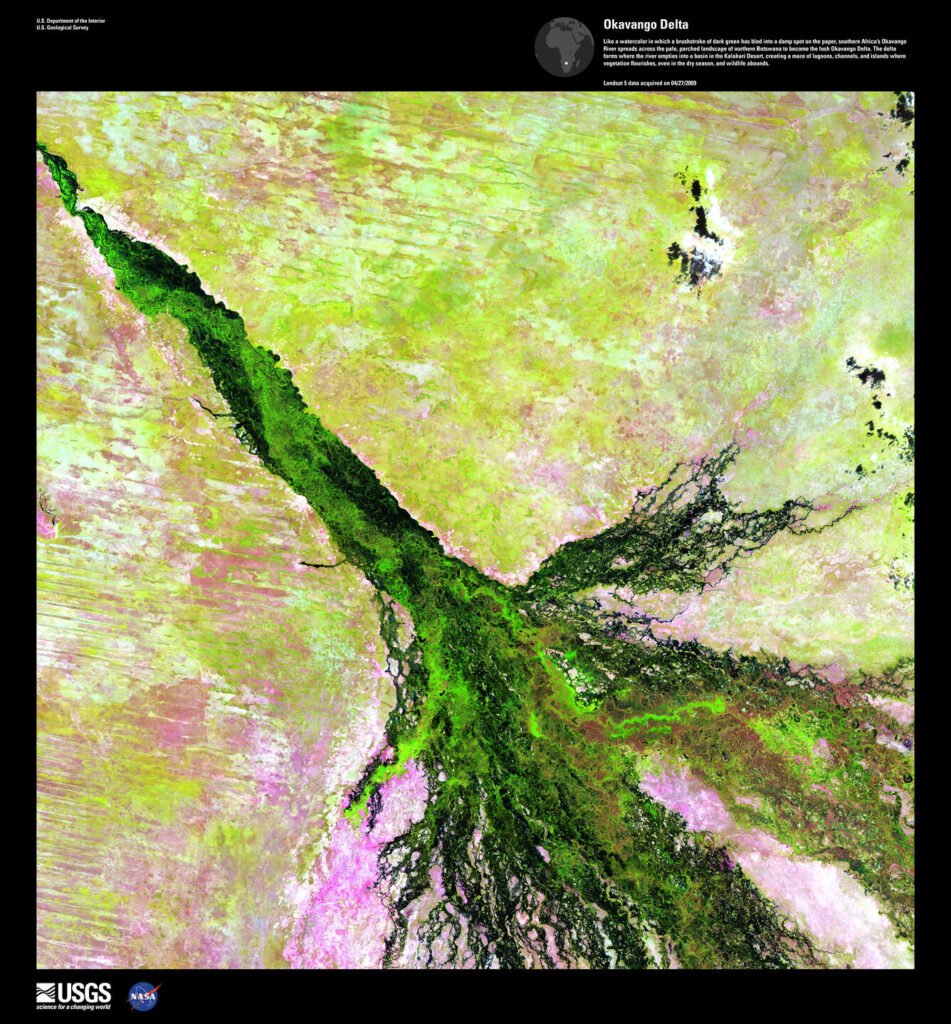
Botswana’s terrain is dominated by the Kalahari, a semi-arid basin that spreads across the interior rather than forming the classic sand-dune desert many people picture. In the northwest, that dry expanse gives way to one of the world’s more unusual river systems. The Okavango River rises in the highlands of central Angola, where it is known as the Cubango, and runs roughly 1,600 kilometers (1,000 miles) southeast, according to Britannica. Instead of reaching an ocean, it spreads out across the Kalahari sands in northern Botswana and forms the Okavango Delta, an inland wetland of permanent marshland and seasonally flooded plains spanning close to 2 million hectares. UNESCO inscribed the delta as a World Heritage Site in 2014, noting that its annual flood arrives during Botswana’s dry season, a reversed seasonal rhythm that shapes the life cycles of the plants and animals that depend on it, per the UNESCO World Heritage Centre.
In the far northwest, near the Namibian border, a cluster of quartzite outcrops known as the Tsodilo Hills rises abruptly from the desert floor. The hills hold more than 4,500 rock paintings within just 10 square kilometers, created by successive communities from the Stone Age through the 19th century, and the site documents human activity and environmental change over roughly 100,000 years, according to UNESCO, which inscribed Tsodilo as a World Heritage Site in 2001.
Brief history
In 1885, three Tswana leaders sought British protection against the threat of annexation by neighboring colonial and settler interests, and the territory became the Bechuanaland Protectorate, according to the Embassy of the Republic of Botswana. After 80 years of British administration, the territory moved to self-government in 1965 and became fully independent as the Republic of Botswana on September 30, 1966, with Sir Seretse Khama as its first president. The Botswana Democratic Party governed continuously from independence until the 2024 general election.
Independence came just before a transformation few could have predicted. In April 1967, geologists working for De Beers identified a diamond-bearing kimberlite pipe near Orapa, and mining began there in 1971, followed by Letlhakane, Jwaneng, and Damtshaa in the decades that followed, according to Debswana, the state-linked mining company formed to develop the finds. The revenue from those deposits underwrote decades of public investment and helped move Botswana from among the world’s poorest countries at independence into an upper-middle-income economy.
Government and economy
Botswana is a multiparty democracy with national elections held every five years, structured around executive, legislative, and judicial branches, and it applies a dual legal framework that combines Roman-Dutch law with customary law, according to the Government of Botswana. Advocate Duma Boko became the country’s sixth president in 2024, ending the Botswana Democratic Party’s uninterrupted run since independence.
The economy remains an upper-middle-income economy built substantially on diamonds, which account for more than 70 percent of total exports, according to the World Bank. Growth that once averaged more than 7 percent a year from independence through the early 2000s has slowed considerably, averaging around 3 percent since 2009 and contracting by an estimated 3.1 percent in 2024 as diamond demand softened. Cattle ranching remains culturally and economically important, accounting for roughly two-thirds of agricultural output, and the government has begun diversifying its energy base: a 100-megawatt solar project at Mmadinare came online in December 2025, meeting an estimated 7 percent of national electricity demand, per the World Bank. Even so, extreme poverty stood at an estimated 13.5 percent in 2023, unemployment at roughly 27.6 percent, and income inequality remains high, with a Gini index of 53.3, underscoring that diamond wealth has not reached all Batswana evenly.
Culture and people
English is Botswana’s official language and Setswana its national language, though a number of other languages are spoken across the country, according to the Government of Botswana. The majority of the population is ethnically Tswana, organized historically into distinct chiefdoms, while the San (also known as Basarwa), among the region’s oldest inhabitants, maintain a deep connection to the Kalahari and to sites like the Tsodilo Hills. Local Hambukushu and San communities regard Tsodilo as sacred ground, a place of worship and a home for ancestral spirits, and continue to use its water holes and hills for spiritual purposes, according to UNESCO. Cattle hold a central place in Batswana life, functioning historically as both an economic asset and a marker of social standing.
What it’s best known for globally
Internationally, Botswana is best known for two things: diamonds and wildlife. It built one of the more closely watched diamond-based development stories in Africa, using mineral revenue to fund infrastructure, education, and health spending rather than letting it flow offshore. At the same time, the Okavango Delta has become one of the continent’s most closely watched conservation sites, sustaining more than 1,000 plant species and roughly 480 bird species, along with populations of cheetahs, African wild dogs, and both black and white rhinoceroses. The delta forms core habitat for an estimated 130,000 African elephants, according to UNESCO, giving Botswana one of the largest elephant populations of any single country and making it a focal point for elephant research and conservation policy across the region.
Why it matters
Botswana is frequently cited as a counterexample to the “resource curse,” the pattern in which mineral wealth fuels corruption and instability rather than development. Its combination of consistent elections, relatively low corruption by regional standards, and diamond revenue channeled into public services has made it a reference point in debates about governance and natural-resource management. At the same time, the country’s current strain, slowing growth, high youth unemployment, and continued dependence on a single export commodity, illustrates a challenge facing many resource-dependent economies: sustaining development once the easiest gains from a boom have already been captured. The Okavango Delta and Tsodilo Hills add another dimension to that story, representing some of the clearest examples worldwide of ecosystems and archaeological records that have persisted in something close to their natural and undisturbed state.
Sources
- World Bank: Botswana Overview
- World Bank Blogs: Time to Regain the Sparkle: A New Growth Strategy for Botswana
- UNESCO World Heritage Centre: Okavango Delta
- UNESCO World Heritage Centre: Tsodilo
- Government of Botswana: About Our Country
- Statistics Botswana: 2022 Population and Housing Census
- Embassy of the Republic of Botswana in Washington, D.C.: History of Botswana
- Britannica: Okavango River
- Debswana: Our History
Key facts
- Population 2,359,609 at the 2022 national census6
- Diamonds account for more than 70 percent of total exports2
- Independence from Britain achieved on September 30, 19667
- Okavango Delta inscribed as UNESCO's 1,000th World Heritage Site in 2014, spanning nearly 2 million hectares3
- Tsodilo Hills preserve more than 4,500 rock paintings and evidence of human activity spanning roughly 100,000 years4
Quick checkWhat is Botswana's economy primarily built on, and what is its most famous natural landmark?Show answer
Diamond mining, which accounts for more than 70 percent of total exports, and the Okavango Delta, an inland wetland UNESCO inscribed as its 1,000th World Heritage Site in 2014.
Sources
- World Bank. Botswana Overview. Undated (continuously updated) (accessed Accessed 2026-09-22)
- World Bank Blogs (Nasikiliza). Time to Regain the Sparkle: A New Growth Strategy for Botswana. April 2025 (accessed Accessed 2026-09-22)
- UNESCO World Heritage Centre. Okavango Delta. 2014 (accessed Accessed 2026-09-22)
- UNESCO World Heritage Centre. Tsodilo. 2001 (accessed Accessed 2026-09-22)
- Government of Botswana. About Our Country. Undated (accessed Accessed 2026-09-22)
- Statistics Botswana. 2022 Population and Housing Census. 2022 (accessed Accessed 2026-09-22)
- Embassy of the Republic of Botswana in Washington, D.C.. History of Botswana. Undated (accessed Accessed 2026-09-22)
- Britannica. Okavango River. Undated (accessed Accessed 2026-09-22)
- Debswana. Our History. Undated (accessed Accessed 2026-09-22)
Editorially reviewed by Specialty Digest Editorial TeamLast reviewed September 22, 2026Researched and drafted with AI assistanceReport an issue