Where Cabo Verde Is and What Kind of Place It Is
Cabo Verde is an island nation of ten volcanic islands in the central Atlantic Ocean, roughly 500 kilometers (about 300 miles) off the coast of Senegal in West Africa. Nine of the ten islands are inhabited, spread across a land area of about 4,033 square kilometers, a bit smaller than Rhode Island. The capital and largest city is Praia, on the island of Santiago. Cabo Verde has been an independent republic since 1975, when it broke from nearly five centuries of Portuguese colonial rule, and it is often referred to in English by its former name, Cape Verde, though the government adopted “Cabo Verde” as the country’s official name in all languages in 2013.
Geography
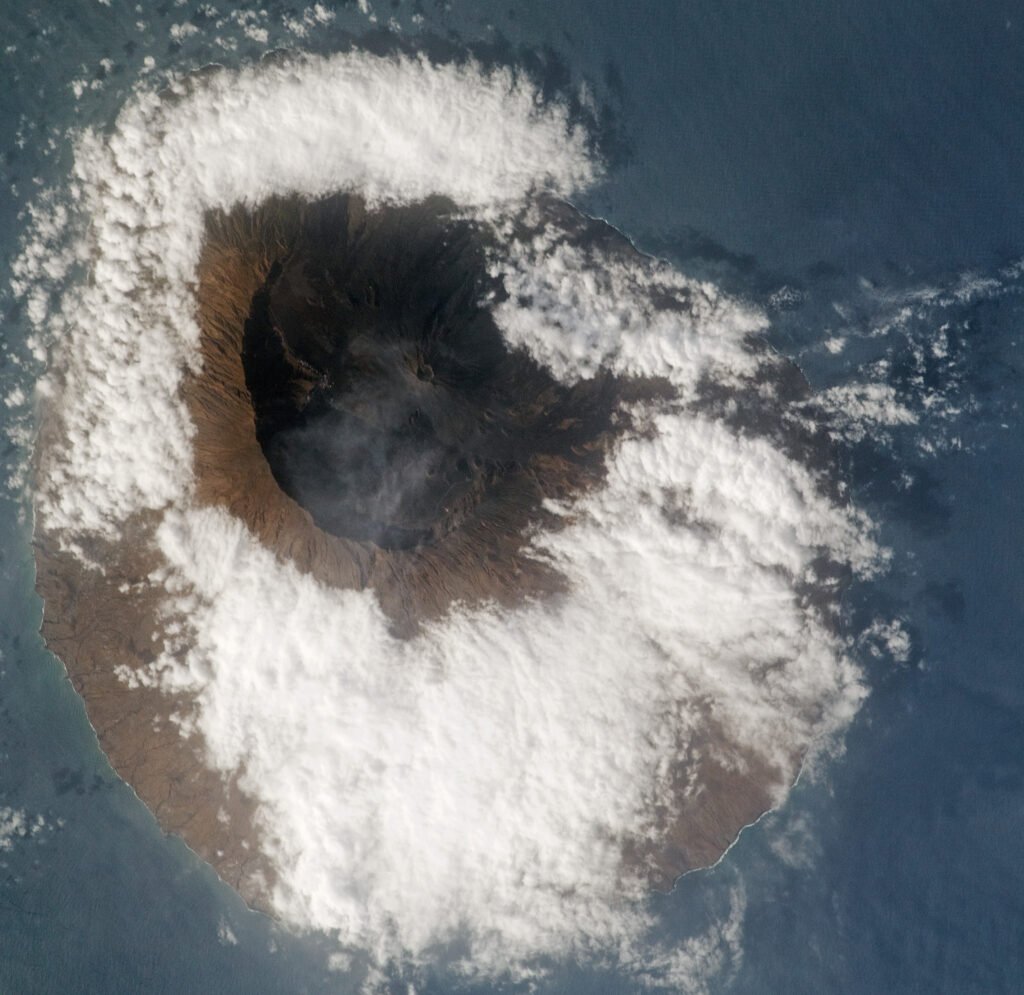
The archipelago splits into two groups named for the prevailing trade winds: the Barlavento (windward) islands to the north, including Santo Antão, São Vicente, and Sal, and the Sotavento (leeward) islands to the south, including Santiago, Fogo, and Brava. Every island formed through volcanic activity, and the terrain ranges from arid, wind-scoured lowlands on islands like Sal and Boa Vista to steep, green highlands on Santo Antão. The country’s highest point is Pico do Fogo, an active stratovolcano rising 2,829 meters (9,281 feet) above a nine-kilometer-wide summit caldera on the island of Fogo. The volcano has erupted repeatedly since Portuguese settlement began around 1500, most recently in a 2014-2015 eruption that destroyed two villages and forced more than 1,000 residents to evacuate, according to the Smithsonian Institution’s Global Volcanism Program. Cabo Verde has a hot, arid to semi-arid climate shaped by the Sahara to the east and cool Atlantic currents, and the islands are prone to prolonged droughts that have historically driven emigration.
A Brief History
Cabo Verde had no indigenous population before Portuguese navigators reached the islands in 1456 and began settling Santiago in 1462. The town they founded, Ribeira Grande, later renamed Cidade Velha, became the first European colonial settlement in the tropics and quickly developed into a hub for transatlantic trade. Cidade Velha’s Historic Centre of Ribeira Grande was inscribed as a UNESCO World Heritage Site in 2009, recognized for its role in early colonial urban planning and, more somberly, as one of the earliest and longest-running points of embarkation in the transatlantic slave trade, a history that also produced what UNESCO describes as the first fully developed Creole society in the Atlantic world, according to the UNESCO World Heritage Centre.
Cabo Verde and Guinea-Bissau were administered together by Portugal until 1879. Independence sentiment grew through the twentieth century, and in 1956 Amílcar Cabral founded the African Party for the Independence of Guinea and Cabo Verde (PAIGC), which turned to armed struggle against Portuguese rule in 1963. Cabral was assassinated in January 1973 and did not live to see the outcome, but Cabo Verde declared independence on July 5, 1975. The PAIGC’s Cabo Verdean branch, later renamed PAICV, governed as the sole legal party until 1991, when the country held its first multiparty elections and the opposition Movement for Democracy (MpD) won, according to Encyclopaedia Britannica.
Government and Economy
Cabo Verde is a semi-presidential republic. Voters directly elect a president, who serves as head of state and commander-in-chief, while a prime minister chosen by the unicameral National Assembly serves as head of government and runs day-to-day policy. The 72-seat National Assembly is directly elected and has operated under a gender-parity law since 2019 requiring electoral lists to include at least 40 percent women or men, according to the Inter-Parliamentary Union. Power has alternated peacefully between the MpD and PAICV since 1991, and the Africa Center for Strategic Studies, a U.S. Department of Defense research institution, reports that Cabo Verde consistently ranks as Africa’s most democratic country in Freedom House’s annual survey, according to the Africa Center for Strategic Studies.
The economy is small and services-led, built around tourism, which employs more than two-thirds of the workforce and generates roughly a quarter of GDP. Cabo Verde has almost no exploitable mineral or agricultural resources and imports most of its food, so it depends heavily on tourism revenue, fishing, and remittances from a large emigrant population. Gross domestic product reached about $3.06 billion in 2025, or roughly $5,800 per person, and the economy grew 6.3 percent that year on record tourism arrivals. The poverty rate fell from 35.5 percent in 2015 to 24.8 percent in 2023, and the government posted its first fiscal surplus since 2007, according to the World Bank.
Culture and People
Cabo Verdean identity grew out of the mixing of Portuguese settlers and enslaved and free West Africans over five centuries, producing a distinct Creole culture and language. Portuguese is the official language used in government and schools, but nearly the entire population speaks Cabo Verdean Creole (Kriolu), a Portuguese-based creole, as a mother tongue in daily life. That mixed heritage is most audible in morna, a melancholic sung and instrumental tradition built around themes of longing, the sea, and separation from home, which UNESCO inscribed on its Representative List of the Intangible Cultural Heritage of Humanity in 2019, according to UNESCO’s Intangible Cultural Heritage program. Cabo Verde’s population is also unusual in that its diaspora, concentrated in the United States, Portugal, France, and the Netherlands, is widely estimated to outnumber the roughly 527,000 people living on the islands, a legacy of drought-driven emigration going back to the nineteenth century.
What Cabo Verde Is Best Known For
Internationally, Cabo Verde is best known for two things: its music and its status as one of Africa’s most stable democracies. The singer Cesária Évora, known as the “barefoot diva” for performing without shoes, carried morna to a global audience beginning in the 1990s and won the Grammy Award for Best Contemporary World Music Album in 2004 for her record “Voz d’Amor,” according to the Recording Academy. Cidade Velha, the country’s UNESCO World Heritage site, draws attention as the oldest surviving European colonial settlement in the tropics and a preserved record of the earliest Atlantic slave trade. Fogo’s active volcano, meanwhile, makes Cabo Verde one of the few island nations where residents live inside a volcanic caldera, and its 2014-2015 eruption drew international scientific and media attention.
Why Cabo Verde Matters
Cabo Verde is a case study in what a resource-poor island nation can build through governance rather than natural wealth. It has no oil, few minerals, and a climate too dry for most agriculture, yet it has sustained one of Africa’s longest unbroken records of democratic elections and used tourism and remittances to cut its poverty rate by roughly a third in under a decade. Its history at Cidade Velha also preserves a physical record of the earliest phase of the transatlantic slave trade and the Creole societies it produced, a history that later shaped Atlantic cultures far beyond the islands themselves. For researchers of small-state governance, Atlantic history, or Creole linguistics and music, Cabo Verde offers an unusually well-documented and compact example.
Sources
- World Bank, Cabo Verde Overview
- UNESCO World Heritage Centre, Historic Centre of Ribeira Grande, Cidade Velha
- Smithsonian Institution, Global Volcanism Program: Fogo
- Encyclopaedia Britannica, Cabo Verde: Struggle for Independence
- Inter-Parliamentary Union, Cabo Verde National Assembly (IPU Parline)
- Africa Center for Strategic Studies, Cabo Verde: Power Sharing that Delivers Stability and Prosperity
- UNESCO Intangible Cultural Heritage, Morna, Musical Practice of Cabo Verde
- Recording Academy (GRAMMY.com), Cesaria Evora Awards and Nominations
Key facts
- Population: approximately 527,000 as of 20251
- Land area: about 4,033 square kilometers across nine inhabited islands1
- Independence: declared from Portugal on July 5, 19754
- Highest point: Pico do Fogo, an active volcano at 2,829 meters, last erupted 2014-20153
- Cidade Velha (Ribeira Grande) inscribed as a UNESCO World Heritage Site in 20092
Quick checkWhen did Cabo Verde become independent, and from whom?Show answer
Cabo Verde declared independence from Portugal on July 5, 1975, after an armed independence struggle led by the PAIGC under Amílcar Cabral.
Sources
- World Bank. Cabo Verde Overview. 2025 (accessed 2026-09-22)
- UNESCO World Heritage Centre. Historic Centre of Ribeira Grande, Cidade Velha. 2009 (accessed 2026-09-22)
- Smithsonian Institution, Global Volcanism Program. Fogo. n.d. (accessed 2026-09-22)
- Encyclopaedia Britannica. Cabo Verde: Struggle for Independence. n.d. (accessed 2026-09-22)
- Inter-Parliamentary Union. Cabo Verde, National Assembly (IPU Parline). 2026 (accessed 2026-09-22)
- Africa Center for Strategic Studies. Cabo Verde: Power Sharing that Delivers Stability and Prosperity. 2026 (accessed 2026-09-22)
- UNESCO Intangible Cultural Heritage. Morna, Musical Practice of Cabo Verde. 2019 (accessed 2026-09-22)
- Recording Academy (GRAMMY.com). Cesaria Evora, Awards and Nominations. n.d. (accessed 2026-09-22)
Editorially reviewed by Specialty Digest Editorial TeamLast reviewed September 22, 2026Researched and drafted with AI assistanceReport an issue