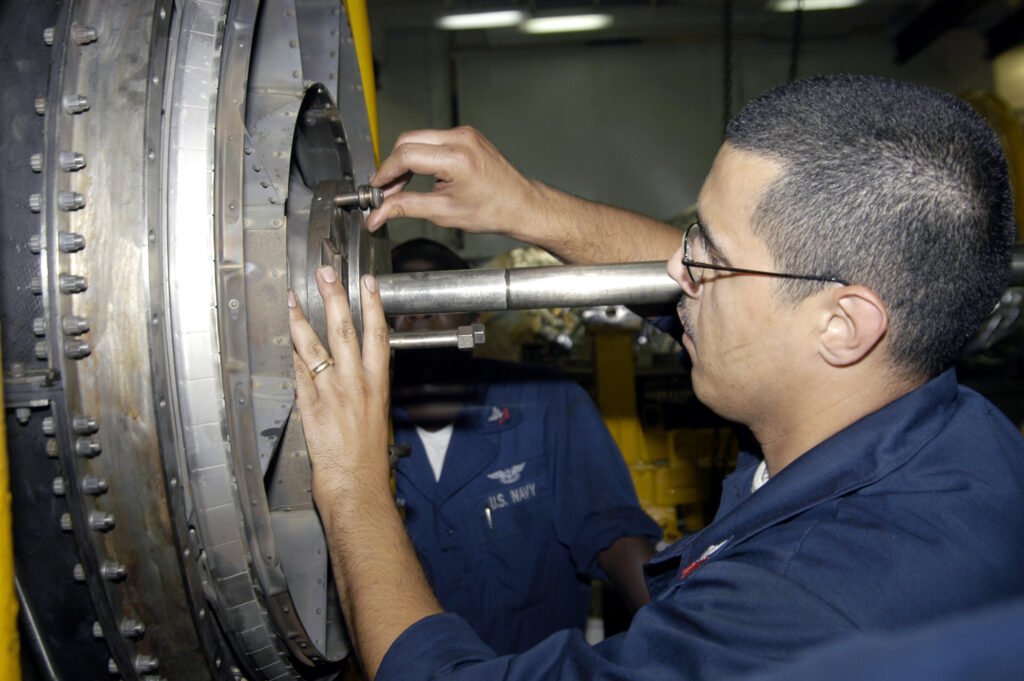
Purpose of Aircraft Maintenance
Aircraft maintenance covers the inspection, repair, and servicing activities required to keep an aircraft safe and airworthy throughout its operational life. Unlike many other vehicles, aircraft maintenance follows strict, legally mandated schedules rather than being left to owner discretion, reflecting the severe consequences of mechanical failure during flight.
Levels of Maintenance Checks
Maintenance is organized into escalating levels of inspection. Line maintenance covers routine checks performed between flights, such as visual inspections and minor servicing. Heavier maintenance checks, performed at longer intervals, involve more extensive inspection of structural and mechanical components. The most extensive checks, sometimes requiring an aircraft to be out of service for weeks, involve detailed structural inspection and major component overhaul.
Maintenance Organizations and Certification
Aircraft maintenance must be performed by mechanics and organizations certified by the relevant aviation authority, following maintenance programs approved for each specific aircraft type. Airlines often operate their own maintenance divisions for routine work while outsourcing heavier checks to specialized third-party maintenance, repair, and overhaul providers.
Maintenance Records and Airworthiness
Detailed maintenance records must be kept for every aircraft throughout its service life, documenting every inspection, repair, and part replacement. These records are essential for determining an aircraft’s continued airworthiness and are closely reviewed during ownership transfers, lease returns, and regulatory audits.
Maintenance Program Development
Each aircraft type operates under a maintenance program developed by the manufacturer and approved by aviation authorities, specifying required inspections and component replacement intervals based on flight hours, flight cycles, or calendar time, whichever threshold is reached first for a given maintenance task.
Unscheduled Maintenance and Troubleshooting
Beyond scheduled checks, aircraft also require unscheduled maintenance to address mechanical issues discovered during flight or pre-flight inspection, with airlines maintaining maintenance crews and spare parts inventories at major stations specifically to minimize how long an aircraft remains out of service for unexpected repairs.
Maintenance Outsourcing and MRO Providers
Many airlines outsource some or all of their heavy maintenance work to specialized maintenance, repair, and overhaul providers, often located in regions with lower labor costs, a practice that has grown substantially as airlines seek to reduce maintenance expenses while still meeting strict regulatory and safety standards.
Component Reliability Programs
Many airlines use reliability-centered maintenance programs that track how specific aircraft components actually perform in service, allowing maintenance intervals to be adjusted based on real-world failure data rather than relying solely on conservative, one-size-fits-all manufacturer schedules, an approach that can reduce unnecessary maintenance without compromising safety.
Maintenance and Aircraft Downtime
Scheduling major maintenance checks requires careful fleet planning, since an aircraft undergoing heavy maintenance generates no revenue while it sits in a maintenance facility, leading airlines to coordinate maintenance timing carefully against seasonal demand patterns to minimize the financial impact of planned aircraft downtime.
Regulatory Oversight of Maintenance
Aviation authorities conduct regular audits and inspections of airline maintenance programs and third-party maintenance providers, with serious maintenance violations capable of resulting in significant fines, operational restrictions, or in severe cases, suspension of an organization’s authority to perform aircraft maintenance work.
Maintenance and Aircraft Resale Value
An aircraft’s maintenance history and documented compliance with required maintenance schedules significantly affect its resale or lease-return value, since buyers and lessors carefully review maintenance records to assess the aircraft’s condition and estimate the cost of upcoming maintenance obligations before completing a transaction.
Predictive Maintenance Technology
Growing use of aircraft sensor data and predictive analytics allows some airlines to anticipate component failures before they occur, shifting maintenance scheduling from purely interval-based approaches toward condition-based maintenance that can reduce both unexpected failures and unnecessary early part replacement.
Maintenance Workforce Development
The aviation industry faces ongoing challenges recruiting and training sufficient certified maintenance technicians, prompting airlines and training institutions to expand apprenticeship and certification programs aimed at building a pipeline of qualified workers for an increasingly technical maintenance profession.
Maintenance Documentation Digitization
The aviation industry has increasingly moved from paper-based maintenance logs toward digital maintenance tracking systems, improving the speed and accuracy with which maintenance history can be reviewed, audited, and transferred between organizations compared with older paper-based recordkeeping methods.
Maintenance Cost Management
Airlines treat maintenance cost management as a significant ongoing discipline, negotiating parts and labor agreements with suppliers and maintenance providers while balancing cost pressure against the non-negotiable safety standards that govern every aspect of aircraft maintenance work.
Outlook for Aircraft Maintenance
As aircraft fleets incorporate more advanced sensor and data technology, maintenance practices are likely to continue shifting toward predictive, condition-based approaches, though the strict regulatory oversight governing aircraft maintenance will remain fundamentally unchanged.
Regardless of how maintenance technology evolves, the fundamental regulatory requirement to prove continued airworthiness before every flight is unlikely to change.
Passengers rarely see this work directly, yet it remains one of the most consequential functions underpinning every flight they take.
Its quiet reliability is, in many ways, the measure of its success.
It is, quite literally, what keeps aircraft flying safely day after day for decades of service.
The discipline required reflects just how much safety depends on consistent, well-documented routine work rather than occasional dramatic intervention.
That consistency is the real foundation of aviation’s strong overall safety record.
Few industries demand this level of sustained documentation and oversight for every single piece of equipment they operate on a daily basis.
It is unglamorous, essential work, carried out largely out of public view, flight after flight, year after year.
That consistency is the real measure of a healthy maintenance culture.
It is, in the end, the quiet backbone of aviation safety itself.
Nothing about that will change.
Key facts
- Array
Quick checkWhy is scheduled aircraft maintenance mandatory?Show answer
To ensure continued airworthiness and catch wear, damage, or defects before they can cause a safety issue.
Sources
- Array
Editorially reviewed by Specialty Digest Editorial TeamLast reviewed November 4, 2026Researched and drafted with AI assistanceReport an issue