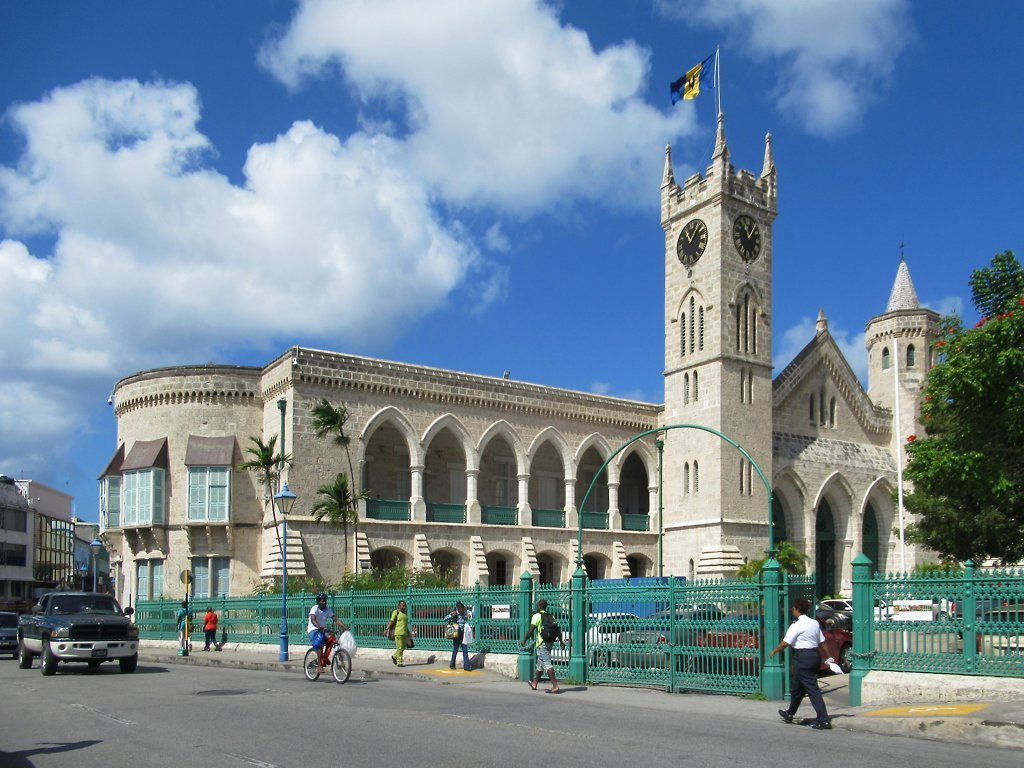
Barbados is an independent island country in the eastern Caribbean, the easternmost of the region’s inhabited islands and, unusually for the Lesser Antilles, situated outside the chain’s main volcanic arc. Its capital, Bridgetown, anchors Barbados’ only UNESCO World Heritage Site, and the country’s economy and society still carry the imprint of a colonial sugar plantation era that reshaped the island’s population and land. Independent from the United Kingdom since 1966, Barbados became a parliamentary republic in 2021 and today functions as a small, high-income Caribbean economy built mainly on tourism and financial services.
Where Is Barbados Located?
Barbados sits in the eastern Caribbean Sea, separated from the main Lesser Antilles chain to its west. According to the Commonwealth Secretariat, its closest neighbors are Saint Lucia to the north, Saint Vincent and the Grenadines to the west, and Trinidad and Tobago to the south, though open ocean lies between Barbados and each of them. The island covers about 430 square kilometers, according to World Bank data, making it one of the smaller sovereign states in the Western Hemisphere.
Geography of Barbados
Barbados is comparatively flat for a Caribbean island, rising through terraced tablelands to its highest point, Mount Hillaby, at 336 meters, according to the Commonwealth Secretariat. Coral reefs surround much of the coastline. Geologically, Barbados sits near where the Caribbean and South American tectonic plates meet, rather than directly on the volcanic arc that produced the mountainous terrain of many neighboring islands, which helps explain its comparatively level terrain.
A Brief History of Barbados
Archaeological evidence shows Arawak and, later, Carib peoples inhabited Barbados before English settlers established a permanent colony in 1625, according to the government of Barbados. Early planters first grew tobacco and then cotton, but poor returns pushed them toward sugar cane by the 1640s, a shift the government of Barbados describes as the single most consequential change in the island’s colonial history. Sugar production required far more capital and labor than small farms could supply, so land consolidated into large plantations, indentured European labor declined, and planters turned to the large-scale importation of enslaved people from Africa, who provided the plantation workforce until emancipation in 1838.
Barbados remained a British colony through the nineteenth and early twentieth centuries, a period marked by recurring economic hardship as sugar prices fell and Britain moved from protectionist to free-trade policy. Labor unrest in 1937 prompted an official inquiry, the Moyne Commission, into social and economic conditions across the British Caribbean, according to the government of Barbados. The country gained independence from the United Kingdom on November 30, 1966, and on the same date in 2021, the 55th anniversary of independence, Barbados completed a widely documented transition from constitutional monarchy to parliamentary republic, replacing the British monarch with a Barbadian head of state.
Government and Economy Today
Barbados is a parliamentary democracy with an elected House of Assembly and an appointed Senate; the Parliament of Barbados describes its own institution as one of the oldest continuously functioning legislatures in the Commonwealth. Tourism is the country’s leading foreign exchange earner, supplemented by agriculture, oil production, and financial services, according to the government of Barbados. The World Bank classifies Barbados as a high-income economy, with a gross domestic product of roughly 8.0 billion dollars and a GDP per capita of about 28,365 dollars in 2025; the modeled unemployment rate stood near 6.5 percent that year, and international tourist arrivals reached nearly 966,000 in 2019, the last full year before the COVID-19 pandemic disrupted global travel. The Barbados dollar is pegged to the United States dollar, a fixed exchange rate the government states at BDS 1.98 to US 1.
Culture and People
Barbados had an estimated population of about 282,600 in 2025, according to World Bank data. A 2010 national census found the population predominantly Black or of African descent (92.4 percent) or of mixed heritage (3.1 percent), with smaller white (2.7 percent) and South Asian (1.3 percent) communities, according to the government of Barbados. English is the official language, while Bajan, a regional English-based creole, is widely spoken in everyday and informal settings. Christianity is the dominant religious tradition: the 2010 census recorded about 75.6 percent of the population as Christian, led by Anglicans (23.9 percent) and Pentecostals (19.5 percent), while roughly one-fifth reported no religious affiliation.
What Is Barbados Known For?
Barbados’ most internationally recognized landmark is Historic Bridgetown and its Garrison, inscribed as a UNESCO World Heritage Site in 2011. UNESCO describes it as one of the earliest fortified port towns in the Caribbean’s network of English Atlantic trade outposts, its 17th-century street layout and Caribbean Georgian architecture reflecting Bridgetown’s role as a trading hub for sugar and, during the plantation era, for enslaved people transported to Barbados and beyond. The property links the town’s serpentine colonial streets to the former military garrison at St. Ann’s along the historic Bay Street corridor, overlooking the natural harbor of Carlisle Bay.
Barbados is also closely associated with cricket, a sport central to national identity; the Parliament of Barbados marked the death of Sir Garfield Sobers, a Barbadian National Hero widely regarded as one of the greatest all-round cricketers in the sport’s history, with a formal lying-in-state. The island’s long dependence on sugar cane also underlies a lasting regional tradition of cane-based rum production, although historians continue to debate exactly where in the Caribbean rum distilling first took hold.
Why Barbados Matters
As one of the world’s smaller sovereign states, Barbados illustrates, in concentrated form, patterns that shaped much of the wider Caribbean: indigenous displacement, European colonization, plantation slavery, twentieth-century labor unrest, and eventual political independence followed by full republican self-governance. Its 2021 shift away from constitutional monarchy also made it a reference point for other Commonwealth nations weighing their own constitutional futures, while its high-income, tourism- and services-driven economy and UNESCO-recognized colonial-era capital make it a frequently studied case of a small island state balancing historical legacy with economic development.
Key Takeaways
- Barbados is a small eastern Caribbean island nation of about 430 square kilometers, with an estimated population of roughly 282,600 in 2025.
- English settlers arrived in 1625; the island’s economy shifted from tobacco and cotton to sugar cane by the 1640s, a change built on enslaved African labor until emancipation in 1838.
- Barbados gained independence from the United Kingdom on November 30, 1966, and became a parliamentary republic on the same date in 2021.
- Historic Bridgetown and its Garrison is Barbados’ only UNESCO World Heritage Site, inscribed in 2011 for its role in the English Atlantic trade network.
- The World Bank classifies Barbados as a high-income economy driven mainly by tourism, alongside agriculture, oil, and financial services.
- About 92 percent of Barbadians are Black or of African descent, and Christianity, led by Anglicanism, is the dominant religious tradition.
Key facts
- Barbados covers about 430 square kilometers and had an estimated population of roughly 282,600 in 2025.7
- English settlers arrived in 1625 and the economy shifted from tobacco and cotton to sugar cane by the 1640s.1
- Barbados became independent from the United Kingdom on November 30, 1966, and a parliamentary republic on the same date in 2021.
- Historic Bridgetown and its Garrison, Barbados' only UNESCO World Heritage Site, was inscribed in 2011.4
- The World Bank classifies Barbados as a high-income economy driven mainly by tourism.7
Quick checkWhat is Barbados' only UNESCO World Heritage Site?Show answer
Historic Bridgetown and its Garrison, inscribed in 2011 for its role as a fortified 17th-century English Atlantic trade port.
Sources
- Government of Barbados. Archaeological History (Visit Barbados). Undated (accessed 2026-09-22)
- Government of Barbados. Demographics (Visit Barbados). Undated (accessed 2026-09-22)
- Government of Barbados. Political System (Visit Barbados). Undated (accessed 2026-09-22)
- UNESCO World Heritage Centre. Historic Bridgetown and its Garrison. 2011 (accessed 2026-09-22)
- UNESCO. Barbados Member State Profile. Undated (accessed 2026-09-22)
- The Commonwealth. Barbados. Undated (accessed 2026-09-22)
- World Bank. World Bank Open Data: Barbados (population, GDP, life expectancy, unemployment, tourism indicators). 2026 (accessed 2026-09-22)
- Parliament of Barbados. Official website (institutional description and National Heroes announcements). Undated (accessed 2026-09-22)
Editorially reviewed by Specialty Digest Editorial TeamLast reviewed September 22, 2026Researched and drafted with AI assistanceReport an issue