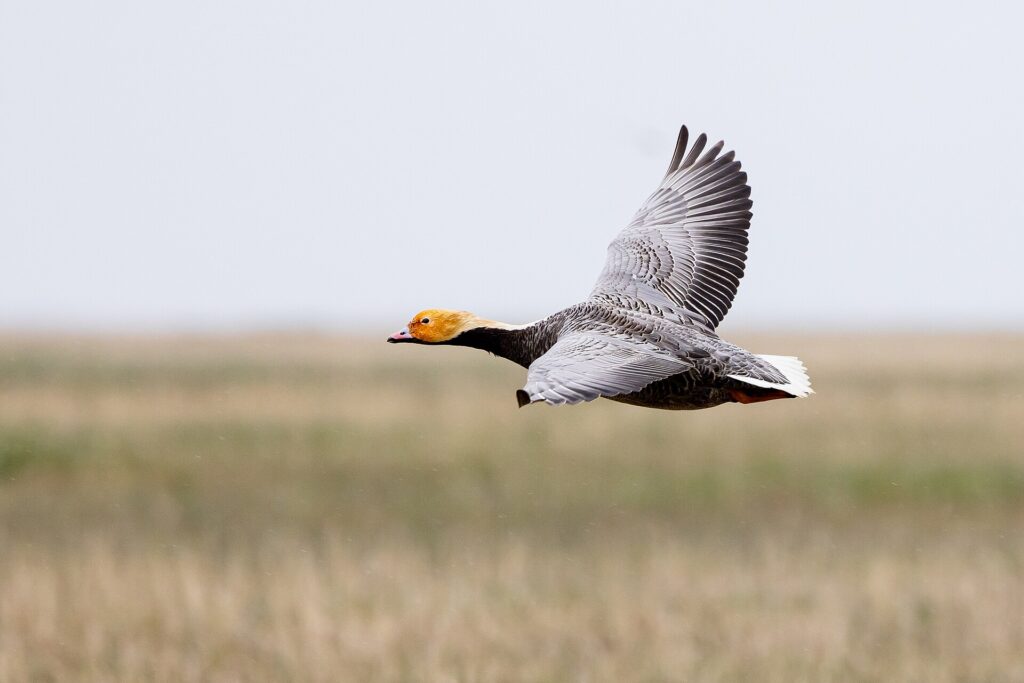
The emperor goose (Anser canagicus) is a chunky, medium-sized goose of coastal western Alaska. Its main nesting ground is a small area along the Yukon-Kuskokwim Delta coast, and nearly all winter in the Aleutian Islands, on the Alaska Peninsula and on Kodiak Island.[1]
| Scientific name | Anser canagicus |
|---|---|
| Weight | 5–7 lb |
| Clutch | 4–5 eggs |
| Population, 1964 | About 140,000 |
| Population, 1986 | 42,000 |
| Population, 1993 | Over 71,000 |
Description
The emperor goose weighs 5 to 7 pounds. The throat and lower neck are black and the rest of the head and neck white, the body is bluish-gray with black-and-white feather edgings, the legs and feet are yellow and the tail is white.[1]
Range and habitat
The main nesting ground is a small area along the Yukon-Kuskokwim Delta coast, with some nesting along coastal northwest Alaska and in Siberia. Nearly all winter in the Aleutian Islands, on the western and south side of the Alaska Peninsula and on Kodiak Island, and stragglers have reached California and Hawaii. The bird is rarely found far from marine waters, which is why it is called the beach goose.[1]
Diet and nesting
In summer and early fall emperor geese eat marsh plants and berries, and in late fall and winter they feed heavily on seaweeds and animal matter such as clams and snails. Clutches are four to five eggs, and although parents are dedicated, first-year survival of young is relatively low.[1]
Population
The population was about 140,000 in 1964 and fell to 42,000 in 1986. After an intensive research and conservation programme began in 1984 it rose to more than 71,000 in 1993. Low first-year survival, periods of high nest predation and past harvest levels contributed to the decline. These figures are from the source and more recent surveys may differ.[1]
FAQs
Why is it called the beach goose? It is rarely found far from marine waters.
Where does it nest? Mainly along the Yukon-Kuskokwim Delta coast.
Where does it winter? The Aleutians, the Alaska Peninsula and Kodiak Island.
Sources
Key facts
- Fell from 140,000 to 42,000
- Over 71,000 by 1993
Quick checkWhy is the emperor goose called the beach goose?Show answer
It is rarely found far from marine waters
Sources
- Alaska Department of Fish and Game. Geese, Wildlife Notebook Series. 2026 (accessed 2026-11-14)
Editorially reviewed by Specialty Digest Editorial TeamLast reviewed November 14, 2026Researched and drafted with AI assistanceReport an issue