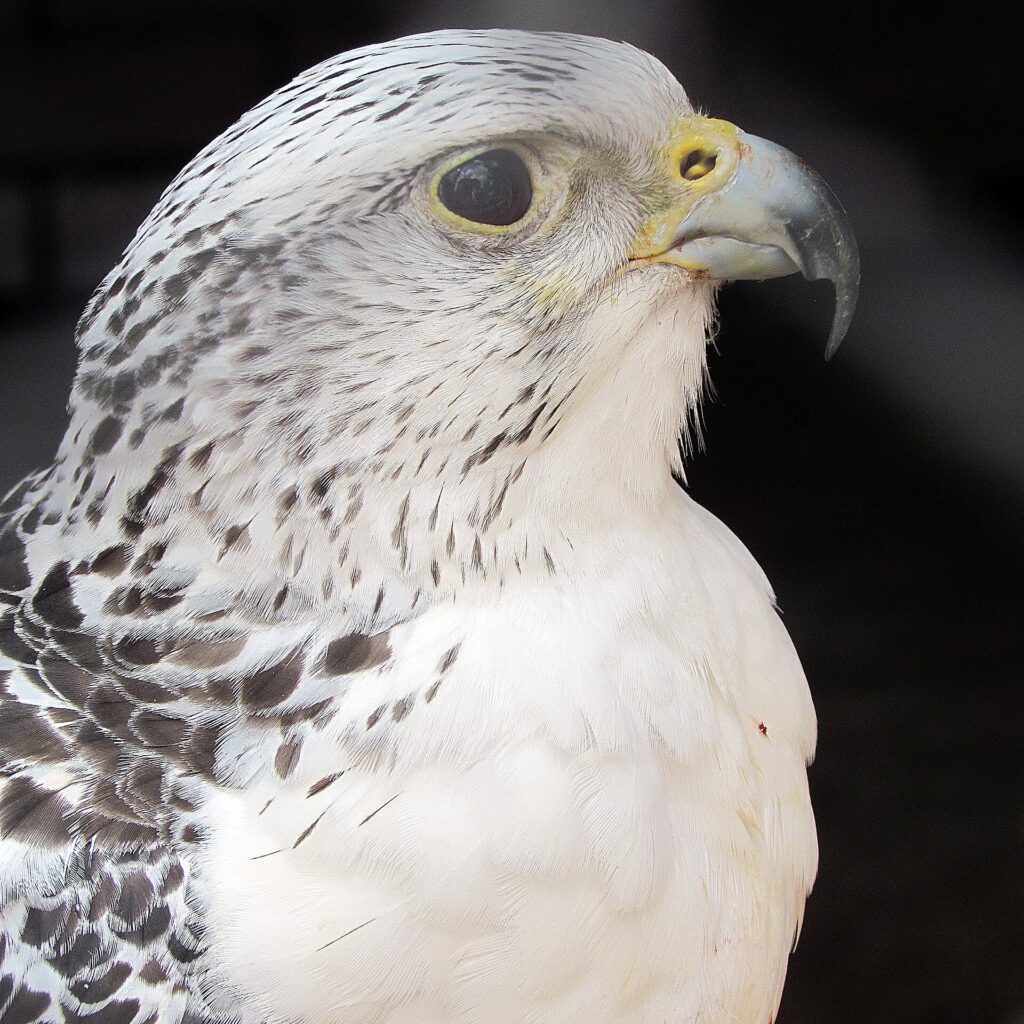
The gyrfalcon (Falco rusticolus) is the largest falcon in the world. A bird of the circumpolar north, it lives across much of Alaska, from the Aleutian Chain and the Alaska and Brooks ranges to the western coastal plains and the North Slope.[1]
| Scientific name | Falco rusticolus |
|---|---|
| Length | 20–25 in |
| Wingspan | 50–65 in |
| Female weight | 2.75–4.5 lb |
| Male weight | 1.75–3 lb |
| Clutch | 1–5 eggs, typically 3 or 4 |
Description
The gyrfalcon is 20 to 25 inches long with a wingspan of 50 to 65 inches, and females, at 2.75 to 4.5 pounds, are larger than males, at 1.75 to 3 pounds. Plumage ranges from almost completely white to nearly black, and the most common pattern has a dark gray head, back and wings with whitish underparts marked by gray teardrops and chevrons.[1]
Range and habitat
The species is circumpolar. In Alaska it occupies much of the state, including treeless southcentral Alaska, the Aleutians, the Alaska and Brooks ranges, the western and northwestern coastal plains and the North Slope. It favours cold, dry areas where open tundra is interspersed with mountains or cliffs. It is not generally migratory but may wander south in winter when prey is scarce at high latitudes.[1]
Diet
Gyrfalcons take ptarmigan, large shorebirds, ducks, geese, gulls, jaegers, smaller raptors, ground squirrels and arctic hares. They stoop on prey but can also outfly most quarry in direct pursuit.[1]
Nesting and young
Falcons do not build nests. Gyrfalcons lay eggs in a scrape on a rocky ledge or cliff and occasionally reuse old raven, rough-legged hawk or golden eagle nests. Adults do not necessarily keep the same mate but often return to the same site year after year. Clutches of one to five eggs, typically three or four, are usually laid in May and incubated for slightly more than a month. Young make short flights at about five weeks and then spend eight or more weeks refining flight and hunting skills while still fed by adults. Birds mature at three to six years.[1]
Conservation
The source lists climate change, especially permafrost thaw that alters vegetation and prey in arctic habitat, as a concern, and gives no population figures or formal listing for the gyrfalcon.[1]
FAQs
Is the gyrfalcon the largest falcon? Yes, in the world.
Does it migrate? Not generally, though it may wander south in winter.
What does it eat? Mainly ptarmigan, waterfowl, shorebirds and small mammals.
Sources
Key facts
- Wingspan 50–65 in
- Eggs laid mostly in May
Quick checkWhat is the largest falcon in the world?Show answer
The gyrfalcon
Sources
- Alaska Department of Fish and Game. Falcons, Wildlife Notebook Series. 2026 (accessed 2026-11-14)
Editorially reviewed by Specialty Digest Editorial TeamLast reviewed November 14, 2026Researched and drafted with AI assistanceReport an issue